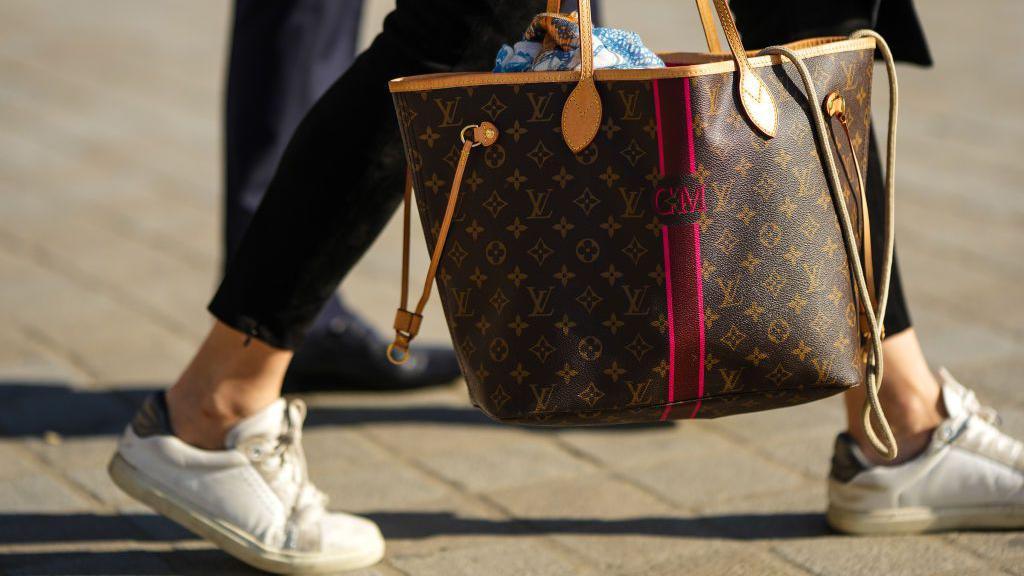
Bags from French designer label Louis Vuitton are among the most popular in the fake designer market
ByGavin ButlerBBC NewsReporting fromSingapore Thuong Le and Duc HaBBC World ServiceReporting fromBangkok
The Trump administration wants Vietnam to stamp out its booming counterfeit industry. Locals are divided.

Bags from French designer label Louis Vuitton are among the most popular in the fake designer market
ByGavin ButlerBBC NewsReporting fromSingapore Thuong Le and Duc HaBBC World ServiceReporting fromBangkok
When Vietnam's police raided a pair of nondescript warehouses in outer Ho Chi Minh City earlier this year, they discovered more than 23,000 pairs of slippers bearing the logos of Nike, Adidas, Crocs and Gucci.
Except those brands had nothing to do with the warehouses. The slippers were all counterfeits.
The raid, which led to the seizure of goods worth VND 2bn (£57,559; $76,053), was part of a crackdown on a black-market industry that has thrived in the public eye for decades.
Just 30km away, at a flea market in Ho Chi Minh City's tourist district, the same models of counterfeit slippers – imitations of those retailing for as much as $900 overseas – are being sold for as little as $30 a pair.
Displayed alongside them is a cornucopia of other fakes: "Chanel" handbags, "Prada" t-shirts and "Rolex" watches lining the racks.
Widely recognised as a global hub for cheap knockoffs of luxury goods, Vietnam is home to some of the biggest fake designer markets in the world.
Now, under mounting international pressure, authorities are on a crusade to rid the country of that reputation.
On 7 May, the government launched a nationwide crackdown on products and practices that violate intellectual property rights, including counterfeit goods, online piracy and trademark infringements.
This is not new: authorities in Vietnam perennially and publicly bust bootleg vendors to show that they are doing something about the country's ubiquitous shadow economies.
But in recent weeks the clampdown has intensified.
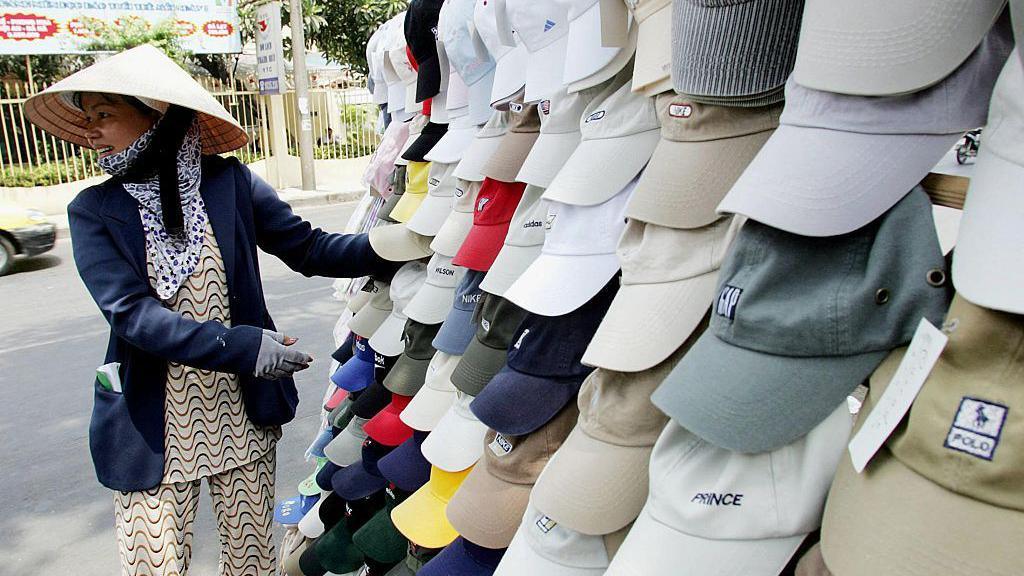
The US government has branded Vietnam the world's worst offender on IP rights
"Enforcement has become stricter," says Thanh Truc, a clothes vendor at a popular street market in Ho Chi Minh City's Saigon Square, who spoke on the condition that she is referred to by a pseudonym.
She has just sold a replica of a Loewe t-shirt, which usually retails at $500, for $17.
"Every now and then the authorities launch anti-counterfeit raids, but they usually focus on higher-value items such as luxury handbags or suitcases," she explains. "The market inspectors would come with camera crews, they'd confiscate goods from some shops, and then things gradually returned to normal."
But not this time.
This crackdown is being fuelled by international forces – most notably, US President Donald Trump's trade war against countries thought to be harming America's interests.
In April, a report from the Office of the United States Trade Representative identified Vietnam as a "priority foreign country" due to its "persistent failure to resolve long-standing concerns about IP protection and enforcement" – the first time in 13 years that a nation has been hit with that designation.
It also branded Vietnam the world's worst offender on IP rights.
Facing the threat of fresh tariffs, Vietnamese authorities pledged to increase IP violation busts by at least 20% in May compared to the same period last year.
One major battlefront was Saigon Square, where Thanh Truc works, and neighbouring Ben Thanh Market - sprawling bazaars that are known to be among Vietnam's biggest hubs for counterfeit goods.
In mid-May, after a series of surprise inspections, authorities confiscated counterfeit goods from the markets and issued fines totalling more than $19,000.
Yet local vendors, who have long since adapted to unwanted police attention, remain unfazed.
"Usually, before inspectors arrive, someone here blows a whistle to warn everyone," Thanh Truc explains. Even after the recent raid blitz, she adds, "business is still continuing".
"Some stores display fewer logo-branded items, but they still have stock in the back."
The supply chain for most of Vietnam's counterfeits can be traced back across its northern border into China, where they are manufactured. Vietnamese wholesalers will select, buy and import products in bulk that they think can be easily sold in their local market, then distribute these to smaller businesses.
Such proximity to China has proven favourable for Vietnam's booming counterfeits industry. So has the fact that even prestigious European brands often rely on Asian manufacturing. Whether it's leather that's pre-cut in China or stitching that's done in Vietnam, these materials and expertise are almost certainly channelled into the region's black market.
It's a tap that has proven difficult to turn off – but the Vietnamese government has heralded their recent sting operations as a success. In the last three weeks of May authorities reportedly handled more than 1,400 IP infringement cases.
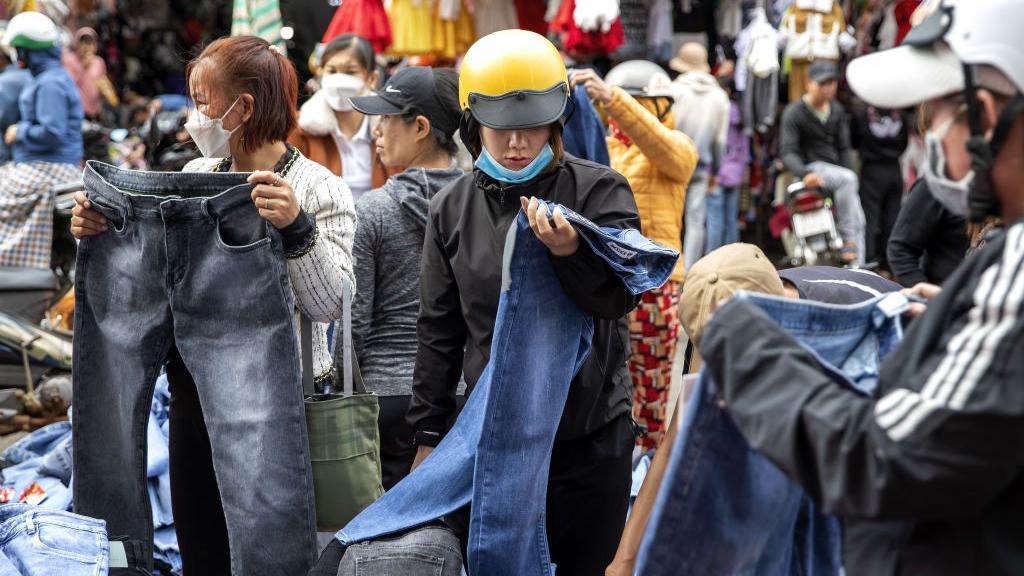
While several market stalls have shuttered their operations, for others it's business as usual
The US, however, has continued to tighten the screws.
In late May it launched an investigation to determine whether Vietnam's failure to stamp out IP violations was "unreasonable" and problematic for US commerce.
So Vietnamese authorities tightened screws of their own.
On 10 June, police in Thanh Hoa province dismantled a ring that manufactured and sold more than 10,000 counterfeit jewellery items. The fakes imitated brands like Bvlgari, Cartier, Louis Vuitton, and Tiffany & Co, and generated an estimated $1.14m in illicit profits for the counterfeit syndicate.
Market stalls in Ho Chi Minh City and Hanoi have been shut, while police have stormed warehouses, clothing outlets and sneaker stores.
Locals, however, are divided by the crackdown. And while it appears to be forcing some vendors out of business, others are hoping for a boon.
Thi Nguyen designs, makes and sells her own clothing across multiple stores in Ho Chi Minh City and Da Lat. The way she sees it, not only does the counterfeit industry violate the IP rights of designers like herself, it also "makes Vietnam's retail market chaotic and turns it into something of a joke".
She says customers are willing to spend $75 on a fake designer dress which appears authentic, but complain when charged half that for a custom piece – "even when it's made with quality fabric and good tailoring".
"Vietnam has no shortage of highly skilled tailors and hand embroiderers, but many of them are overlooked and do not receive the income they deserve," she says. "Quite a few eventually end up working in factories producing counterfeit goods."
Now that those counterfeit sellers are being forced to close, she is preparing to invest more in her business and raise prices.
"I feel more confident operating in a business environment that is cleaner, more transparent, and fairer," she says. "This isn't really about winners and losers. It's about restoring fairness and putting right and wrong, genuine and fake, back into their proper place."
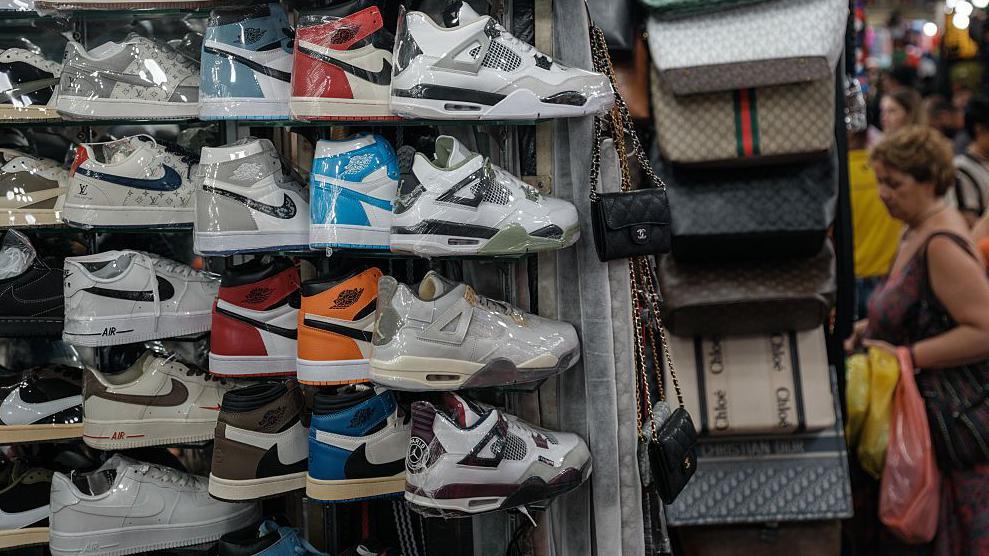
Vietnam police regularly bust bootleg vendors, but the market has proven hard to extinguish
Others are not so pleased.
Huy, an office worker in Da Nang, is a devoted buyer of counterfeit clothes – most commonly soccer shirts and shoes.
"Arresting the vendors does not solve the problem," he says. "If counterfeit goods cannot be completely stamped out, and I can still easily buy them, I will maintain my old habits."
Huy tells the BBC he prefers fakes because they're "cheap, convenient and easy to buy".
Customers like him make up a sizeable market in Vietnam, where 60% of the population lives in rural areas and the average income is just $225 per month. In this way, the government's crackdown on affordable knockoffs threatens to lock many local customers out of the market.
Thi Thanh Huong Tran, an associate professor at SKEMA Business School who grew up in Vietnam and studies ethical consumption, reaffirms this point: the strength of the country's counterfeit market is underpinned by economic realities.
"Even though [Vietnamese people] know it's fake... in a context where they don't have the money to afford the real thing, for them it's the most suitable option they have," she says.
"And it makes them feel happy, so [they think] 'why not?'"
Since there is "no overlap" between consumers of luxury goods and those who buy fake ripoffs, Thi Thanh Huong Tran suggests, the potential revenue loss for international luxury brands is negligible.
"Even without the counterfeit products the customer with low income will not buy the product from the authentic brand anyway, because they cannot afford it," she says.
"And they cannot see why they have to pay that much money to buy just a bag."
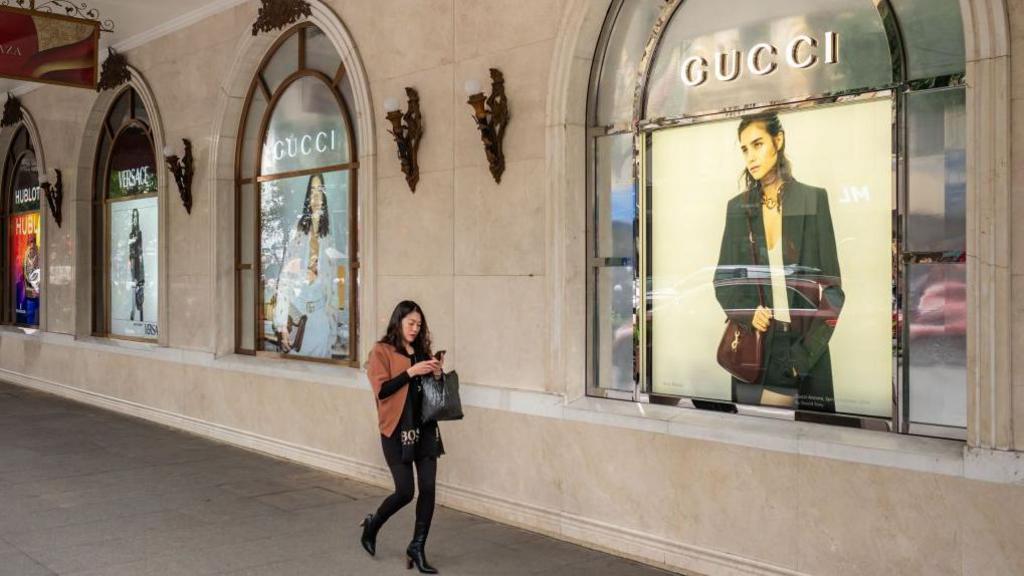
Many Vietnamese locals can't afford or access authentic designer clothing
Of course, locals aren't the only customers.
Thanh Truc says she sells mostly to foreigners, and some of the most notorious hubs for fakes are in tourist hotspots.
Thi Thanh Huong Tran and others suggest, however, that authorities have slim chance of eradicating Vietnam's counterfeit market.
Manufacturers and sellers are already finding ways around IP laws, including by changing the product design or brand name – from Nike to Mike, for example.
The trick, she explains, is getting as close as possible to the line without crossing it: sufficiently changing the design to evade legal liability, while still retaining enough of the original aesthetic, quality and brand association to appeal to consumers.
Such innovations have long protected vendors from authorities. And even if the government's crackdown makes it more difficult, those whose livelihoods depend upon the industry will find new ways to ensure it survives.
"You cannot eliminate it," Thi Thanh Huong Tran says.
"Whatever regulation or actions the government will take, they will find a way to go around it and continue – because the demand of the customers is always there... And if there is the demand, of course, there will be the seller."

The test launch came hours after Australia signed a new defence pact with its Pacific island neighbour Fiji.
China’s campaign against corruption, which the country’s leaders have linked to the Communist Party’s ability to stay in power, has been President Xi Jinping’s signature policy since he rose to power in 2012. More than a decade on, it continues apace. The South China Morning Post takes a multimedia

China’s technical schools offer hope to desperate university graduates who cannot find a job – but for many, the reality falls short of the promise. As China’s university graduates face mounting pressure in the job market, a growing number are turning to an unconventional lifeline: vocational traini

The order comes days after the BBC published an investigation about the platform showing such ads to users.