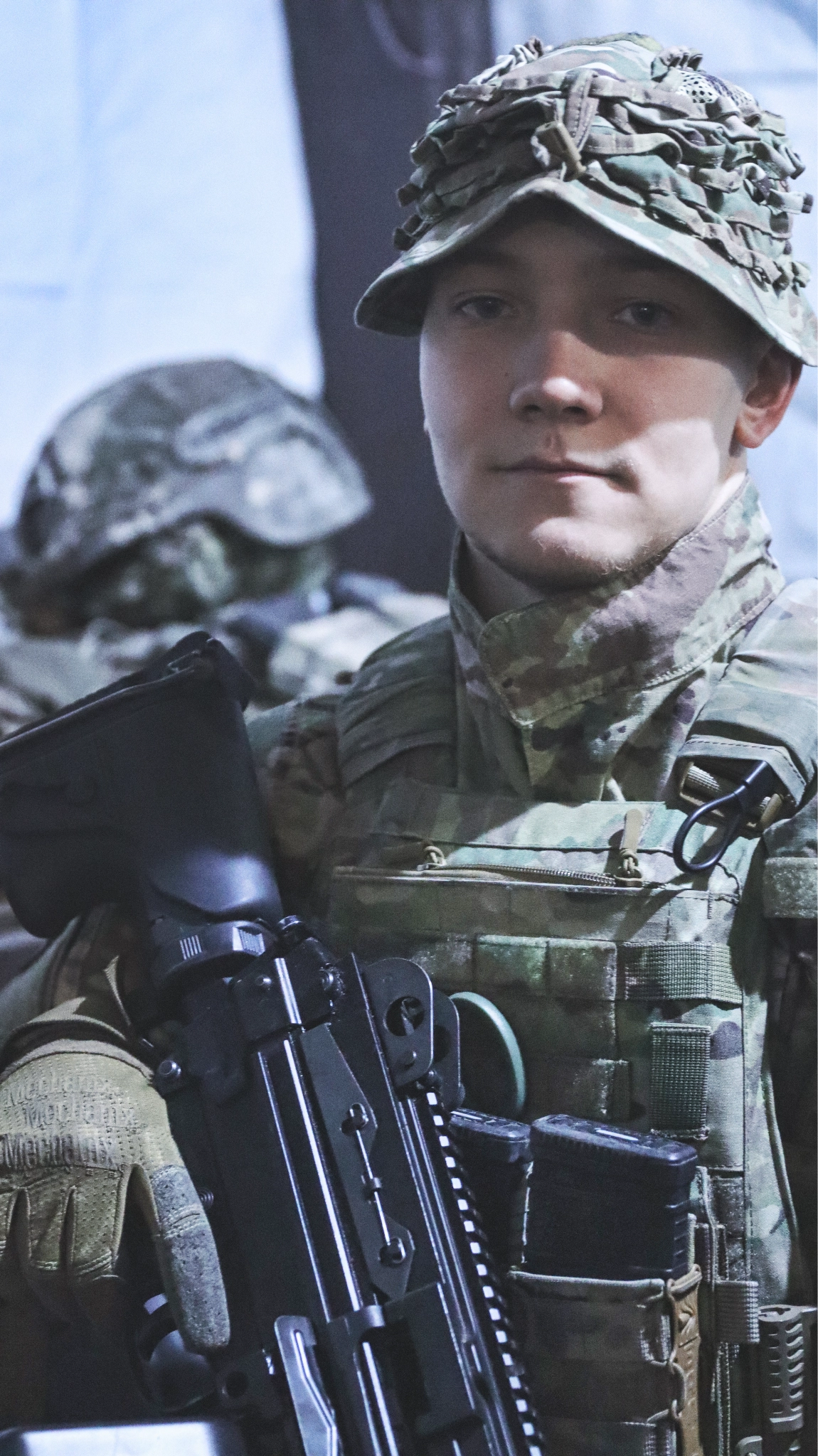
A Journey to the Kharkiv Front, Where Khartia Holds the Line
An inside look at Ukraine’s Khartia Brigade near Kharkiv, where soldiers face a war shaped by drones, pressure and an uncertain future.
Kyiv Post
75
17 دقيقة قراءة
0 مشاهدة
The 13th Khartia Brigade has become one of the most visible and fastest-growing formations within Ukraine’s National Guard. What began as a volunteer unit defending Kharkiv in the early days of Russia’s full-scale invasion has since expanded into a corps, operating along some of the most contested sections, including Bakhmut in 2023 and, more recently, the battles around Kupyansk, where it helped retake roughly 90 percent of the city.
Just a short drive beyond Kharkiv, the war reveals itself in fragments: in positions, in improvised workshops, in training grounds, and in the people moving between them.
On a large parking lot in Saltivka, the northeasternmost district of Kharkiv, a white van pulls up. The sliding door opens. Inside are Titan, the driver, Kit and Cat. With a slight smile, I check once more if I heard correctly. Cat is my contact with the Khartia Brigade, an operational unit with a high degree of autonomy, bringing together infantry, artillery and drone systems under one structure. Based here in the city, its presence is hard to miss – its tags and symbols appear on walls, bus and tram stops across Kharkiv and beyond.
From city streets to the edge of the front
We head further north, passing one high-rise after another, long rows of Soviet-era panel buildings. Saltivka is among the areas most frequently hit by Russian drones and missiles. Facades are torn open, entire sections are missing, and some floors are exposed. Almost every block has windows boarded up with plywood.
Overnight attacks have left 380,000 residents without power in the Chernihiv region, while strikes in Odesa and Zaporizhzhia hit industrial sites and residential areas, injuring at least two.
It is mild, the kind of day that makes it feel as if winter has receded. People come up from the metro, stand in line at small kiosks and markets, and traffic moves through the streets.
A Khartia Brigade tag on a wall in Saltivka, one of the most heavily targeted districts of Kharkiv, April 2026. (Photo by Korbinian Leo Kramer)
Saltivka district, a residential area of Soviet-era apartment blocks in Kharkiv, April 2026. (Photo by Korbinian Leo Kramer)
Saltivka district, a residential area of Soviet-era apartment blocks in Kharkiv, April 2026. (Photo by Korbinian Leo Kramer)
Right after the city limits, we reach an intersection where the picture starts to change. It is something I have seen before in other frontline regions in Ukraine:
Checkpoints, concrete blocks and heavy steel crosses set along the road. To the left and right, shallow ditches cut through the ground, coils of barbed wire stretched between them. The further we go, Titan picks up speed, pointing to the increasing threat from above. On either side, I recognize the charred shells of houses and shops, some burned out completely.
A street north of Kharkiv, where buildings bear the marks of repeated Russian shelling, April 2026. (Photo by Korbinian Leo Kramer)
A street north of Kharkiv, where buildings bear the marks of repeated Russian shelling, April 2026. (Photo by Korbinian Leo Kramer)
Buildings north of Kharkiv damaged by repeated Russian shelling, April 2026. (Photo by Korbinian Leo Kramer)
We leave the main road and turn onto a narrow dirt track. As the city falls behind us, the surroundings become more rural, but not in any sense of calm or retreat. Quite the opposite.
Scattered houses appear, some still standing, others hollowed out. Then another turn, a driveway, before the engine cuts. We finally enter a house that has been sealed off from the outside world.
The windows are covered with black plastic from within, blocking all natural light. The first room, once a winter garden, is filled with gear. Boots, helmets, jackets, everything layered and stacked, not carefully arranged, but ready to be used at any moment
This was someone’s home once. Now it is a place between movements.
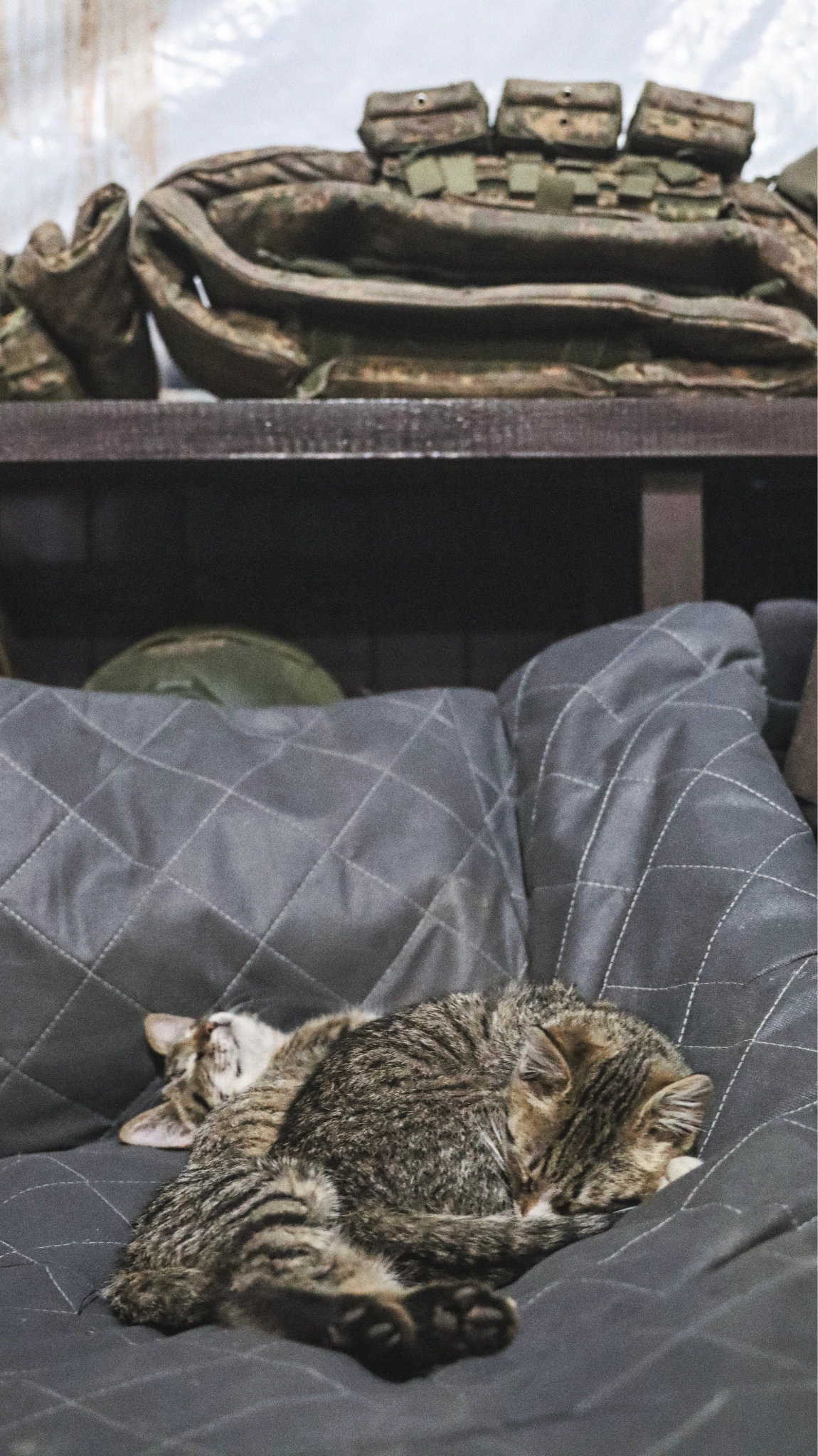
On a bench, two small kittens sleep on a cushion. Men move through the space continuously, entering, leaving, passing each other without stopping. Some pause briefly, lingering for a cigarette or crouching down to play with the kittens. One of them climbs onto a lap and stays there, indifferent to everything else. The mood is relaxed, not tense.
Kittens sleeping inside a rotation house used by the Khartia Brigade outside Kharkiv, April 2026. (Photo by Korbinian Leo Kramer)
Inside the small house, the kitchen is functional in the most minimal sense. Nothing has been cleaned beyond what is necessary to use it. Further inside, a room with bunk beds – two levels, narrow frames, sleeping bags thrown across thin mattresses. There is no table. No central point. Everything is provisional, set up with the understanding that it may have to be abandoned as circumstances change.
This was someone’s home once. Now it is a place between movements. They say it was likely used by Russian forces when this area was still occupied.
Lives redirected by war
The light in the room is dim and uneven. Two of the soldiers sit on the lower bunk, almost pressed into the shadow of the upper frame.
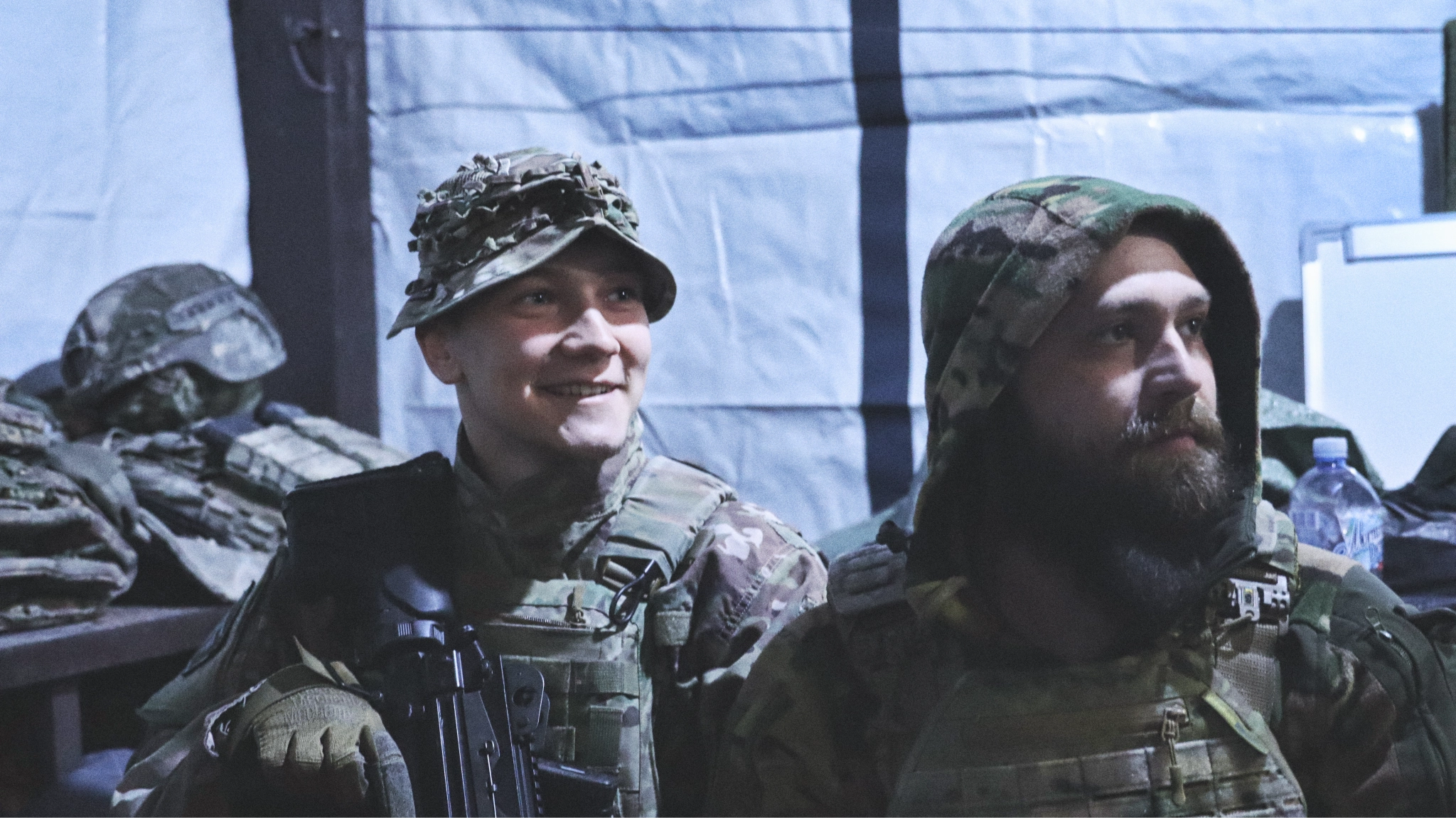
The younger one keeps smiling. Not constantly, but often enough that it stands out. A kind of reflex that could be read as uncertainty, not quite aligning with the space around him. There is something in his face that still belongs elsewhere – not untouched, but not fully hardened either.
This was someone’s home once. Now it is a place between movements. They say it was likely used by Russian forces when this area was still occupied.
The light in the room is dim and uneven. Two of the soldiers sit on the lower bunk, almost pressed into the shadow of the upper frame.
The younger one keeps smiling. Not constantly, but often enough that it stands out. A kind of reflex that could be read as uncertainty, not quite aligning with the space around him. There is something in his face that still belongs elsewhere – not untouched, but not fully hardened either.
He never really entered a civilian adult life, with no clear break between adolescence and war, only a continuation, redirected.
Baby boy. Behind him, a rifle leans against the bedpost. The men in the room point out that he is a very good shot. Baby boy killer. His call sign is Serpen – August. When the full-scale invasion began in 2022, he was 20, studying at a military academy in Kharkiv. He had wanted to be a soldier since childhood, he says. At one point he considered studying robotics in Poland, then chose to return and pursue a military career instead. The war began while he was already on that path.
He never really entered a civilian adult life, with no clear break between adolescence and war, only a continuation, redirected. Now he is an infantryman, at the very front.
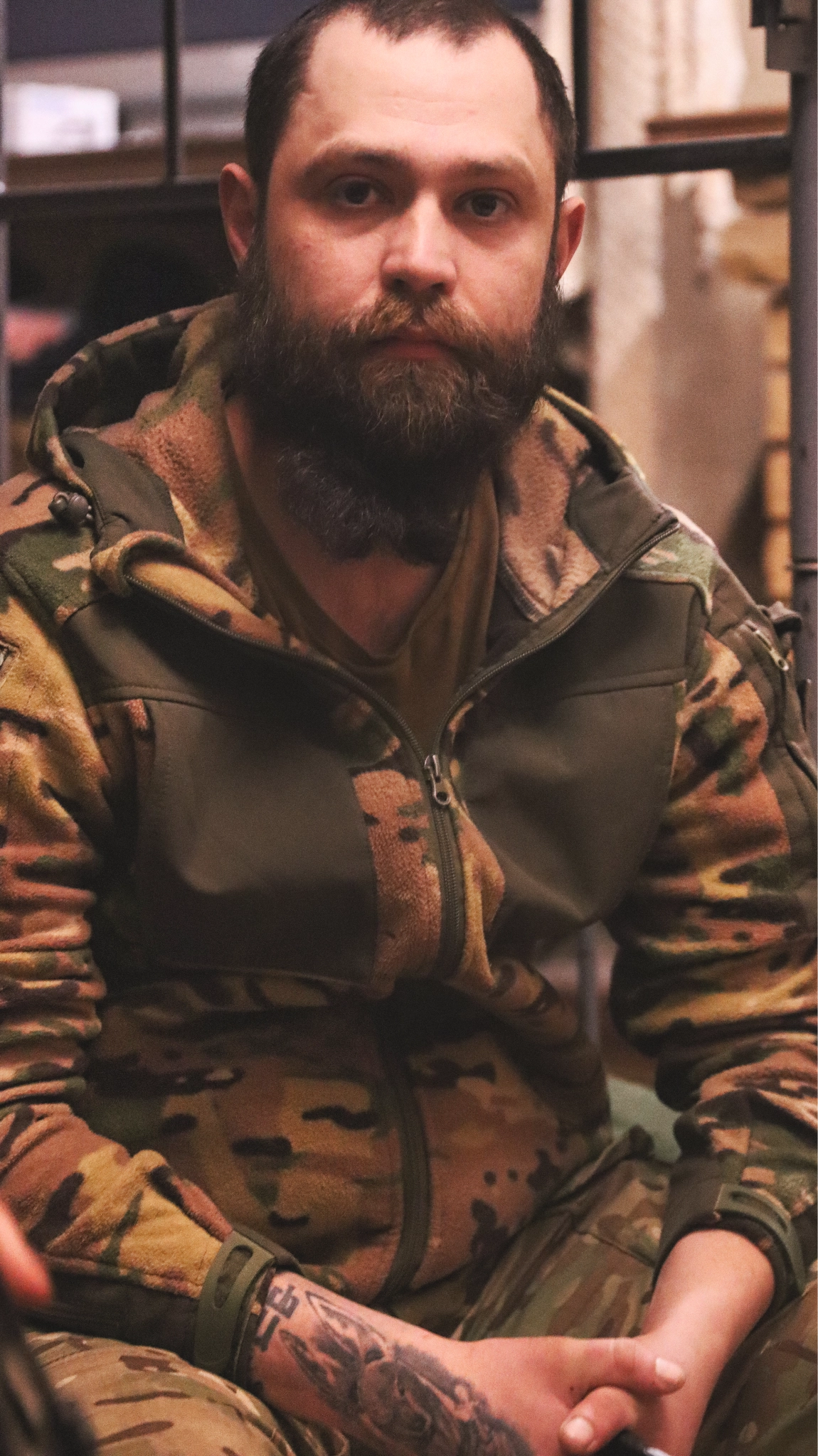
Next to him sits a bearded man, his hands resting loosely between his knees, listening more than speaking. He goes by Khor, born and raised in Dnipro, where he worked in a factory producing construction materials before joining Ukrainian forces on March 3, 2022, just one week after Russia started that war. “At that point it was already clear that there was no distance between what was happening and where we were,” he recalls from those early days.
"Khor", a soldier of the Khartia Brigade, in a house used for rotations outside Kharkiv, April 2026. (Photo by Korbinian Leo Kramer)
He has a wife and a five-year-old daughter. He tries to call them every day.
Over the four years of war he became a medic. “It’s not like people imagine,” he says, shaking his head slightly.
There is no separation between front and rear, no clear boundary between treating and fighting. He is where the others are, in the same positions, moving under the same conditions, only with a different set of tasks layered on top.
“When someone is wounded, I try to get in if I can, give first aid before we evacuate.” Khor is the one responsible for keeping the others alive, for preventing injuries from turning into permanent loss.
Evacuation under drones
He describes a situation in which a fellow soldier stepped on a mine, suffering severe damage to both legs. “There was a real risk of losing them,” he remembers, as the tourniquets had been applied too high initially.
“When I got him, I worked on the wounds, packed them properly, and stabilized him. In that case, it was possible to save both his legs.”
Reaching the wounded, he explains, is no longer a question of distance alone. It has become a question of visibility.
What used to be possible with a vehicle – driving in, taking someone out – now often isn’t. Not because the terrain changed, but because the air above it did. Drones have flattened that space.
Outside, another distant detonation.
“If conditions change – fog, rain – then there is a window. Not safe. But possible.”
“Before, you could evacuate by car,” Khor says. “You could approach positions more directly. Now, because of drones, especially [first-person view] FPVs, movement itself becomes the most dangerous moment.”
He speaks slowly, building the thought. “They watch the roads. The paths. They don’t always attack immediately. Sometimes they just wait.”
It has become a kind of hide-and-seek, as the digital age of surveillance finds one of its most perverse expressions here at the front.
“If visibility is good, you are seen quickly,” he continues. “And if you are seen, you are targeted. So you don’t move.”
He pauses. “If conditions change – fog, rain – then there is a window. Not safe. But possible. So everything depends on that. Not just evacuation. Everything.”
“There are situations where a wounded soldier cannot be reached,” he says. “Not because you don’t want to go, but because if you go, you create more wounded. So you wait.” How long that waiting lasts is uncertain.
“Sometimes this takes a long time. It depends on the injury, on the position. But there were cases where someone waited around ten days. Just lying there, waiting for a moment when it becomes possible to move.”
“This is how it works now.”
Drones that wait
As warfare, especially in its use of unmanned aerial vehicles (UAVs), evolves rapidly, the situation on the battlefield keeps shifting, sometimes from week to week, forcing both sides to adapt just as quickly.
With radio frequencies and GPS increasingly disrupted, mostly assault FPVs – especially Russian ones – are more and more connected via fiber-optic cables, immune to electronic interference.
These drones can remain at ground level without losing the signal, set along likely routes, concealed in the grass or brush.
“Serpen” and “Khor,” soldiers of Ukraine's Khartia Brigade, in a house used for rotations outside Kharkiv, April 2026. (Photo by Korbinian Leo Kramer)
“They just hide until someone comes,” Serpen says, drawing from experience.
A few days earlier, in dense fog, he had been guiding a group along such a path.
“We couldn’t see far,” he notes. “Maybe two or three meters. We walked carefully, because you know something can be there.”
He shrugs slightly. “That time, we saw it first. It was hiding just off the track. We moved around it, cut the cable, and finished it.”
It still comes down to infantry
Drones have changed the rules of war, but not replaced the people inside it. “In the end, everything still depends on infantry,” Serpen puts it simply. When the weather closes in, when drones can’t fly, when information becomes unreliable, everything contracts back down to what it always was: Men sitting in positions, listening, trying to understand movement without seeing it. “And if they come, you meet them directly. There is no distance in that moment, no delay.”
"You don’t react in the same way to death anymore. You have seen too much."
But holding these lines is increasingly close to its limits, with fewer people stepping into these roles. As new brigades have been formed and the front has expanded, the demand has grown further, with rotations alone requiring a steady flow of fresh troops. After more than four years of a grinding war with no clear end in sight, the shortage of personnel is no longer an abstract problem, but something visible across Ukrainian forces, not only in the infantry.
“Everybody knows,“ Khor says, “it is not just a number, it is that you see who is simply not there anymore, because someone is injured, someone is killed or someone cannot continue because he is too tired, not physically only, but mentally.”
They speak about losses in a way that is neither detached nor overtly emotional. More like something that has been absorbed into the structure of how things work nowadays.
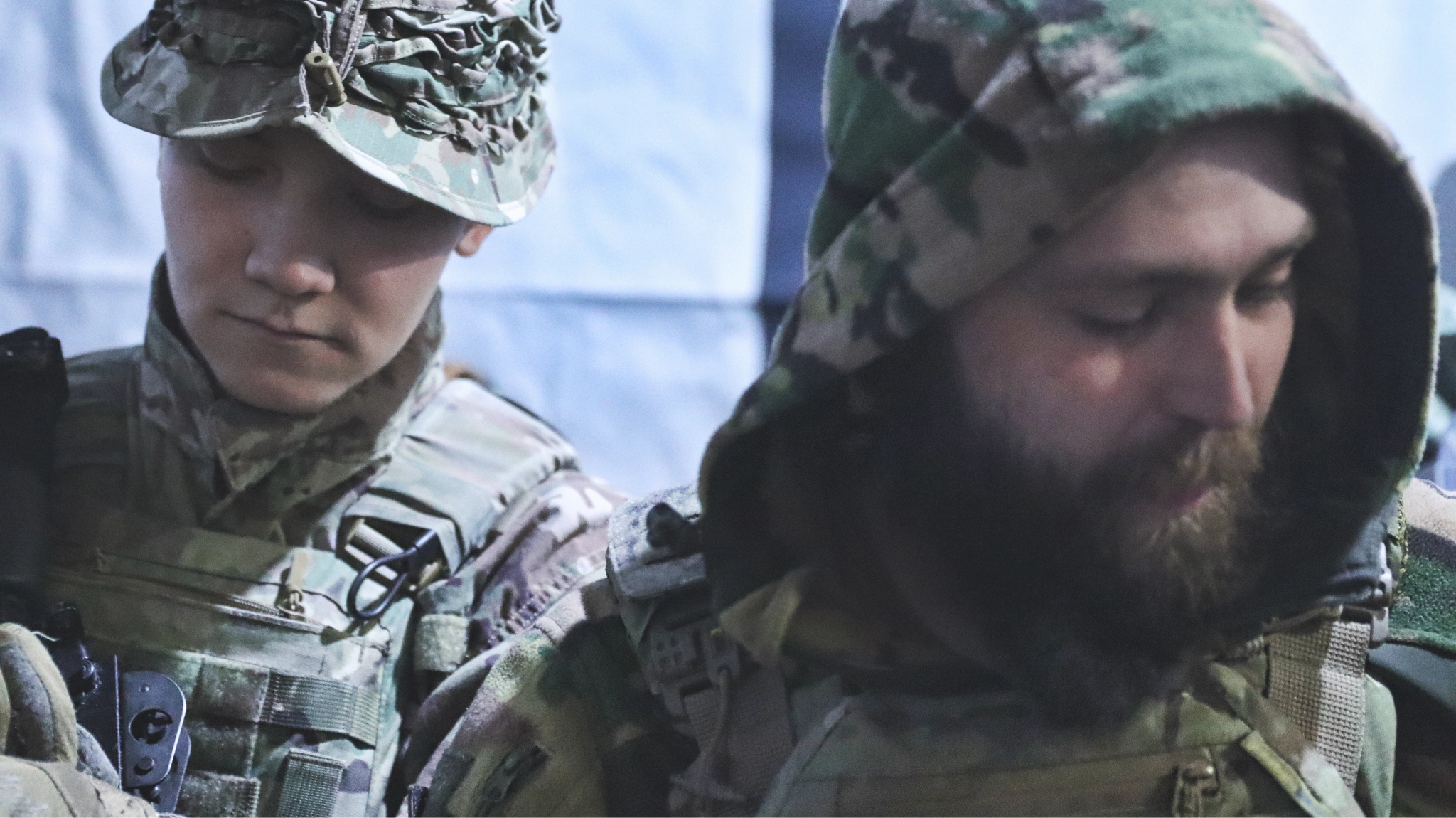
“Serpen” and “Khor,” soldiers of Ukraine's Khartia Brigade, in a house used for rotations outside Kharkiv, April 2026. (Photo by Korbinian Leo Kramer)
“You become different in how you see things,” Serpen explains. “Not without fear, maybe more cynical. You don’t react in the same way to death anymore. You have seen too much.”Khor nods slightly. “They keep sending people forward without hesitation,” he says. “At that scale, losses are simply absorbed differently.”
“Ukraine has been strong in adapting, in finding new solutions,” he says, describing a constant effort to offset its disadvantages through improvisation.
A war that reaches everyone
While recruitment centers were flooded with volunteers in 2022, that initial wave has since subsided, and those who have not come forward so far are unlikely to do so now. As a result, most of those arriving today are no longer there by choice, but have been called up through mobilization.
Those who come on their own, he adds, still have a choice.
At the same time, the composition of some units has begun to shift. Alongside Ukrainian soldiers, more and more foreign fighters are appearing – particularly from South America, but also from across Europe.
Some come for economic reasons, drawn by salaries higher than what they can earn at home. Others speak of values, of defending democracy beyond Ukraine itself.
But the underlying dynamic remains: As fewer Ukrainians step forward, the need for additional manpower grows.
In cities far from the front, men have learned to move differently. They avoid metro stations, train hubs, crowded streets – places where officers from the Territorial Recruitment and Social Support Centers (TRC), Ukraine’s military enlistment offices, might be waiting. Some rarely leave their apartments. Others withdraw to villages, staying out of sight for as long as possible.
“They don’t understand.” Serpen remarks. What he refers to is not explained in abstract terms, but in consequences. Those who come on their own, he adds, still have a choice.
“If you come yourself, you choose your brigade, your specialty. If they take you, that decision will be made for you.”
“Serpen,” a soldier of the Khartia Brigade, in a house used for rotations outside Kharkiv, April 2026. (Photo by Korbinian Leo Kramer)
For them, this is not a question of judgment, but of inevitability.
“They don’t think about tomorrow. The war will reach everyone,” Khor says, with no doubt in his voice.
“This is not something you can step out of. Even if you are not here, you will feel it through the economy, through power outages, through everyday life,” he continues. “Everyone will be affected. You cannot walk away from this.”
“We are the shield of Europe”
Despite ongoing diplomatic efforts and discussions about ceasefires and peace plans on the global political stage, there is little sense here that the war is nearing an end. From where they are, it feels as if it will continue indefinitely, and that Russia is unlikely to step back, let alone abandon its ambitions.
For now, the future is not something they allow themselves to dwell on.
“I haven’t thought about it,” Khor says, after a moment. “There is no time for that now.”
Serpen takes it a step further. “This is a historical turning point,” he says, “not only for Ukraine, but beyond it. This is part of something bigger, something that didn’t start recently.”
For a moment, it is easy to forget how young he is. When Russia annexed Crimea and the first fighting began in the Donbas, he was still a child. Most of his life is still ahead of him, at least in theory.
“We can’t afford to think too far ahead, because what matters is that we stand now.” He looks down briefly. “A lot of comrades died,” he adds, more quietly. “You cannot say it was for nothing.”
So their resistance carries on. For Serpen and Khor, an alternative does not exist, while they stress that this is not just Ukraine fighting for itself. Along the front line, in conversations with those responsible for holding it, I have heard this again and again: “If Ukraine falls, next will be Poland and the Baltic states,” Serpen notes. “We are the shield of Europe.”
“It’s more effective to hit the archer than the arrow flying at you.”
All the more reason why support from outside must not fade. For them, it only makes sense if it is thought through, smart and grounded in what actually works. Ideas about foreign troops, from their perspective, are not only politically unrealistic, but would make little difference.
What matters instead is continued financial support and, above all, systems that can reach further, that can shift the balance, not only intercept what is already in the air.
“It’s more effective to hit the archer than the arrow flying at you,” Khor makes clear. “If you only intercept what is already coming, you are always reacting, but striking the places where missiles are launched and where they are made, like airbases and factories, then you change the situation at its source.”
A life between fighting and waiting
For now, these men are holding their positions as best they can, trying to prevent any breakthrough by Russian forces. This is their task. It is what shapes their days.
Time here does not move in a linear way. It compresses, stretches, loops.
“It all depends on the situation at the front,” Serpen says, gesturing behind him, as if the fighting were already unfolding just beyond the house. “And that situation is always changing. We don’t have a fixed rotation, let alone a clear schedule.”
He tries to sketch something like a structure. “You go out for combat, you come back, you eat, you sleep, and then you go back to the line. So yes – it’s fighting and waiting, over and over again.”
He lets out a short, strained laugh. “This is our life.”
A small kitten darts between my legs. I notice how Serpen’s and Khor’s eyes follow its movements – slowly, a bit heavily. For a moment, nothing is said.
Somewhere, a phone lights up. Serpen glances at it, but doesn’t pick it up right away. It’s his girlfriend. “She worries,” he says, almost apologetically.
“So I don’t tell her everything. I just tell her I’m fine.”
This is the first part of our special feature covering the experience of Ukrainian soldiers with the Khartia brigade on the Kharkiv front. Stay tuned for more.