Interest in lunar and deep space exploration is sky high – but progress depends on advancing communications bandwidth beyond RF.
May 8, 2026
Interest in lunar and deep space exploration is sky high – but progress depends on advancing communications bandwidth beyond RF.

Interest in lunar and deep space exploration is sky high – but progress depends on advancing communications bandwidth beyond RF.
May 8, 2026

By Greg Johnson, Director, Business Development, SSC Space
After the US astronauts, Neil Armstrong and Buzz Aldrin, made history as the first humans to walk on the moon, nobody thought it would be so long until the next crew would visit. With NASA’s Artemis II mission recently returning four astronauts to Earth after a 10-day journey around the moon, human space exploration reached farther from Earth than ever before – traveling 252,756 miles and around the far side of the moon.
Last year, Firefly Aerospace became the first commercial company to successfully land on the moon with its uncrewed Blue Ghost lunar lander as part of NASA’s Commercial Lunar Payload Services (CLPS) initiative. The CEO of Firefly Aerospace said that this trip, during which many landmark science research projects were completed, would be the first of many, preparing for annual lunar voyages that will eventually create a permanent presence on the moon.
It’s clear that the moon is re-emerging as the proving ground for the next era of space exploration, not only because of scientific ambition, but because cislunar space is fast becoming the operational bridge between low Earth orbit (LEO) and deep space.
NASA’s Artemis campaign is central to that shift. The US agency says Artemis is designed to establish a long-term presence on the moon, develop the technologies needed to live and work far from Earth, and prepare for future human missions to Mars. NASA is targeting early 2028 for the first Artemis lunar landing under the current plan. NASA announced new priorities in March 2026 as part of their Ignition Initiative and will invest $20 billion over the next seven years to build permanent and sustainable habitats, pressurized rovers and nuclear power systems on the lunar surface.
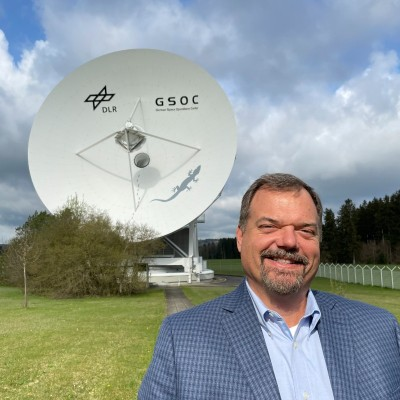
Lunar missions depend on advanced communications systems which support spacecraft commanding for maneuvers, tracking for navigation, and the secure return of mission data to Earth. Lunar surface operations for rovers don’t require the same precision as a lunar lander deorbiting for landing, but remote commanding and the return of video and science data are similar. Regardless of the sophistication of the lander, rover or science payload, they all rely on a communication link back to Earth to execute the mission objectives and return the valuable science data to the mission stakeholders.
Cislunar missions place very different demands on the ground segment than LEO operations. Distance changes the equation. Operators need larger apertures, more sensitive links, precise radiometric tracking, and geographically distributed ground stations that can maintain continuity as the Earth rotates. They also need resilient terrestrial interconnection back to mission operations centers so that the space segment and ground segment behave as one operational system.
The strength of SSC Space, which frequently partners with NASA, the European Space Agency (ESA) and other space agencies and commercial players like Firefly, Blue Origin, Isar Aerospace and more, lies in bringing these elements together. Through one of the world’s largest networks that combines 11 of our own sites strategically located for maximum coverage as well as partner capabilities, SSC Space can support the round-the-clock communications and tracking that lunar missions increasingly require.
That model has already been tested on real missions. SSC Space supported the Artemis II mission from our ground stations in Chile and Hawaii, as well as partner station in South Africa, to provide critical Doppler data for the in-orbit Orion spacecraft. These ground stations are a part of NASA’s Near Space Network, which uses government and commercial assets to support missions within 2 million kilometers of Earth.
SSC Space also exclusively provided Firefly’s Blue Ghost Mission 1 with tracking and communications services throughout the mission, from transit to lunar surface operations – setting records for the highest data rate from the lunar surface and 119 GB downloaded from the lunar surface.
As lunar operations become more ambitious, the communications requirement will move beyond legacy radio frequency (RF) approaches. More surface assets, more sensors, more video, more autonomy and more distributed operations all mean more data. NASA’s own lunar communications architecture work states that RF communications will become limiting for sustained lunar operations and highlights Artemis II’s Orion Optical Communications System demonstration as a step toward higher-rate laser links. Using laser technology installed on the Orion capsule, the crew were able to beam out-of-this-world Netflix-quality video back from the moon.
To prepare for these increased communications needs, SSC Space is investing along two fronts. First, we are augmenting large-aperture RF capability via our partnership in Latvia. There we are adding 16-meter and 32-meter assets aimed at lunar and deep-space support, including services aligned with NASA’s Lunar Exploration Ground Sites (LEGS) performance needs.
Second, we are investing in optical ground infrastructure. In 2026, SSC Space announced a new optical ground station in Chile, complementing a second facility in Western Australia. The European Space Agency (ESA) says these stations are now ready for operations as part of SSC Space’s optical ground network. This matters because optical communications can deliver far higher data rates than traditional RF, while using smaller apertures on the ground. NASA notes that optical systems will be essential for future deep-space missions and that diverse ground locations are necessary because weather and atmospheric conditions can interrupt laser links.
In other words, the future of lunar connectivity is not a single antenna or a single technology. It is a layered architecture: proven RF for resilience, higher-frequency services for growing mission demands, and optical links for the step-change in data return that future exploration will require.
The moon is not simply the next destination. It is the place where the space sector will learn how to operate in a persistent, data-intensive, multi-actor environment beyond Earth orbit – and the organizations that help solve that challenge will help define not only the cislunar economy, but the path onward to Mars.

What began as rumors last year has now become reality: Rheinmetall has formally moved forward with the purchase of German Naval Yards Kiel (GNYK). By Lars Hoffman / Hartpunkt Rheinmetall’s new naval division, formerly NVL, has submitted a non-binding offer for GNYK, as Rheinmetall CEO Armin Pa
Satellite imagery published by the open-source intelligence community Exilenova+ has confirmed a successful Ukrainian strike on the research and production branch of the NTC Radar scientific center in Rostov, struck overnight between May 7 and 8. According to Exilenova+, the main building was comple
Rostec has dispatched a new batch of T-90M, T-80BVM, and T-72B3M tanks to Russian forces, the state defense conglomerate announced on Sunday. The shipment, described by Rostec as incorporating lessons learned from combat experience and direct feedback from frontline troops, represents the latest in
Russia commissioned its eighth Project 22800 Karakurt-class missile corvette into the Baltic Fleet on May 8, 2026, in a ceremony at Baltiysk — one day after Ukraine struck a vessel of the same class at a naval base on the Caspian Sea some 2,000 kilometers away. The new ship, named Burya with hull nu