
As drones become ubiquitous on the modern battlefield, controlling them at scale without a one-operator-per-drone model is critical to maximizing their capabilities.
Palladyne AI’s SwarmOS software enables this by distributing intelligence across every drone in the swarm, drawing on the same principles that allow ants and bees to collaborate at scale. While humans remain in the loop to make final decisions, SwarmOS runs entirely on each drone at the edge — no cloud connection required — enabling real-time perception, reasoning, and action in GPS-denied and communications-contested environments.
Breaking Defense discussed the differences between automation and autonomy, swarm capabilities, and decentralized control with Palladyne AI President and CEO Ben Wolff.
Breaking Defense: Many companies are saying that they have swarm AI and autonomous drone capability, but what’s real and what’s marketing, and how does that translate into the field? What is the actual difference between autonomy and automation?

Wolff: From our perspective, when we talk about autonomy and swarming, we’re talking about the ability for a drone to have true artificial intelligence on the drone itself and to be able to respond in real time to what it sees happening on the battlefield without human intervention or direction for every movement. Not pre-programmed flight, collision avoidance, or waypoint coordination. Those capabilities are table stakes, and that’s what I’d refer to as automation rather than autonomy. That’s an important differentiation.
What that differentiation comes down to is, at the end of the day, who’s having to think about what’s being done? Is the human providing clear direction that the machine cannot vary from? Or is the drone actually thinking about what it is sensing and then responding in real time on its own, given a set of predefined parameters, but not predefined instruction sets?
I would imagine we don’t want armed, attack drones acting without human intervention. Where do the autonomy vs. automation questions come into play here?
We’re talking about different levels of decision-making about different tasks. Take the example of an armed drone following a convoy. Right now, for a drone to follow that convoy of suspected adversaries, you’d typically have a human with a remote-control joystick in his or her hand manually controlling that machine to follow the convoy. A level of automation could be that the drone is now locked onto a particular car, and it can follow that car wherever it goes. A level of autonomy may be that the car stops and an individual gets out and runs away from the car. What is the drone going to do? Is it going to stick with the car, or is it going to follow the individual?
With our level of autonomy, the priority could be that if an individual is spotted who meets certain criteria, the drone will break off from following the vehicle and follow the individual. We still haven’t approached anything about whether it’s going to execute a kill decision. It’s simply making a navigation and mission-prioritization decision. It could be that the drone then signals to the operator: I’ve identified a target, and this is the specific target we’re looking for. Do you want me to pursue a kinetic solution or just observe? That is autonomous navigation and mission adaptation, followed by human intervention for any go/no-go decision involving a kinetic effect.
Palladyne AI has been in the defense industry for years, but now is focusing on new capabilities. What besides the automation vs. autonomy capabilities are you offering?
We spent about 30 years in the R&D space building hardware platforms for the military — and used to be called Sarcos Robotics, and for a while we were called Raytheon Sarcos because we were the robotics division of Raytheon. Two-and-a-half years ago, we made a deliberate decision to focus primarily on AI. Our team had been working on these kinds of decentralized artificial intelligence platforms for decades. Our lead on AI used to be the head of AI for BAE for 15 years. We’ve got a team that is well acquainted with what the challenges on the battlefield are, and we believe we have a novel solution with the architecture that we brought to market.
That gap between human action and automation is what we call autonomy, and that is exactly what we’re trying to solve. There’s a lot of confusion about what that really means. Just because a machine is doing something without a human’s fingers on a joystick doesn’t mean that’s autonomy.
How do you see your shift to AI, software, and vertical integration helping the Pentagon meet its top priorities?
When you look at what the Department of War is talking about, its priorities on weapons production and collaborative autonomy are what’s on everybody’s lips. Obviously, we’re checking that box with our software. Also top of mind are supply chain resilience and domestic sovereign manufacturing. We decided to address that directly by getting into the precision components manufacturing business, so that we now produce high-value precision components for the F-35, F-22, F-18, the Abrams, and some missile programs.
We are making some of the stuff that is hard to source domestically, and we are doing it so that we can try to drive cost down, quality up, and increase the reliability of our supply chain for many of our large, prime defense contractors.
We’re also developing a low-cost long-range precision effects platform targeted at approximately one-tenth the cost of today’s cruise missiles, and we went from concept to first flight in less than six months. That’s kind of unheard of in the industry.
When we talk about being a mid-tier defense prime, what we’re really saying is that we’re trying to bring the best of both worlds. We’re trying to bring some of the engineering rigor and design-for-manufacturing rigor that our team learned while working for the large defense primes, but bringing to that capability a more startup-oriented approach to doing business, which means we’re willing to take financial risk ourselves.
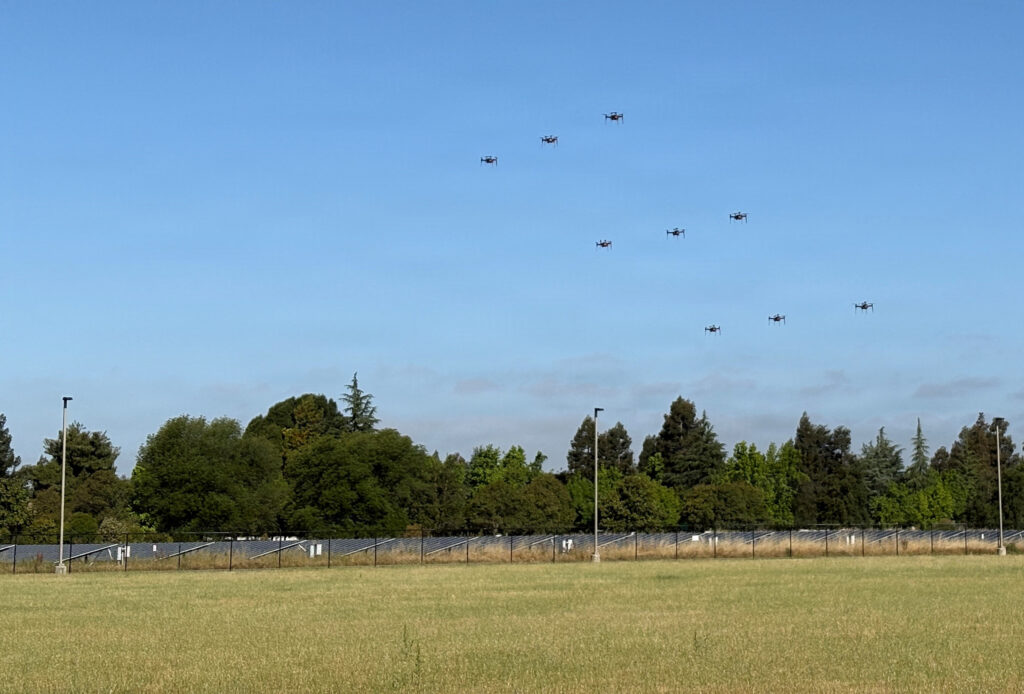
What happens with SwarmOS that doesn’t happen in other systems, and how does its decentralization capability work in an operational scenario?
Most AI today lives in the cloud, and the reason it lives in the cloud is that you have to have significant processing power. You don’t have that kind of processing capacity on a machine that is small and moves around.
Our approach to AI was to say, “You know what? Those centralized systems all have their purpose, but in a comms-denied world and a latency-riddled world, latency even in milliseconds can make a big difference to being able to respond in real time.” My colleagues have been focused on that problem since the late ’90s, and what they were inspired by then, and continue to be inspired by today, is how nature has solved two of the biggest problems that I just addressed.
Number one, nature has solved for us as humans how our senses can detect billions of data points and yet cognitively, we only think about 15 or so at any given point in time. For example, if you were to walk down a set of stairs, your brain isn’t actually thinking about how you walk down each stair so you don’t fall.
Number two, we were inspired by the way ants and bees have collective intelligence and communicate with each other. The queen doesn’t sit there and give direction to each member of the hive or the colony. There is collective intelligence with very limited-bandwidth communication going on among all of the members of that group, whether it is a hive or a colony. They are able to transmit information such as: Where is the best food source? Where’s the water source? Who’s the enemy that’s threatening the hive or the colony? That gets transmitted on this decentralized basis.
We like to say that we are biologically inspired with our edge AI because we are inspired by the way human intelligence works by sifting through all of the noise to focus only on the bits of information that are really relevant, and by the way collaborative autonomy happens with hives of bees and colonies of ants.
We have been able to take those basic philosophies and put them on very low compute requirements of a low-cost drone. We’ve built our algorithms to sit on those machines themselves, not be centralized, not require connectivity to a central node, and use the mesh radios that are on drones. This enables each drone to communicate in a hive-like manner with only limited bits of data required.
A drone says, “I’ve got a mission. I need more information. Can my peers in the swarm provide me with the data I need to get a better perspective of the mission I need to execute?” That’s what makes us different.
What have your demonstrations told you about where SwarmOS is and where its capabilities are right now, and what does the Pentagon still need to see to commit to this technology?
We just completed a real-world exercise that was a joint exercise, a very large one. I can’t give you any details because it was an actual exercise. We were flying on drones from different OEMs. Multiple OEMs each had our software on them, with a single soldier managing all of them, and all of them collaborating as a swarm.
Even though they’re from different manufacturers, now you’ve got a single soldier managing multiple drones, all collaborating and completing a mission. It worked not only as advertised, it exceeded expectations.
This future is here. It isn’t science fiction any longer. We aren’t the boys with toys PowerPoint crowd claiming to have autonomous collaboration capabilities that are really nothing more than pre-programmed flight.
The fundamental questions for the Pentagon are these: Who makes what decisions and when? What decisions can and should be offloaded to a machine so that operators can focus on what really matters? Just as we humans don’t consciously think about every breath and step we take, we shouldn’t have to think about every action a drone takes, not to mention an entire swarm of drones. We give the Pentagon the flexibility to implement the answers to those questions in real time with a simple to implement, easy to learn and use, hardware agnostic and cost-effective scalable solution that is available today.


