
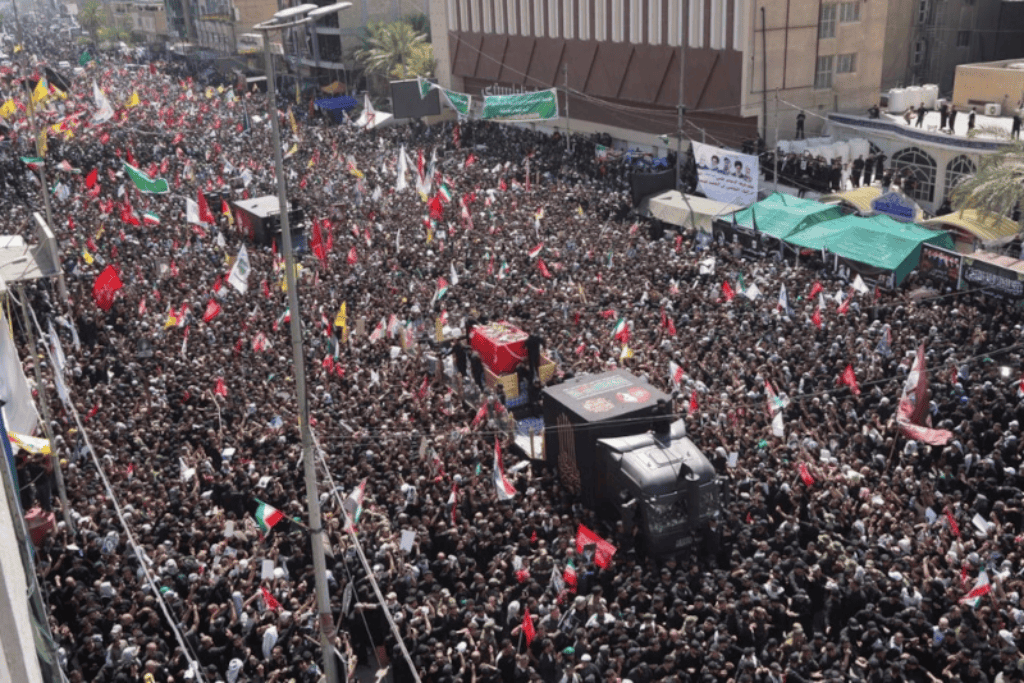
The body of Iranian Supreme Leader Ali Khamenei was taken to the Iraqi holy cities of Najaf and Karbala on July 8 as part of his funeral procession. Large crowds gathered to mourn the slain leader of the Islamic Republic alongside both Iraqi and Iranian political elites, though senior Iraqi cleric Grand Ayatollah Ali Sistani was noticeably absent.
Khamenei was killed in an airstrike on February 28, at the launch of the US-Israeli military campaign against Iran, but his multi-day funeral only began on July 4 in Tehran. His body traveled to the Iranian city of Qom before going to Iraq and then returning for burial in Mashhad, Iran’s holiest city and Khamenei’s hometown.
In Iraq, some estimates claimed that two million people attended the mourning procession in Najaf alone, though these numbers likely rely on claims by Iran and its allies in Iraq. Nevertheless, images from the events show significant crowds. Like Iran, Iraq is a Shiite-majority country, and the holy cities of Najaf and Karbala are major pilgrimage destinations that are home to the two most important Shiite shrines and, in Najaf in particular, centers of religious study.
Khamenei’s body arrived in Najaf on the evening of July 7, where Iraqi Prime Minister Ali al Zaidi received the funeral delegation. Alongside Zaidi was a who’s who of Iraq’s elites across sectarian divides. Former Shiite Prime Ministers Mohammad Shia al Sudani and Nouri al Maliki were in attendance. Also there to receive the body and delegation was Faiq Zaidan, the president of Iraq’s Supreme Judicial Council. Leaders of Iran-backed militias, including Qais Khazali, a US-designated terrorist, and Rayan Kildani, a Christian militia leader and US-designated human rights abuser, were also at Najaf airport.
Sunni politician and former Speaker of the Iraqi Council of Representatives Mohamed Halbousi attended, as did Muhsin al Mandalawi, a Shiite Kurdish politician who served as acting speaker of the council. Ammar Hakim, an Iraqi cleric and leader of the Hikma Movement, a Shiite political party, was also in attendance. Iraqi cleric and political leader Muqtada al Sadr also attended the funeral procession.
At the ceremony in Najaf, Iraqi cleric Ayatollah Mohmmad Taqi Hakim led funeral prayers at the Shrine of Imam Ali, one of Shiite Islam’s holiest sites. Iran’s state-controlled Islamic Republic News Agency described Hakim as “a senior scholar of the Najaf seminary and a prominent member of the Hakim family.” The fact that Sistani, Iraq’s top cleric, did not lead prayers or attend the ceremony was a notable absence. In a statement to the Office of the Supreme Leader, Sistani’s son, who manages his office, said the cleric would be unable to perform the prayer due to his health.
According to Iraq’s Shafaq News agency, the Iraqi government had placed some restrictions on the funeral procession. Specifically, the authorities prohibited senior commanders from Iran’s Islamic Revolutionary Guard Corps (IRGC), such as Esmail Qaani, commander of the IRGC-Qods Force, and limited the official ceremonies to Najaf and Karbala. The inclusion of Iraq in Khamenei’s funeral procession is a particularly delicate development as Prime Minister Zaidi prepares for a visit to Washington in mid-July.
Bridget Toomey is a research analyst at the Foundation for Defense of Democracies focusing on Iranian proxies, specifically Iraqi militias and the Houthis.
Tags: Ali Khamenei, Iran, Iraq, Iraqi militias


