
On June 12, 2026, Canada’s Ministry of Defence announced the ceremony for the keel-laying ceremony of the first River-class destroyer in Halifax.
Canadian MoD press release
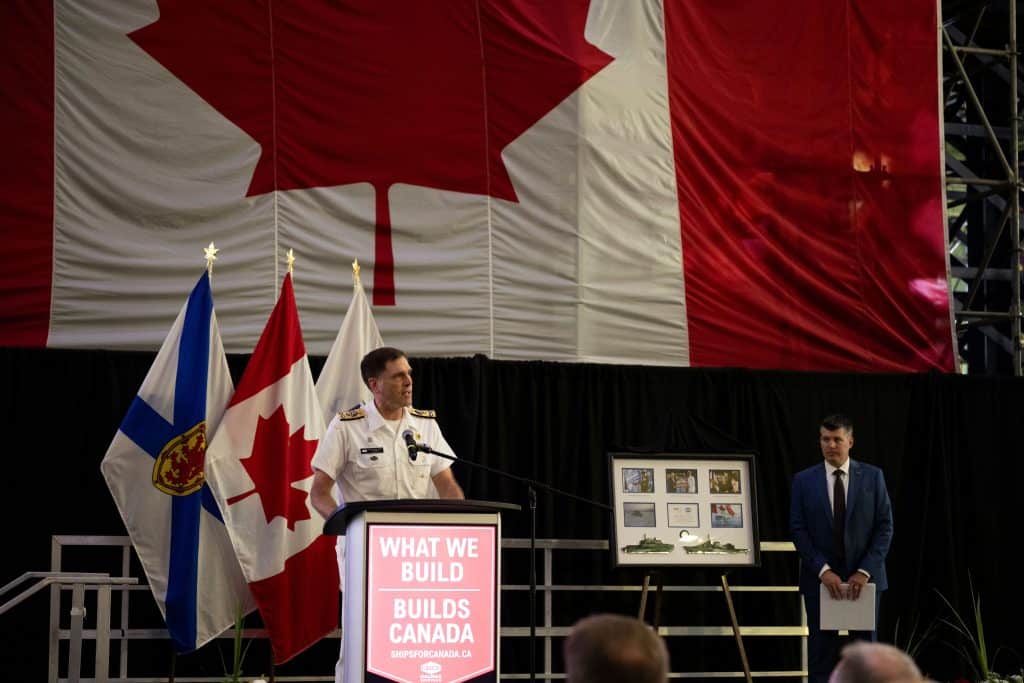
Today, the Honourable Lena Metlege Diab, Minister of Immigration, Refugees and Citizenship, on behalf of the Honourable David J. McGuinty, Minister of National Defence, along with the Honourable Sean Fraser, Minister of Justice and Attorney General of Canada and Minister responsible for the Atlantic Canada Opportunities Agency, attended the ceremonial keel laying for the first River-class destroyer (RCD), the future His Majesty’s Canadian Ship (HMCS) Fraser.
Keel laying is a centuries-old tradition signifying the formal start of a ship’s construction and is believed to bring good fortune to the ship and its crew. The ceremony involves welding a symbolic coin onto the ship’s keel, which serves as the structural spine, running along the entire bottom length of the ship. The coin for the first RCD features a design of the explorer Simon Fraser traversing a gorge forged by the river that later became his namesake. Today’s milestone follows initial construction activities that began on the ship’s production test module in June 2024, enabling the start of full-rate production in April 2025.
Through the National Shipbuilding Strategy, the RCD Project will provide the Royal Canadian Navy (RCN) its major surface combat power. Full-rate construction of the first RCD has been underway since April 2025, with delivery of the future HMCS Fraser expected in the early 2030s. Once in service, the RCD will replace the capabilities of the retired Iroquois-class destroyers and the Halifax-class frigates with a single, modern, combat-capable ship. Consolidating capabilities in one platform will streamline training and maintenance, and enable the RCN to respond to diverse and evolving threats in open oceans and highly complex maritime environments.
Beyond strengthening the RCN’s operational readiness, the RCD Project demonstrates how investments in industry reinforce Canada’s defence industrial base and generate downstream economic benefits for Canadians—a key objective of the Defence Industrial Strategy. Between 2025 and 2039, the RCD implementation contract is estimated to contribute almost $720 million to Canada’s gross domestic product (GDP) and support approximately 5,250 jobs annually. At the same time, consumer spending by employees is estimated to contribute an additional $191 million to Canada’s GDP and support a further 1,545 jobs per year.
The Ministers also recognized progress on the Arctic and Offshore Patrol Ships (AOPS) Project during the ceremony. In addition to six in-service Harry DeWolf-class Arctic and Offshore Patrol Vessels (AOPV) delivered to the RCN between 2020 and 2025, Irving Shipbuilding Inc. is expected to deliver two AOPV to the Canadian Coast Guard by the end of 2027, marking the culmination of the AOPS Project.
Shipbuilding projects translate defence investment into real capabilities: delivering modern ships for the RCN and CCG to safeguard national sovereignty and security, while growing employment, industry and the economy across Canada.
Quotes
“Reaching the concrete start of construction on the first River-class destroyer, our next-generation maritime capabilities, coupled with the steady delivery of Arctic and Offshore Patrol Vessels, is an encouraging step forward in strengthening our national resiliency and revitalizing our domestic shipbuilding industry.”
The Honourable David J. McGuinty, Minister of National Defence
