1 hour ago
Kali Hays,Technology reporterand
Archie Mitchell,Business reporter

 Getty Images
A total of 17 US executives are set to join the president on his visit, where he will meet his Chinese counterpart Xi Jinping.

1 hour ago
Kali Hays,Technology reporterand
Archie Mitchell,Business reporter
Getty Images
US President Donald Trump is expected to bring a host of top business and technology industry executives on his trip to China this week.
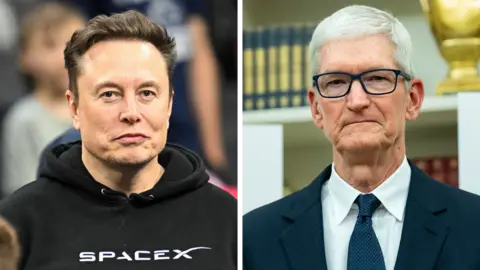
Among those set to join the president on his official trip to Beijing are Tim Cook of Apple, Elon Musk of Tesla and SpaceX, Larry Fink of BlackRock, as well as other executives from Meta, Visa, JP Morgan, Boeing, Cargill and more.
In total, 17 US executives will join Trump on the trip, a White House official with knowledge of the plans told the BBC.
The trip is seen as important for the US, as Trump will meet with President Xi Jinping at a time of growing economic and technological animosity between the two countries.
In addition to Musk, Cook and Fink, the full list of the executives set to join Trump as part of the official US delegation to China is as follows:
Absent from the list is Nvidia boss Jensen Huang, whose company is central to the rivalry between the US and China over computer chips and artificial intelligence (AI).
The BBC has contacted Nvidia for comment. Last week, Huang told business news channel CNBC that it would be a "privilege" to represent the US in China if he was invited on the trip.
It is also notable that Sanjay Mehrotra, the CEO of Micron Technology, will be part of Trump's delegation.
His presence is interesting as Beijing restricted the use of some Micron chips in critical infrastructure in 2023 on national security grounds - a move the firm has said negatively impacted its business in China.
Semiconductors remain central to the US-China economic relationship, despite ongoing tensions over technology and export controls.
Chuck Robbins, chief executive and chairman of Cisco, had been invited to be a part of the trip "but is unable to due to earnings," according to a company spokeswoman.
Together, the executives represent a swath of US business interests, from social media and consumer hardware, to computer chips and commercial manufacturing.
A spokeswoman for Illumina, a biotechnology company based in Californa, said Thaysen "is honored to be part of the delegation" and that the company hopes the trip will be "an opportunity to strengthen relationships and shape the future of precision medicine."
Representatives of the other companies did not immediately respond to requests for comment.
Trump's visit to China will be the first by a US president in nearly a decade and marks a key test of a fragile trade truce between the two countries, following a tit-for-tat trade war which saw them roll out tariffs which at times topped 100%.
The tariffs were paused in October 2025 after Trump's last meeting with Xi, which took place in South Korea.
Looming large over the upcoming meeting will be the US and Israel's war in Iran, which has already forced a delay to Trump and Xi's meeting.
Trump is expected to push China, which relies on Iran for cheap oil, to help facilitate an agreement between Tehran and Washington to end the war.
China also wants the conflict to end. It has limited the supply of oil to the country, hitting the buying power of other countries around the world that import Chinese goods.
But China's vast oil reserves and diverse energy supply have helped it so far in weathering the fallout of the war better than many neighbours.

Himanta Biswa Sarma is seen as one of the architects of BJP's rapid growth in India's northeast.

Senator Ronald "Bato" Dela Rosa, a former national police chief, has sought refuge in the senate.

Beijing is on stronger footing over Taiwan compared with Donald Trump’s first presidential term, according to a leading mainland analyst. Wu Yongping, dean of the Institute for Taiwan Studies at Tsinghua University in Beijing, said the issue would “definitely” be discussed when Trump meets his Chine

Renowned biologist Xu Xianzhong has returned to China, taking up a full-time position in the southern tech hub of Shenzhen, months after four researchers in his laboratory at the University of Michigan were accused by the United States of “biological material smuggling”. Xu, a fellow of the prestigi