Germany relocate ships for readiness in Strait of Hormuz
Two German Navy ships will join Nato Mine Countermeasures Group 2 incase the alliance deploy to the contested Strait of Hormuz.
The post Germany relocate ships for readiness in Strait of Hormuz appeared first on Naval Technology.
Naval Technology
75
3 دقيقة قراءة
0 مشاهدة
Berlin will send a minehunter and replenishment ship to join Nato Mine Countermeasures Group 2.
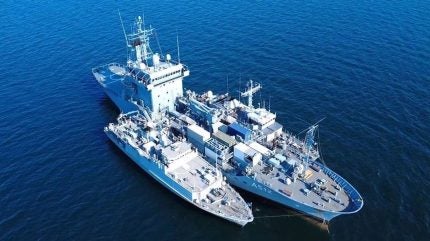
German Navy Elbe-class replenishment ship Mosel rests at anchor with the Estonian navy ship Sakala on its starboard, 6 June 2025. Credit: DVIDS.
The Bundeswehr will send two ships to join Nato Mine Countermeasures Group 2
Germany will deploy the Fulda minehunter and Mosel replenishment ship
Both ships will depart from other engagements to join a potential Nato mission in the Strait of Hormuz
The Bundeswehr has redirected two ships from other engagements to support Nato Mine Countermeasures Group 2, should the unit be mobilised to remove mines in the contested Strait of Hormuz.
The German Navy has deployed the Elbe-class replenisher Mosel and Frankenthal-class minehunter Fulda to the Mediterranean for readiness.
Discover B2B Marketing That Performs
Combine business intelligence and editorial excellence to reach engaged professionals across 36 leading media platforms.
Find out more
Nato partners are preparing for a possible deployment to the Strait of Hormuz, a contested maritime chokepoint in the Middle East. Iran’s strategic control of the narrow trade route, crucial to the global economy, has brought the US to heel in a game of wills despite its overwhelming air campaign against the rogue state.
Nato will deploy to the Strait so long as the US and Iran agree to a sustained ceasefire and an international legal mandate for a defensive operation is secured. Berlin’s decision comes in anticipation of such an effort.
Reassigned for readiness
Reassigning the auxiliary ship Mosel suspends Germany’s contribution to Nato activity in the Aegean Sea, where the Navy is helping to improve cooperation between the Greek and Turkish coastguards and acting against human traffickers and their networks.
Meanwhile, Fulda departed Germany through the Kiel canal to join Group 2 in the Mediterranean on the 4 May.
Likewise, unspecified supplementary capabilities will be relocated in the coming weeks, depending on whether necessary conditions for deployment are met.
The purpose of the measure is to station potential German capabilities for a possible operation in the Strait of Hormuz at a shorter geographical distance and to conduct joint operational preparation, according to a Bundeswehr statement.
“Our goal,” the statement read, “is to ensure that the Strait of Hormuz, as a vital shipping and trade route, is safely navigable again as soon as possible.”
Status of the strait
On 4 May, the US Navy began to escort ships through the Strait under what is known as Operation Freedom, distinct from the offensive activity conducted against Iran under Operation Epic Fury.
Describing the nature of this defensive effort, the US Secretary of War Pete Hegseth emphasised that the operation is only temporary, urging global partners, particularly European allies, to take up the mantle: “we will hand responsibility back to you.”
But as of yesterday (5 May), US President Donald Trump agreed to pause Operation Freedom under pressure to revive negotiations and bring an end to the conflict.
In tandem, the US State Department announced plans to put forward a United Nations resolution to defend freedom of navigation and secure the Strait of Hormuz.
The US alongside partners inflicted by Iranian strikes – including Bahrain, Kuwait, Qatar, Saudi Arabia and the United Arab Emirates – drafted the resolution. Among other requirements, the reoslution demands that Iran disclose the number and location of the sea mines it has laid and cooperate with efforts to remove them.