
Iraqi politicians and security forces have responded to a May 9 report in The Wall Street Journal claiming that “Israel built and defended a secret Iran war base in Iraq.” The news provoked a mix of denials that the base existed and condemnations over a possible violation of Iraqi sovereignty, and prompted an operation conducted by security forces.
“If the circulating press reports about the establishment of a secret military base in the Najaf desert are true, then we are faced with a grave breach that undermines Iraq’s sovereignty, necessitating full transparency with the Iraqis about all the facts and a clear assignment of responsibilities without equivocation or justification,” former Iraqi Prime Minister Mustafa al Kadhimi wrote on X on May 11. The next day, the Popular Mobilization Forces (PMF), an official Iraqi security institution largely comprised of Iran-backed militias, launched an operation with other security forces on May 12 to “impose sovereignty” in southwestern Iraq.
“The base, set up for special forces and search-and-rescue teams, was almost discovered early in the conflict,” The Wall Street Journal reported. The news sparked several controversies and unconfirmed reports that have circulated through Iraqi media. For example, one unverified and repeated claim on social media alleges that an Iraqi shepherd was “killed by Israeli forces” near the base. Other reports have claimed to geolocate the site of the temporary facility, including an unused airstrip.
An Iraqi security source told Saudi Arabia’s Al Arabiya on May 10 that Iraqi forces had detected military movements in the Najaf desert in southwestern Iraq. At the time, apparently in March when the base was reportedly operational, the Iraqis thought there had been a temporary airdrop by unknown forces. “The source explained that the Iraqi security forces were unable to identify the force present there after they came under heavy fire while trying to approach the site,” Al Arabiya noted.
Iraqi and Saudi Arabian media reports quoted Iraqi security sources as saying that the US had warned Iraq not to approach the site. On May 11, Iraq’s Joint Operations Command denied that there were “unauthorized bases and forces,” according to the Rudaw Media Network. This statement attempted to downplay the story, referring to “outdated images related to a one-time incident in March, during which Iraqi forces engaged ‘unidentified’ detachments in a southern desert area” and portraying the new controversy as being used “politically.” This was likely a reference to the fact that Iraq’s new prime minister-designate, Ali al Zaydi, was seeking to form a cabinet as the news broke. An Iraqi official told Turkey’s Anadolu News Agency a similar story, suggesting that a “‘mysterious’ airborne operation in March” had occurred near Al Nukhaib and had been “handled at the time.”
In contrast, on May 11, Iraqi parliament member Shaker Abu Turab al Tamimi of the Badr Organization, a pro-Iranian Shiite organization in Iraq that has several militia brigades within the PMF, claimed that an “American-Israeli” base was still active in Iraq. Kadhimi, the former prime minister, added, “Protecting Iraq cannot be achieved through speeches or political promotion campaigns, but rather by building a state that possesses its own decision-making authority, imposes its authority across the entire geography, subjects weapons to the rule of law, and prevents the country from being turned into an open arena for settling regional and international conflicts.”
The operation launched by the PMF and other security forces on May 12 is focused on southern and western Iraq. The PMF’s official government website described the operation, which included several elements, among them the 2nd Brigade, a Badr unit, as happening in response to reports of a “Zionist-American” airdrop in the desert. The PMF claimed that its forces intend to sweep a 120-kilometer radius, which would imply 52,279 square kilometers, an area larger than the US states of Vermont and New Hampshire combined. The effort is supposed to include areas west of Najaf and Karbala, through the town of Al Nukhaib, and to the Arar border crossing on the Saudi border.
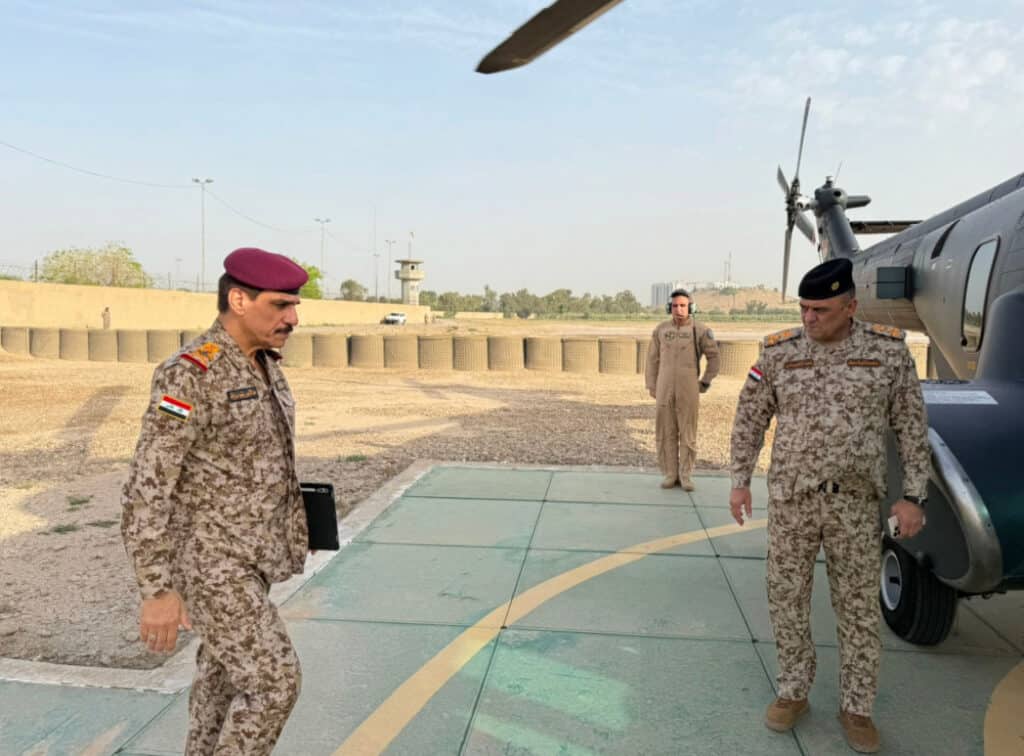
Iraq’s Ministry of Defense announced on May 12 that Chief of Staff of the Armed Forces Lt. Gen. Abdul Amir Rashid Yar Allah traveled to Al Nukhaib. The ministry said his trip was to inspect units and follow up on “important developments,” without specifying that the visit was linked to the PMF operation. Throughout May 12, Iraqi social media accounts closely followed the PMF operation and security forces’ search for the alleged site of the base.
Reporting from Israel, Seth J. Frantzman is an adjunct fellow at FDD and a contributor to FDD’s Long War Journal. He is the senior Middle East correspondent and analyst at The Jerusalem Post, and author of The October 7 War: Israel's Battle for Security in Gaza (2024).


