More cows than pupils - what is behind mass school closures in rural Kenya?
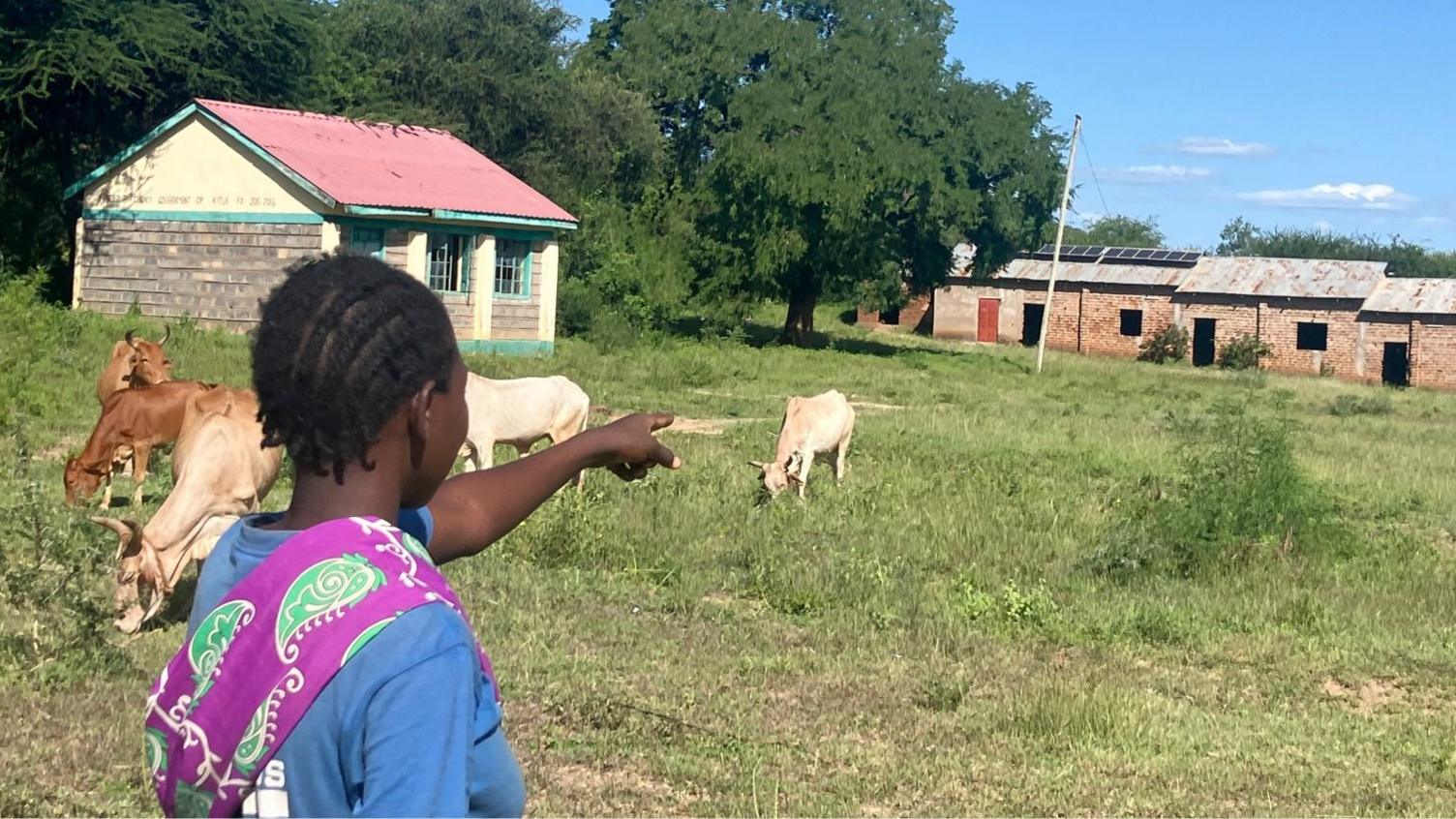
Kaliluni Primary School has lost most of its pupils over the last three years
ByWycliffe Muia
Reporting fromKitui county
More than 2,000 primary schools are facing closure as enrolment numbers plummet.

Kaliluni Primary School has lost most of its pupils over the last three years
ByWycliffe Muia
Reporting fromKitui county
On what should be a busy morning at Kaliluni Primary School in southern Kenya, only cows are in attendance, grazing between broken classroom doors that hang open to reveal rows of empty chairs.
Three years ago, more than 200 children filled this rural school with noise and activity. Now there are only five pupils - and on the day we visit they, and the only remaining teacher, are absent.
As we leave the dilapidated compound, with books strewn across the floors of some classrooms, we spot a schoolgirl in uniform walking forlornly towards her home.
Maureen Mwisiwa, 12, says she has been turning up to school for the past week to find herself on her own.
"I feel bad missing lessons all those days while pupils in other schools are still in class," she tells the BBC.
Her mother, Josephine Muasya - like the remaining parents with children there - is planning to transfer her daughter to another school where most of Maureen's friends are now. It is quite a distance away - 8km (5 miles) on rough roads.
But as there is no public transport in this remote area of Kitui county, which is more than 200km east of the capital, Nairobi, the children opt for a short cut, trekking over fairly rugged terrain.
It will still take Maureen just over an hour to walk to the new school, instead of the 10 minutes to Kaliluni Primary.
"I was hoping the government would restore operations here - bring more teachers and facilities to accommodate the new curriculum - but there is no hope," her mother says.
Muasya is referring to a major shake-up of Kenya's education system that was introduced in 2017 - a less exam-orientated and more creative and practical approach to teaching, known as Competency-Based Education (CBE).
But it is having a devastating effect on rural junior schools - and Kaliluni Primary is one of more than 2,000 across the East African nation now facing possible closure as enrolment numbers plummet.
BBC
The CBE curriculum should strengthen schools, especially for low-income communities, not weaken them"
Under the old system, primary schools would teach children until grade eight and then aged around 14, they would move to senior school.
Now the final year of primary school ends in grade six and there is a new intermediary stage, known as junior secondary school, for grades seven to nine, which includes more science and practical subjects.
It was decided that primary schools would accommodate these intermediary grades with children moving to senior school at around 15 years old.
But it meant that suddenly under-resourced primary schools needed more classrooms, science laboratories, additional teachers with subject specialisations and new learning materials.
"Infrastructure gaps are acute. Many rural schools lack basic facilities such as laboratories, yet learners are expected to pursue science and technical pathways," Mark Kasyoki, an education expert, told the BBC.
He warned that the new curriculum, which was designed to address inequality in education - free for all children in Kenya - could end up doing the opposite if the problems were not urgently addressed.
Other schools in Kitui county have also been affected. Sooma Primary School shut in 2023 after its enrolment dropped to just six pupils and the following year Manooni Primary School closed its doors after only three pupils registered.
There were no farewell assemblies, no tearful speeches under a mango tree. The children just quietly migrated, one by one, to better-equipped schools.
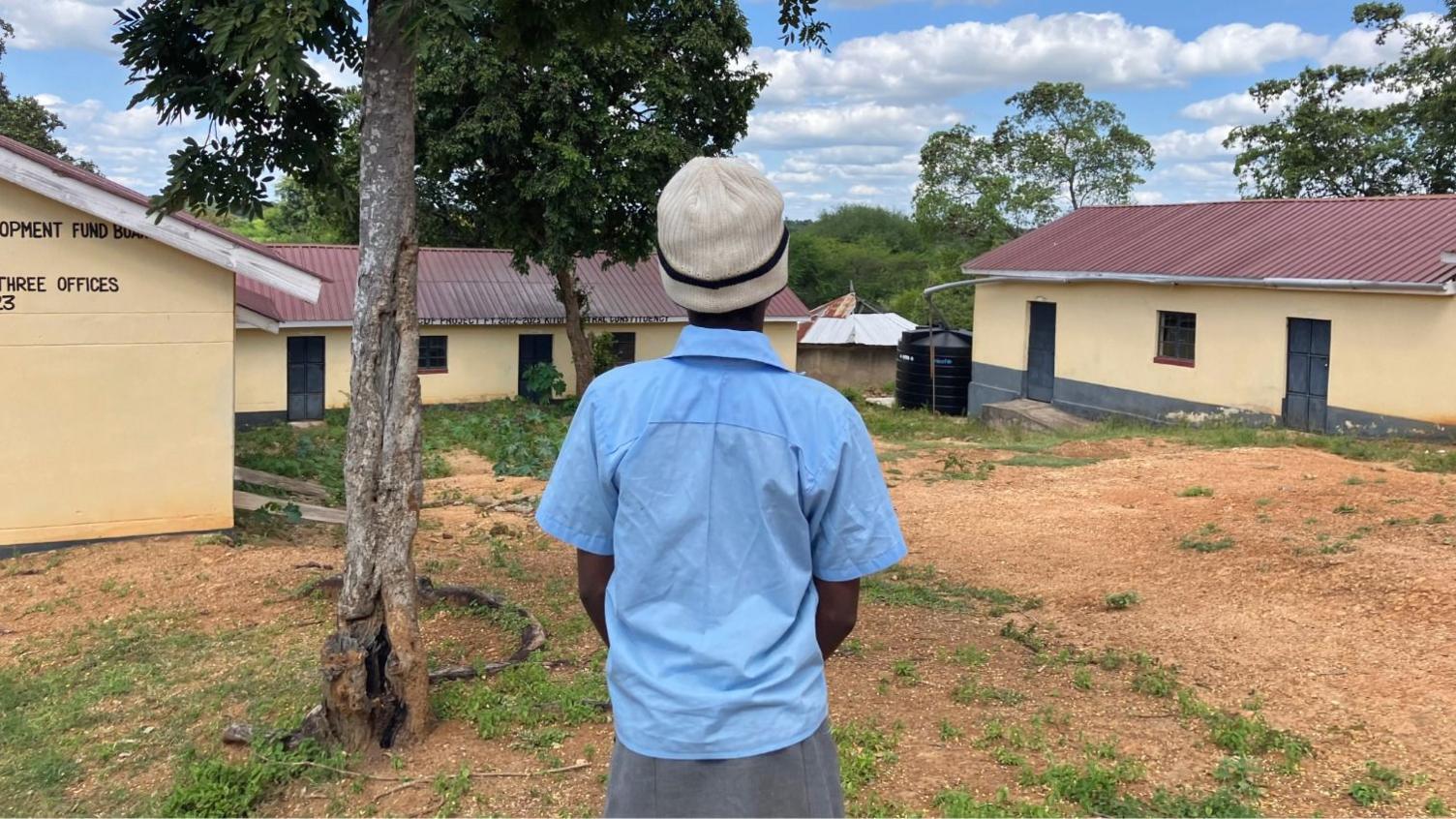
This girl used to attend Manooni Primary School, which is near her home, but she now has to walk 3km to the nearest school
"The CBE curriculum should strengthen schools, especially for low-income communities, not weaken them," said Tabitha Katingu, a mother from the area, who has transferred her two children, meaning they now have a 3km walk to school.
"We want the best for our children. If a school has not enough trained teachers and other required facilities - why would we waste time there?"
It has left many teachers frustrated too.
"The challenge is not that teachers are unwilling to embrace CBE. It's that many of us have not been adequately prepared for it. The training has been inconsistent, especially in rural schools," said a teacher based in Kitui county.
Not all Kitui residents put the blame for school closures solely on the curriculum. Some note that people are having fewer children, while others are moving away for better job opportunities.
"Young people want to marry, but life is hard. Everything is expensive, and many fear they cannot provide for a family. That is why there are fewer children growing up in our villages nowadays," Sarah Mumbua from Kilukuya village told the BBC.
Those who secure jobs in towns often relocate with their families, further draining rural communities of school-age children.
About 70% of Kenyans lived in rural areas in 2023, according to national statistics, external. Should the current trends continue, UN-Habitat predicts more than half of Kenya's population will be living in towns or cities by 2050.
The decline in pupil numbers is also affecting rural secondary schools. According to government data, 2,700 of the country's 9,605 public secondary schools, mostly located in remote areas, have fewer than the required 150 learners.
Ten secondary schools were closed earlier in the year when teachers arrived to take up posts to discover not one single student, local media reported.
EPA/Shutterstock
It makes no sense to have a school with just 10 students when you need a headmaster, a classroom, a watchman and a teacher"
January marked the moment when approximately 1.1 million pioneer grade 10 students - the first full cohort to have gone through the new system - moved to senior school, something the government celebrated as an important milestone for the country.
Education Minister Julius Ogamba has acknowledged there is a rural enrolment problem, saying earlier this year that 2,145 public primary schools would be closing or merging with others to optimise resources.
He also announced an audit of all schools - explaining the minimum enrolment needed for a primary school to remain viable was 45 students.
"It makes no sense to have a school with just 10 students when you need a headmaster, a classroom, a watchman and a teacher. It doesn't make sense. This tells us that we need to face reality," he said.
"We now need to change course and ensure that our schools have all the necessary facilities and the right number of students."
However, the closure of rural schools is also leading to an overcrowding crisis for other institutions struggling to absorb the influx of students.
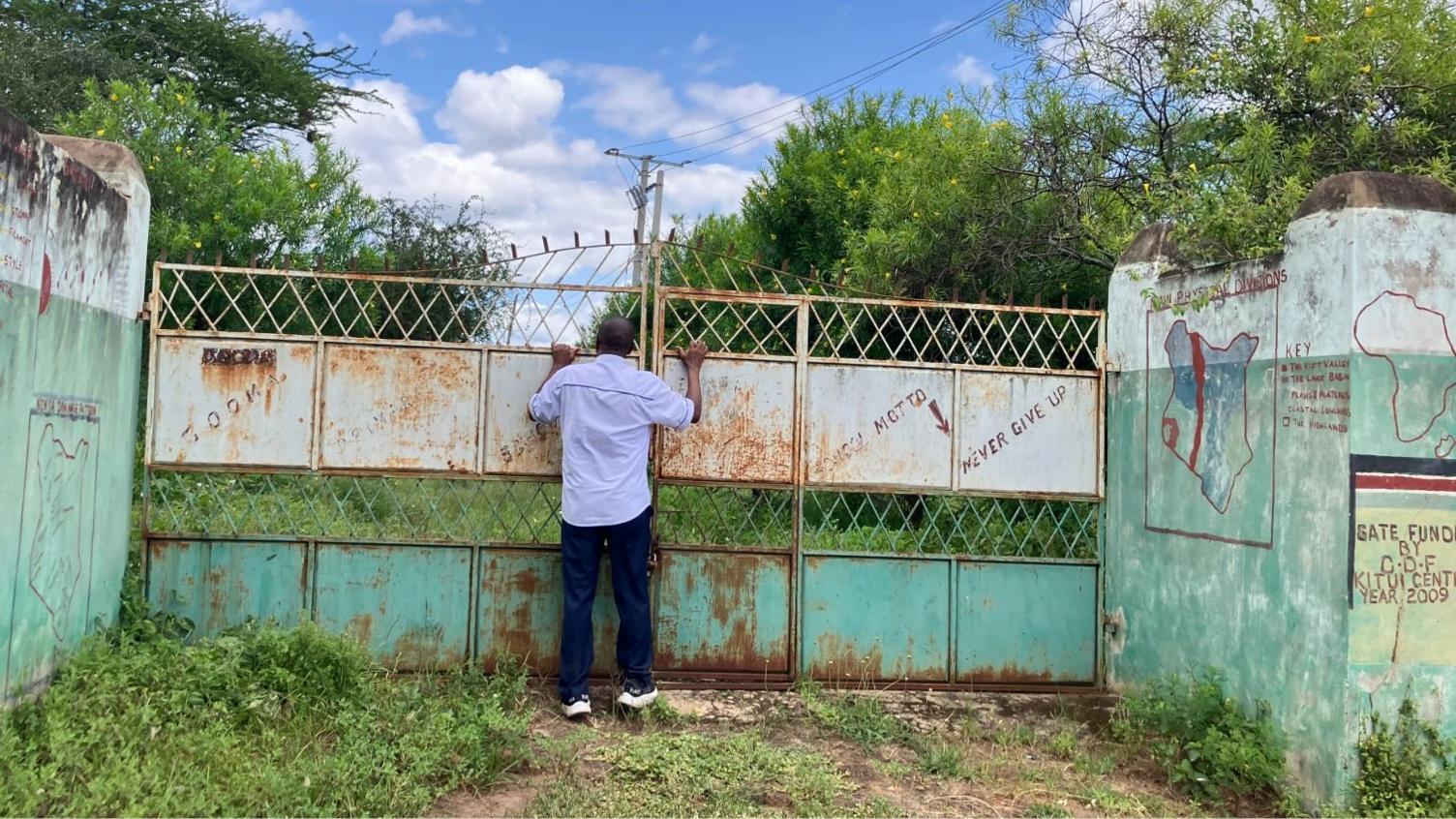
Some experts warn that closing schools like Sooma Primary in Kitui county increases overcrowding elsewhere
Dr Emmanuel Manyasa, the head of Usawa Agenda, a non-profit Kenyan education research group, cautions against closing so many schools, warning about overcrowding and safety risks elsewhere.
"CBE is a good curriculum but we're failing in the implementation. We skipped critical early stages like a cost and implementation plan. We have been just crisis-managing the transition, which is not sustainable," he told the BBC.
Bernard Musyoki, a teacher who spent seven years teaching in a rural part of Machakos county, which borders Kitui, could not agree more.
He loved the community school, but with fewer than 20 pupils it was merged with another one and he transferred to a much larger institution.
"We are moving from one extreme to another," the 36-year-old said about the overcrowded classes.
Musyoki believes the government should cap the number of pupils in each school and distribute teachers more evenly to allow the new system to flourish for all.
"Every child, whether they are in a small rural school or a large one, deserves equal access to teachers, classrooms and learning materials," he said.

Cape Verde may have been the World Cup's second-smallest nation but they leave the largest impact as they depart following defeat by defending champions Argentina in an epic.

Six fans of the Black Stars are living proof of how football can drive supporters to extreme lengths to follow their team.

Former President Zuma's trip to India reignites anger over a decade-old corruption scandal.

The US said the joint operation, which began in December last year, was a success.