
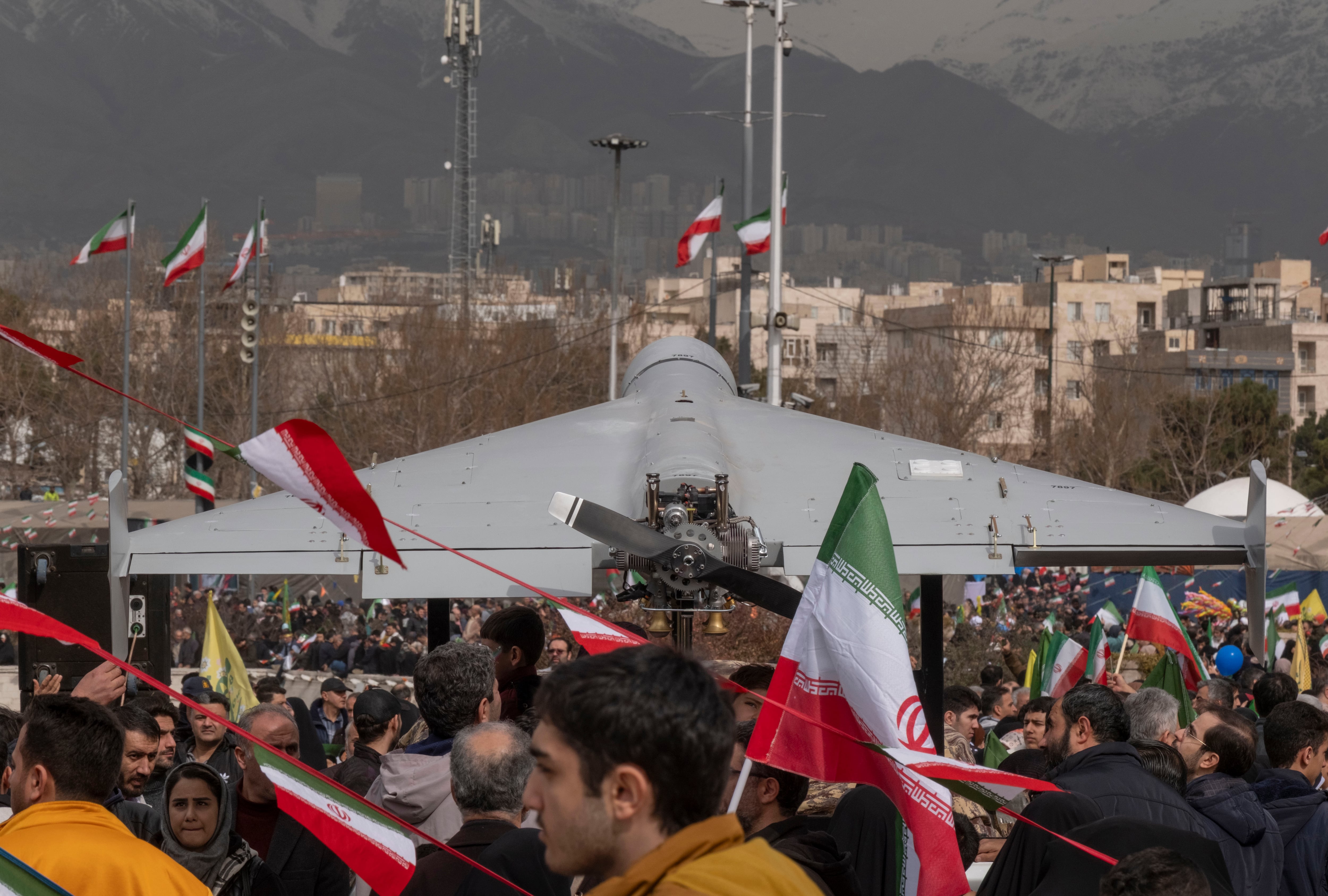
Trump administration officials conceded during a private briefing on Capitol Hill this week that Iran’s Shahed-136 drone is proving more disruptive on the battlefield than the Pentagon had anticipated, two people familiar with the matter told Military Times.
Secretary of Defense Pete Hegseth and Chairman of the Joint Chiefs of Staff Gen. Dan Caine led the group of senior military leaders who warned lawmakers that gaps in counter-drone technology could leave U.S. forces and assets increasingly vulnerable.
“They were ill-prepared,” one person inside the briefing said, referring to U.S. defense plans in the Middle East.
Iran’s Islamic Revolutionary Guard Corps has launched thousands of one-way drones toward U.S. military bases and diplomatic sites across the region since the start of the war, according to the Department of Defense. While American forces and their allies have thwarted most of the onslaught – largely with the Patriot missile system – some projectiles have still managed to reach their targets.
RELATED
One drone that penetrated air defenses at a U.S. installation in Kuwait on Sunday killed at least six American service members and wounded several others. The Iranian drone barrage has also expanded to 12 other countries in the region, CENTCOM Commander Adm. Brad Cooper said, adding that on Thursday the Islamic Republic fired seven attack drones at civilian residential neighborhoods in Bahrain.
The Shahed-136 is a triangle-shaped munition approximately 11 feet long. It carries an explosive warhead in its nose that detonates on impact. The drones can be assembled from relatively simple components and volleyed from the back of a truck, allowing operators to conceal and disperse launch sites. Shaheds cost between $20,000 and $50,000 apiece – a fraction of the price of the American missiles needed to shoot them down.
“Iran knows it can’t match the U.S. or Gulf states plane for plane or missile for missile, but it can change the economics of the conflict,” Patrycja Bazylczyk, an associate director with the Missile Defense Project at the Center for Strategic and International Studies in Washington, D.C., said in an interview with Military Times. “Drones let Iran punch above its weight, keep its adversaries off balance, and project power across the region at minimal cost.”
“We can’t just play whack-a-mole in the sky,” Bazylczyk continued. “Shooting drones down one by one is the most expensive way to fight the cheapest threat. We have to go after the roots – the launch sites, the production lines, and the storage depots.”
The Pentagon has surged aircraft carriers and fighter jets to the region – its largest agglomeration of air and naval power in the Middle East in decades – but intercepting swarms of low-cost drones is rapidly draining U.S. missile stockpiles.
The U.S. has turned to Ukraine for assistance in countering the drones, the country’s President Volodymyr Zelenskyy announced Thursday. Drone warfare has become a fixture during the four-year war sparked by Russia’s invasion of Ukraine. The Kremlin began deploying the Iranian-designed drone in 2022 and has since launched thousands against Ukraine. Engineers in Kyiv have developed a range of anti-drone laser systems, some of which cost as little as $1,000.
“We received a request from the United States for specific support in protection against ‘shaheds’ in the Middle East region,” Zelenskyy wrote in a post on X. “I gave instructions to provide the necessary means and ensure the presence of Ukrainian specialists who can guarantee the required security.”
In a statement to Military Times, White House spokesperson Anna Kelly insisted, “The Iranian regime is being absolutely crushed.”
“Their ballistic missile retaliation is decreasing every day, their navy is being wiped out, their production capacity is being demolished, and proxies are hardly putting up a fight,” Kelly claimed.
Tanya Noury is a reporter for Military Times and Defense News, with coverage focusing on the White House and Pentagon.

