‘The White Book’ – Ukraine Launches Guide to Navigating Russian Propaganda Minefield
The new book is offered as a manual for the democratic world.
Kyiv Post
75
11 دقيقة قراءة
0 مشاهدة
IIn wartime Kyiv, books are rarely just books. They can be testimony, warning, field manual, and act of resistance all at once.
That is the atmosphere in which Media Center Ukraine launched “The White Book: Navigating the Russian Propaganda Minefield” on March 18 – not as an abstract study of media manipulation, but as an essential guide forged in the country that has spent decades living under the pressure of Russian lies, and more than ten years under their most violent modern form.
The volume, produced by Media Center Ukraine with support from the EU, sets out to systematize Ukraine’s experience in confronting Russian disinformation and to make that essential knowledge usable for journalists, diplomats, policymakers, researchers and public figures far beyond Ukraine.
The book does not treat propaganda as a side issue to war. It treats it as a core part of the war itself. In the foreword, Media Center Ukraine describes Russian disinformation as “one of the primary tools of hybrid warfare against Ukraine for decades”, capable of shaping public opinion, political processes and national security domestically and abroad.
How the Kremlin’s anti-Semitic propagandistic agenda – funneled through the social media influencer ecosystem – seeks any opportunity to smear Ukraine.
The purpose of the guide, it says, is to gather lessons that had long been scattered across reports, projects and initiatives and turn them into a clear, structured resource. Ukraine’s long struggle against Russian information aggression is presented not as a niche Ukrainian story, but as essential knowledge that “can now serve as a valuable resource for other states seeking to strengthen their information defenses.”
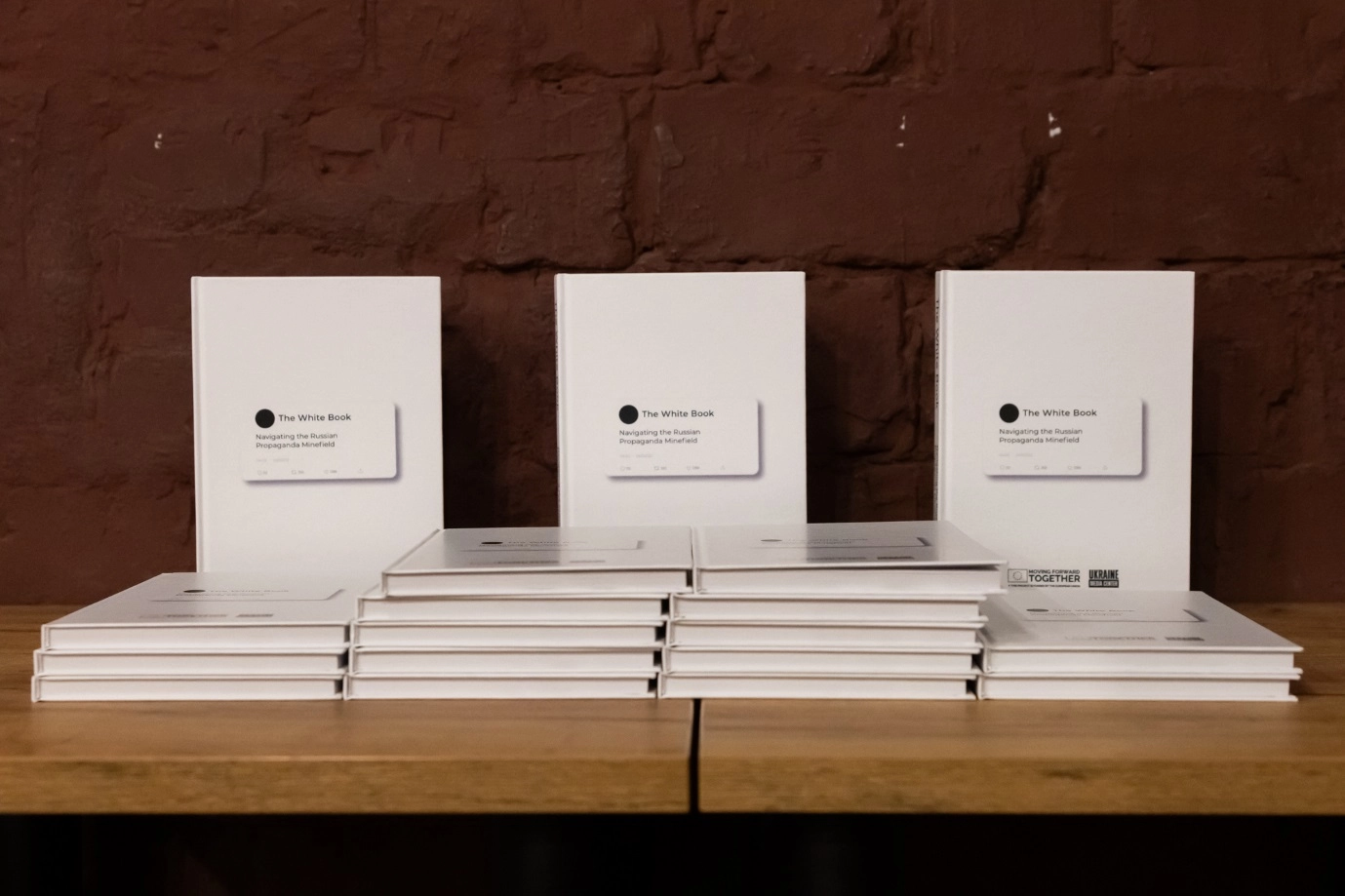
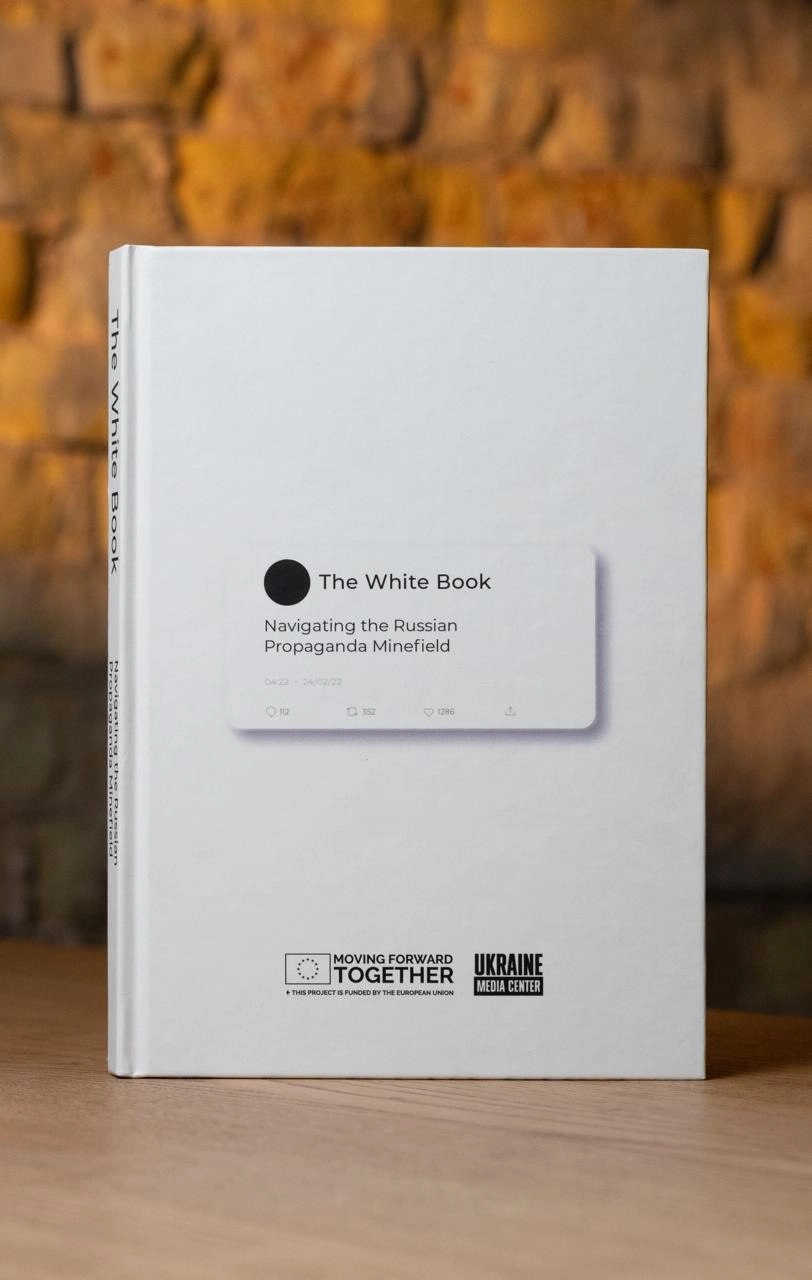
“The White Book.” (Image courtesy of Media Centre Ukraine)
That ambition was stated plainly at the launch. Alina Frolova, co-founder of Media Center Ukraine, said the idea for the book emerged from a practical need. Foreign media and diplomatic representatives arriving in Ukraine often encountered fragments of a much bigger reality but struggled to see the whole picture.
Creating something comprehensive and accessible
Ukraine had “a mass of projects” dealing with propaganda, war crimes documentation and resistance, she said, but these efforts are dispersed across the information landscape. What was needed was an accessible guide that was comprehensive without being unreadable – “a handbook” that could help readers “immerse themselves” in how Russia builds its narratives, how Ukraine fights back, and “how we can all contribute to this struggle”.
Frolova’s team wanted to produce something “complex, but in simple human language” – a book that would offer a retrospective of how Russia prepared the information ground for war and identify the “milestones” and main points on which Russian propaganda has relied in relation to Ukraine, “and indeed the whole democratic world.”
She added that the organizers intend it as a “a desk book in embassies, publishing houses, and media houses” that people could reach for in order to understand “the overall strategy of Russia in the war, in the cognitive war, that it is waging against the democratic world.”
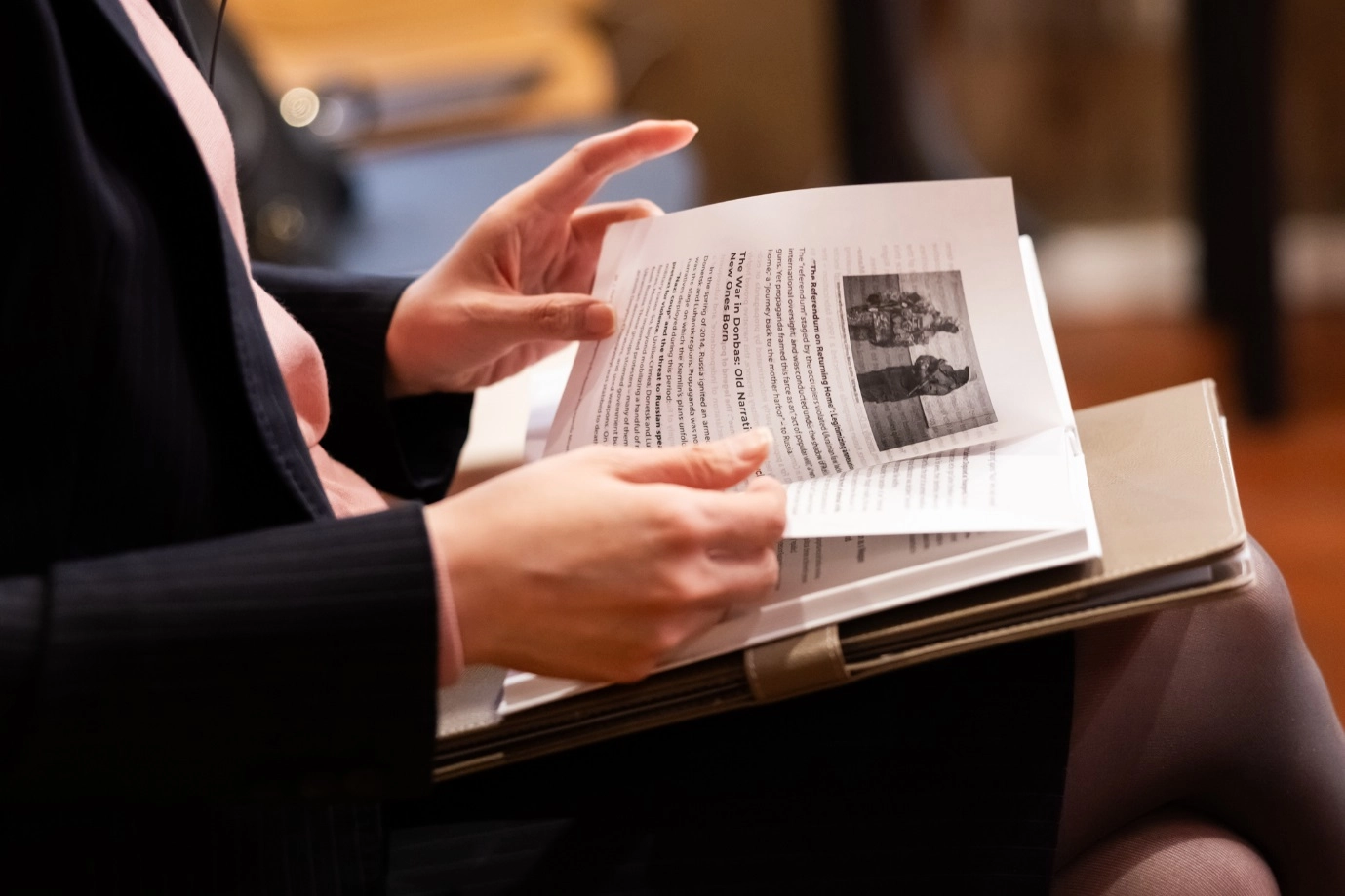
Audience members at the launch of “The White Book.” (Image courtesy of Media Centre Ukraine)
That phrase, “cognitive war,” cannot be underestimated in its significance. “The White Book” argues that Russia is not merely spreading falsehoods. It is attempting to shape the frameworks through which people understand events in the first place.
In its final section, the book warns that disinformation has become a permanent feature of the information environment, increasingly amplified by overload, emotional exhaustion, bot swarms, deepfakes and algorithmic manipulation. The problem, it argues, is no longer only factual falsehood. It is the intentional erosion of the public’s ability to interpret information clearly. The democratic world, the authors suggest, is not only facing a battle over facts, but over the architecture of thought itself.
Historical depth
The power of the book lies in how concretely it shows this process. It begins not in 2014 or 2022, but in the 1990s, with the birth of the “Russian Crimea” narrative. Even in the first years after the Soviet disintegration, the guide argues, Russian propaganda was already constructing myths that later became foundational.
Statements that Ukrainian statehood was artificial, that Ukrainian language and sovereignty were somehow contrived, and that Crimea was not really Ukrainian were weaponized. One enduring fabrication was the myth of the so-called “Friendship Trains”, allegedly carrying Ukrainian nationalists to Crimea to terrorize Russian-speaking residents. The book dismantles that story by example and shows how such narratives were designed to sow fear, resentment and false memories long before annexation became reality.
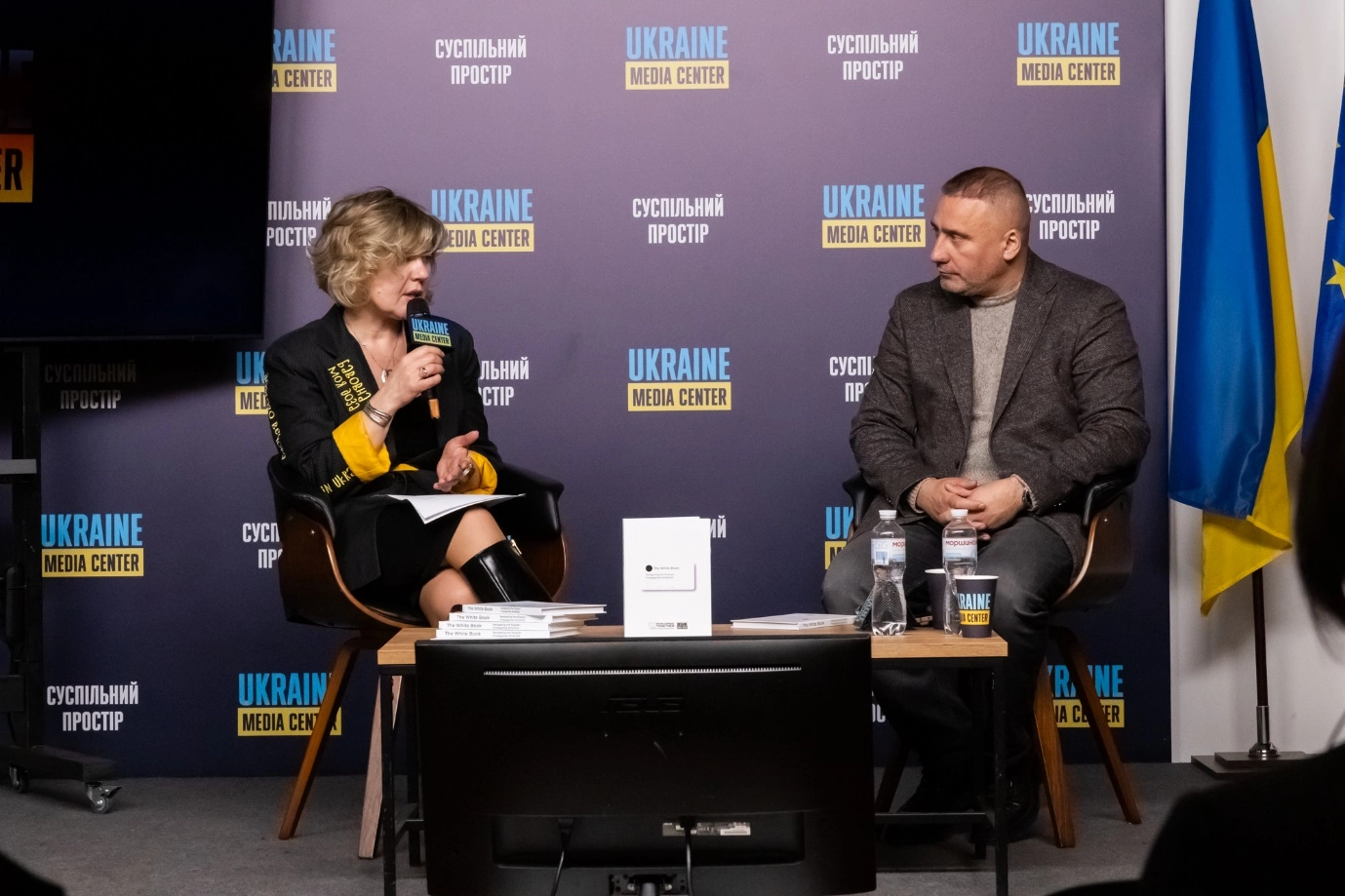
Alina Frolova and Ihor Solovey in discussion. (Image courtesy of Media Centre Ukraine)
This historical depth is one of the reasons the book feels important rather than merely timely. Otar Dovzhenko, the book’s editor, said at the launch that one of its strengths is precisely its sense of continuity. He praised the way it shows Russian propaganda “as a continuity, beginning from Soviet and early post-Soviet times,” tracing how those mechanisms and narratives were formed in parallel with the independence of Ukraine and other post-Soviet states. He put the point more sharply: “There is an illusion that Russian propaganda is Russia’s response to the color revolutions or some other actions by Ukraine. In reality, this book shows that Russian propaganda is a toxic field that has existed since the very inception of Russia as a state.”
That argument pushes against one of the most common Western misunderstandings about the Kremlin’s information war. That is the belief that it is merely reactive, a by-product of political conflict, rather than a longstanding instrument of Russian statecraft. The White Book insists on the opposite. Its chapters map a system of political technologists who inserted Kremlin narratives into Ukrainian elections; intelligence services that coordinate disinformation efforts; censors and propagandists who refine and disseminate the message; and exploitation and manipulation of newer digital ecosystems, from Telegram to TikTok to influencer-style YouTube operations, that allow narratives to mutate and spread across borders.
Some of the examples Russia uses are by now infamous, but that is exactly why they matter. The book revisits the fake “three sorts of Ukrainians” map used during the 2004 presidential campaign; the grotesque invention of a “crucified boy” in Sloviansk; and other falsehoods used to inflame fear and legitimize aggression.
In the section on the full-scale war, it shows how similar methods were repurposed at scale: claims that Ukraine planned attacks on Donbas, fantasies about US biolabs, the idea that Ukraine is an “anti-Russia,” and the recurring attempt to portray the Ukrainian state as illegitimate, lawless, collapsing or controlled entirely from abroad. The point is not only that these claims are false. It is that they are interlocking. They create a worldview in which aggression looks like defense, occupation tries to look like liberation, and annihilation looks like moral necessity.
Shaping collective understanding
This background in continuity greatly helps us understand the current moment and the world’s response over the last four years.
There is something uncomfortably familiar here. These are not simply lies intended for Russians to generate belief and support, or for Ukrainians to generate fragmentation. They are narratives designed for multiple audiences at once: to demoralize Ukrainians, confuse outsiders, fracture alliances and exploit the open information systems of democratic societies.
One of the book’s later sections focuses explicitly on how Russian disinformation operates in Europe, and Dovzhenko highlighted that chapter during the launch. In supposedly pro-Western and anti-Russian countries, he said, local establishments, media figures and researchers are often “not sufficiently clear-sighted” when it comes to identifying and exposing Russian disinformation. That is a diplomatic way of describing a much larger vulnerability: democratic societies still often mistake hostile narrative operations for ordinary pluralism, fringe opinion or mere online noise.
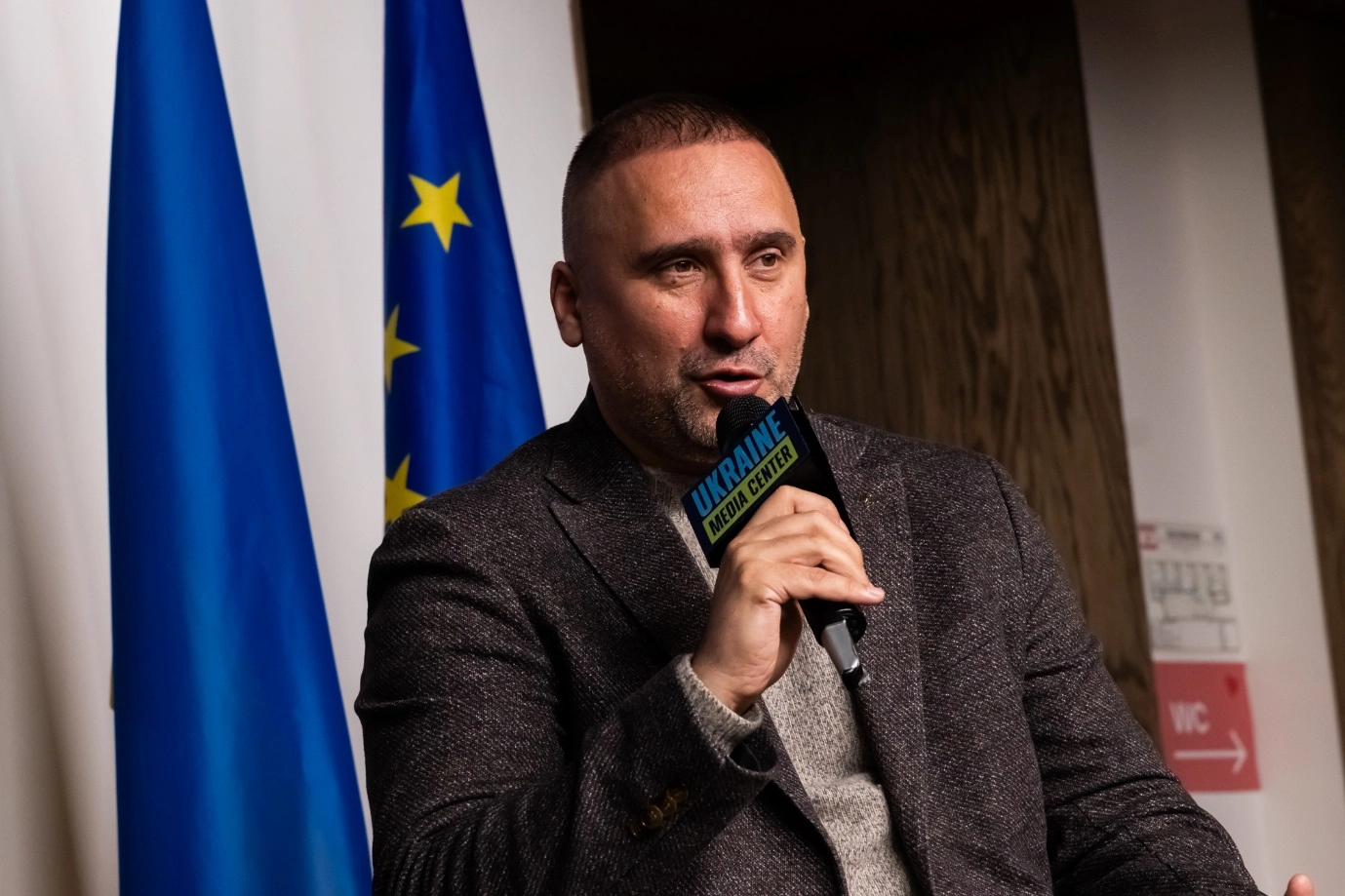
Ihor Solovey, head of the Center for Strategic Communications and Information Security, provided thematic analysis of the work. (Image courtesy of Media Centre Ukraine)
“The White Book” is especially strong when it explains how that vulnerability has been exploited inside Ukraine itself. Its discussion of Viktor Medvedchuk’s media ecosystem is one of the most instructive sections in the volume. Russia, the book argues, spent years building multifaceted influence networks in politics, media, academia, religious institutions and civil society, often hiding political goals behind the language of business ties, culture or free speech.
Medvedchuk’s television channels, it says, prepared the ground for invasion by normalizing Kremlin narratives while presenting themselves as independent or oppositional voices. Any state attempt to restrict them could then be cast as censorship. It is an object lesson in how authoritarian influence learns to wear the vocabulary of liberalism as camouflage.
Yet the launch was not presented in any language of victimhood. Dovzhenko stressed that the book’s account of Ukrainian resistance is just as important as its catalogue of manipulation. “It shows that we are not a victim being beaten,” he said. “We are, in principle, sufficiently agentic, capable of resisting, able to use different tools, to act systemically, to block Russian disinformation, to refute Russian disinformation.”
“The White Book.” (Image courtesy of Media Centre Ukraine)
That matters, because much foreign coverage of information war still treats Ukraine chiefly as a target. “The White Book” argues that Ukraine is also one of the world’s most important laboratories of democratic self-defense.
There is an urgency to that claim. At the end of his remarks, Dovzhenko warned that the job is already incomplete.
Russian disinformation and Russian influence, he said, “do not stand still”. By the time researchers think they have described and structured them, those systems have already “moved on, wriggled out, changed form, found new cracks” through which to influence Ukrainian society and others as well. In other words, the book is significant partly because it is not complacent. It is an attempt to spotlight moving targets long enough for the rest of the world to learn from it.
Why all this matters for the target audience
“The White Book” is not written purely for specialists in Ukraine. It is explicitly intended as an essential practical resource for policymakers, journalists, analysts, ambassadors, politicians and researchers.
It is designed to help people recognize how narratives are engineered, how they travel, who amplifies them and which audiences they target.
Frolova noted that English-language copies are already being distributed to diplomatic missions and partner organizations, while electronic versions are being shared more broadly. The goal is as pragmatic as it is political: to make sure that those encountering Russia’s information war from outside Ukraine no longer do so blindly.
That may be the deepest significance of “The White Book.” It is an attempt to convert Ukrainian experience into shared democratic knowledge. Not all countries will face Russian propaganda in the same form as Ukraine has. But the methods outlined here – emotional saturation, historical falsification, moral inversion, covert influence dressed up as debate, platform-driven manipulation, the exploitation of “free speech” by those who seek to destroy it – are not uniquely Ukrainian experience but problems challenging the entire democratic world. They are features of a wider political climate in which authoritarian states try to make truth seem relative, evidence partisan and democratic societies too confused to defend themselves.
Books do not stop missiles. They do not dismantle troll farms or sanction propagandists. But they do something essential by naming the system clearly enough that others can no longer pretend not to see it. In that sense, the launch of “The White Book” was not just a publishing event in Kyiv. It was a warning from the front line of the information war, and an invitation to the rest of the democratic world to stop treating propaganda as background noise and start treating it as the powerful weapon Ukraine has long known it to be.
Once we understand the information war, the rest falls into place and our efforts can be directed most effectively.