
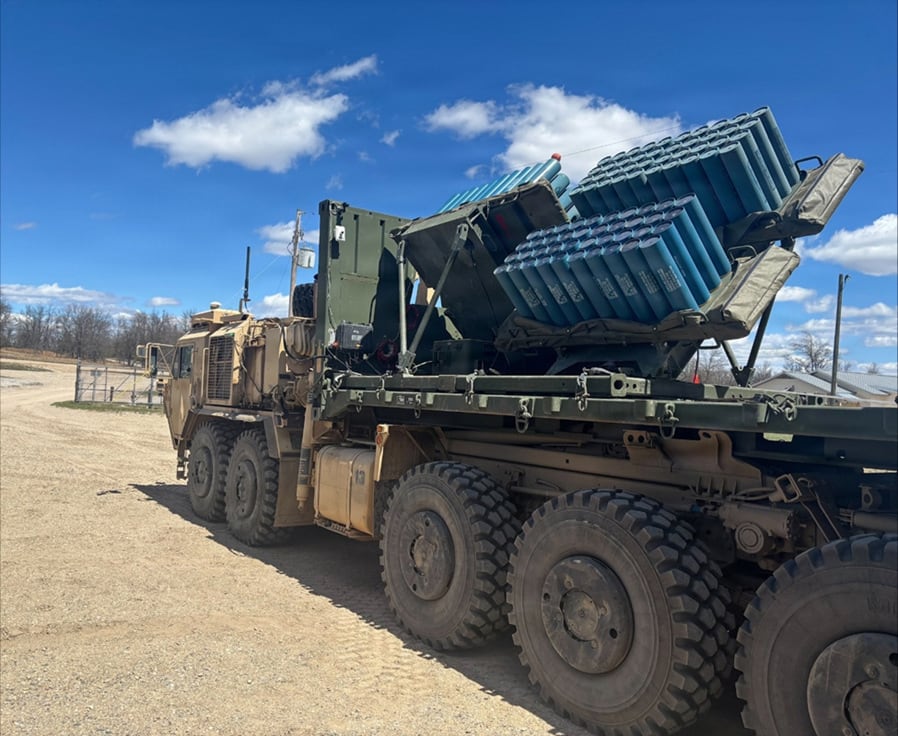
When mounted to a vehicle, the U.S. Army’s Volcano mine dispenser can blanket roughly 32 acres with up to 960 mines. Now, the service is testing a system that can do the same thing without a driver behind the wheel.
During May demonstrations at Camp Grayling, Michigan soldiers remotely fired the Autonomous Volcano for the first time before later having it lay two separate minefields without human assistance, Picatinny Arsenal announced Tuesday.
The test represents the Army’s latest move to modernize legacy equipment, systems tactics and munitions with emerging technology. In the combat engineering world, the service is experimenting with using unmanned aerial systems to drop grappling hooks, and it is trying to send drones — instead of humans — into the breach.
The Army has also tested autonomous vehicles for mortar resupply and autonomous boats for information gathering.
The autonomous Volcano variant paired the service’s decades-old M139 Volcano dispenser with a driverless Palletized Load System truck — an upgrade designed to keep combat engineers out of danger. The system also automatically logs locations and uploads it to the Army’s shared battlefield map, or common operating picture.
Soldiers from 4th Engineering Battalion remotely fired inert mine canisters from the dispenser in the demonstration’s first live-fire scenario. Then, the system autonomously and simultaneously emplaced two minefields.
“Autonomous Volcano leverages low-cost modernization to turn a legacy platform into a high-yield autonomous asset — securing asymmetric overmatch and closing a critical area-denial gap,” Col. Vinson Morris, who oversees the Army’s project manager for close combat systems, said in a statement.
The project was developed jointly by the U.S. and United Kingdom, according to the release, with defense contractor Forterra integrating the existing Volcano mine dispenser onto the automatic vehicle.
The Army plans to test the system in a series of realistic battlefield scenarios later this month.
Eve Sampson is a reporter and former Army officer. She has covered conflict across the world, writing for The New York Times, The Washington Post and The Associated Press.

