
Commercial orders for the Military Sealift Command (MSC), the backbone of global U.S. Navy operations, can rapidly close the U.S. Navy’s logistics shortage concerns in the Pacific.
The U.S. Navy’s newly established Portfolio Acquisition Executive (PAE) Maritime office has started a search for commercial tankers to fill the service’s shortage of logistics ships, pushing a “non-developmental vessel” class that has already completed functional design, according to documents published last week.
The Navy is searching for both complete ship designs and shipyards that can facilitate the construction of such designs, including the current limitations of yard workforces and orderbooks, for the next 3-8 years.
The medium-range tankers will serve a minimum 230,000 barrels of various fuel types in the consolidated cargo replenishment at sea (CONSOL) mission, which the fleet tested last year with the USS Tripoli and a contracted commercial ship, M/V Empire State. “The ability to CONSOL allows Navy ships to stay at sea and get fuel instead of needing to go into port,” said Capt. Joseph A. Riendeau, M/V Empire State’s civilian master, at the time.
“The ability to take fuel from a tanker ship like Empire State allows ships, to stay at sea to refuel, rather than to come into a commercial fuel pier in port. The concept was developed to keep United States Ships out of foreign ports during times of conflict.”
U.S. NavyCommercial-spec, complete designs will allow the Navy to rapidly expand its current inventory of logistics and refueling platforms which have come under pressure as the fleet expands operations in the Pacific. A growing gap between the Military Sealift Command’s available oilers and the Navy’s demands for distributed operations in the Indo-Pacific have put a focus on recapitalizing the backbone of the fleet.
Not just for underway replenishment but for allied operations across a number of new airfields being rebuilt across the vast expanse of the Pacific Ocean—some of which have no organic fuel distribution and storage systems. Commercial tankers can pull into expeditionary ports to unload critical fuel supplies for supporting services, especially in places like Saipan and Tinian that will serve at the forefront of U.S. Air Force operations during a potential conflict.
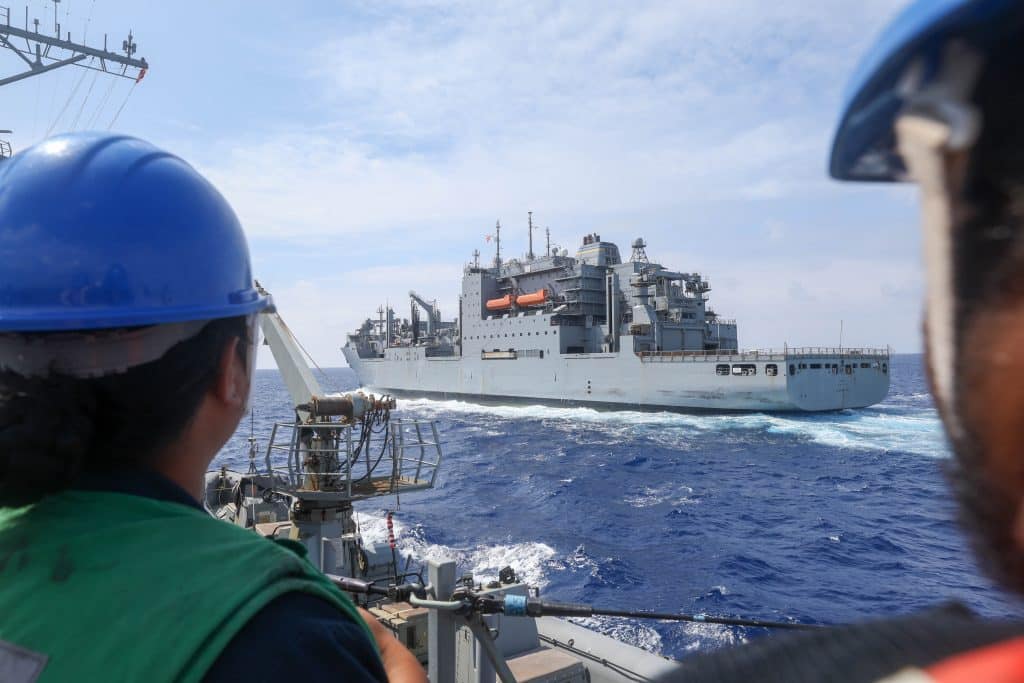
In 2022, during Exercise Rim of the Pacific, the M/T Maersk Perry, a commercially-operated tanker, delivered JP-5 aviation fuel and diesel to the USNS Henry J, Kaiser (T-AO 187), USNS Pecos (T-AO 197), and USNS Washington Chambers (T-AKE 11) during CONSOLS-at-sea. The service has since expanded those operations across the world, supporting underway MSC ships that refuel U.S. Navy ships at sea.
The U.S. Navy has been steadfast in rapidly expanding its number of hulls, including the cancellation of the Constellation-class guided missile frigate, in favor of the smaller, more producible FF(X) program. The added potential force of CONSOL tankers, which the Navy has been leveraging since 2015 to fuel its current fleet of MSC-operated USNS fleet replenishment oilers, can alleviate the service’s fuel and logistics shortage concerns, especially with a force that intends to stay out of port during combat operations.