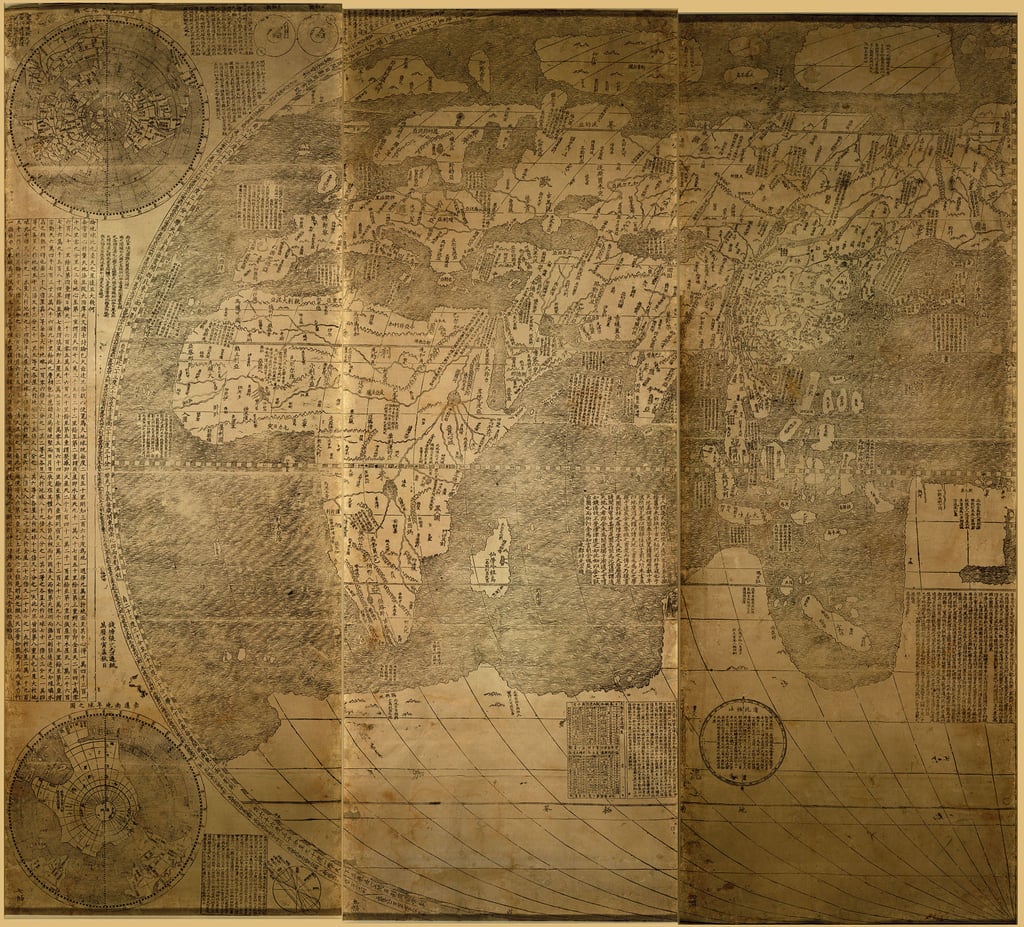
Scholar and author Sheng-Wei Wang discusses how studying an ancient Chinese world map led her to conclude China explored and mapped the world before the European Age of Discovery and how the legacy of colonialism and a Eurocentric record of global history continue to affect power dynamics today.
What first made you suspect that it was Chinese explorers and not Europeans who launched the true Age of Discovery?
The European Age of Discovery followed Christopher Columbus’ landing in the Americas, which occurred in 1492. However, many of the European maps in that period, or even before that, already showed places that the Europeans had not yet explored.
We know that the map records the situation at the time of its being drawn and maybe even further in the past, but maps cannot predict the future. Even the most serious scholars agree that the forward-looking anomaly of these European maps is an enigma that has not been resolved.
Furthermore, the big missing part is that the Eurocentric narratives talk about the European sea powers, but what about China’s role? Before the European Age of Discovery, or in the pre-Columbian era, China was the strongest sea power in the whole world. We have books written on that, not only by Chinese but also by Western scholars to show how impressive China’s sea power was.