8 hours ago
Vitaly ShevchenkoRussia editor, BBC Monitoring
Ukraine has embarked on a programme to deploy armed robots on the battlefield against Russian forces.

8 hours ago
Vitaly ShevchenkoRussia editor, BBC Monitoring

 Tencore
Since the start of Russia's full-scale invasion, the war in Ukraine has developed into a high-tech conflict.
Swarms of spy and killer drones have set the skies of Ukraine abuzz, and uncrewed boats have crippled the Russian navy in the Black Sea.
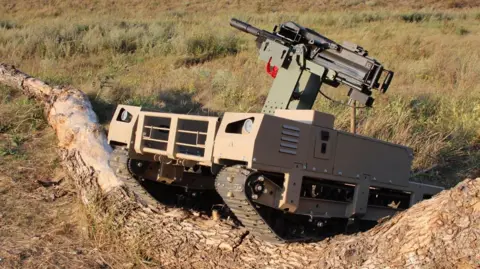
Now, Ukraine has embarked on a massive programme to deploy armed robots on the ground.
Uncrewed ground vehicles (UGVs), or ground robot systems as they are known in Ukrainian military parlance, have already proven their worth.
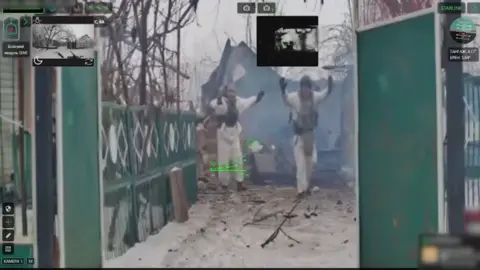
There have been reports of UGVs successfully repelling Russian attacks and even taking enemy soldiers prisoner.
Ukrainian and Russian killer robots are even said to have clashed without humans being present at the site of the battle.
"Robot wars are already happening," says Oleksandr Afanasiev from the Ukrainian army's K2 brigade. He commands its UGV battalion - the world's first, he says.
One way in which the brigade has been using these robots is by mounting Kalashnikov machine guns on top.
"They open fire on a battlefield where an infantryman would be afraid to turn up. But a UGV is happy to risk its existence," Maj Afanasiev says.
 Devdroid
His battalion has also been using explosive-laden, battery-powered kamikaze UGVs to blow up enemy positions and hideouts.
Unlike aerial drones that buzz overhead, they make no sound to warn the enemy of an impending strike.
The deputy commander of the 33rd Detached Mechanised Brigade's tank battalion, who goes by the callsign Afghan, claims that one Ukrainian UGV armed with a machine gun ambushed a Russian personnel carrier, while a robot defended a Ukrainian position for weeks.
Afghan admits there are limits to the killer robots' autonomy on the battlefield, and says many of them are self-imposed, because of ethics and international humanitarian law.
"Modern UGVs are part-autonomous. They can move on their own, they can observe and detect the enemy. But still, the decision to open fire is made by a human, their operator," Afghan says.
"Robots can misidentify the wrong person or attack a civilian. That's why the final decision must be made by an operator."
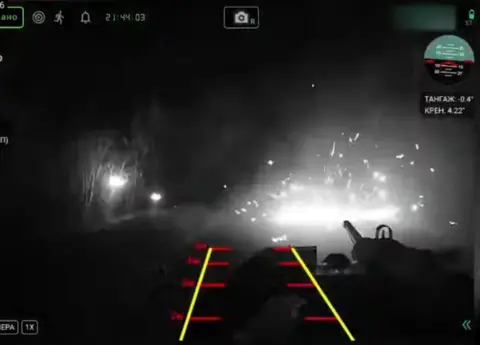
Which means that in most cases on the battlefield armed UGVs are remote-controlled by operators over the internet from a safe distance.
Ukraine's lethal UGVs can be armed with grenade launchers as well as machine guns, and can also be deployed to plant landmines or barbed wire.
But the vast majority of its uncrewed vehicles are still used for their original purpose of delivering supplies and evacuating the wounded.
The role of armed UGVs will soon grow exponentially, according to Valerii Zaluzhnyi, Ukraine's former commander-in-chief and now ambassador to the UK.
Speaking at the London think-tank Chatham House about the future of warfare, he described how strike UGVs would be used not just on their own, but as part of large, AI-powered swarms of drones.
"In the near future we'll see dozens and even hundreds of smarter and cheaper drones attack from various directions and heights, from the air, ground and sea at the same time," he said.
 Devdroid
Necessity is a key factor driving innovation in this field. Drones in the air have made it infinitely more dangerous for humans to be present on the battleground, expanding Ukraine's so-called "kill zone" to 20-25km (12-15 miles) from the line of contact.
Infantry is not replaceable but "it needs to be supported by UGVs", says Maj Afanasiev: "Ukraine can afford to lose robots, but it simply cannot afford to lose battle-ready soldiers."
The Ukrainian army has been facing severe manpower shortages, and recruiting new soldiers behind fallen ones is proving increasingly more difficult.
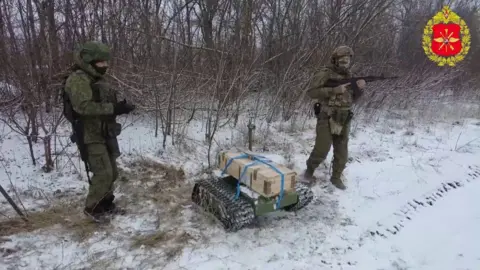
Russia has also been developing combat UGVs, such as the Kuryer. According to Russian media reports, it can be equipped with a flame-thrower, a heavy machine gun normally found on tanks, and it can run autonomously for five hours.
The Russian army has also been using Lyagushka ("Frog") kamikaze vehicles to blow up Ukrainian positions.
Clashes between Russian and Ukrainian killer robots on the battlefields of Ukraine are a matter of time given their increasing numbers and capabilities, says Yuriy Poritsky, CEO of Ukrainian UGV manufacturer Devdroid which produced hundreds of "strike droids" for the military last year.
 Russian Defence Ministry
"Sooner or later, we'll end up in a situation where our strike UGV will come up against their strike UGV on the battlefield. Robot wars may sound like science fiction, but there's nothing sci-fi about the battlefield. It's our reality," he says.
His company is now working on a system that would enable its ground drones to return should communications with the operator be lost.
Further ahead in the future, it wants its machines to be programmed to travel autonomously to a location, carry out its task - such as watching out for advancing enemy soldiers and engaging them if necessary - and then return to base after a certain time.
Another Ukrainian manufacturer of UGVs, Tencore, produced more than 2,000 UGVs for the Ukrainian army in 2025.
Its director, Maksym Vasylchenko, expects demand to jump to around 40,000 units in 2026, at least 10-15% of them armed with weapons.
"Strike drones [UGVs] will become indispensable, there's no question about it," he says.
Further ahead, Vasylchenko believes robots will engage in combat in human form: "It won't be science fiction anymore."

On the night of March 7, Russia carried out another massive attack on Ukrainian settlements, damaging residential and critical infrastructure.

A primary school teacher from secondary school No. 6 and her son, a second-grade student aged about 7 or 8, were killed in their home in a Russian attack on Kharkiv on the night of 6-7 March.

Masoud Pezeshkian vowed continued resistance as the regional conflict entered its second week, while apologizing to neighboring states hit by Iranian strikes and pledging to avoid further attacks.

According to preliminary information, Russians struck a building in Kharkiv with an Izdeliye-30 missile.