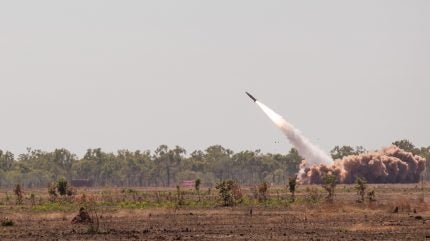
UK Minister for Defence Readiness and Industry Luke Pollard confirmed that contracts have been signed under Project Nightfall.
Army Technology
75
3 min read
0 views
Defence Minister confirms contracts have been signed to deliver tactical ballistic missiles to Ukraine.
US Army units firing an ATACMS missile in Australia in 2023. Credit: US DoD
UK Minister for Defence Readiness and Industry Luke Pollard confirmed that a number of contracts have been signed under Project Nightfall
The weapon, it is said, will be resistant to electromagnetic interference
Companies involved will be announced “shortly” with no reason for the delay given
The UK announced that contracts have been signed with companies to develop tactical ballistic missiles (TBM) in Britain for Ukraine’s forces nine months after the Government initially called for bids.
In a parliamentary written statement on 22 May, the Minister for Defence Readiness and Industry Luke Pollard said that the winners will be announced “shortly.”
Discover B2B Marketing That Performs
Combine business intelligence and editorial excellence to reach engaged professionals across 36 leading media platforms.
Find out more
Such a delay coincides with the routinely delayed Defence Investment Plan – a document that will provide a cost breakdown of priority programmes – which the Government pledged would cover all details of the acquisition and long-term scaling of advanced strike systems.
This could indicate the imminent release of the real data behind UK defence strategy.
Nightfall TBMs will reach more than 600 kilometres, carry a 200-kilogramme warhead, and cost no more than £800,000 ($593,000) per unit.
Nightfall difficulty
Nevertheless, British companies are already working closely with Ukraine, adopting their weapon designs and building them in the UK. This includes Octopus drone interceptors, of which there are supposedly a thousand units produced each month.
But Nightfall will prove more challenging. The Government require the winning industry team to deliver at least ten missiles per month.
A TBM must survive under extreme thermodynamic stress, which requires specific materials to overcome the issue. More than that, the requirements also stipulate resistance against electromagnetic interference. This will likely incorporate novel navigation technologies whereas existing Western munitions have relied on satellite signals deeply susceptible to Russian jamming.
In 2023, for example, expert analysis noted the effectiveness of Russian jamming against Ukraine’s Joint Direct Attack Munitions supplied by the United States.
The use of another TBM in Ukraine, the US-made Army Tactical Missile System (ATACMS), uses a GPS receiver continuously during its flight time to achieve pinpoint accuracy. However, according to the federal register, the M57 ATACMS are aided by a Selective Availability Anti-Spoofing Module.
TBMs in action
Ukraine has acknowledged the effectiveness of TBMs by recognising that its forces should also be able to counter them.
Today (26 May), Ukraine’s President Volodymyr Zelenskyy accepted that anti-ballistic capabilities are now in short supply globally, which he attributed to the US war against Iran, wherein THAAD and Patriot systems are dotted around a number of Gulf countries, and for which there is no better substitute.
“But we must look for solutions” nonetheless, the head of state maintained.
According to the Institute for the Study of War, footage of the Oreshnik strike against Kyiv City showed six submunition clusters of multiple independently targetable reentry vehicles with each cluster carrying six kinetic rods.