
French President Emmanuel Macron today unveiled the official name of France’s next-generation nuclear-powered aircraft carrier (CVN) during a ceremony at a Naval Group site near Nantes. The vessel, until now designated under the program title Porte-Avions de Nouvelle Génération (PANG), will henceforth bear the name France Libre.
After the fall of France in June 1940, Free France (France Libre) became the government-in-exile and the resistance movement that refused to accept the armistice with Nazi Germany. Led by Brigadier General Charles de Gaulle, it transformed from a small group of “rebels” in London into the legitimate provisional government that led France to liberation.
French president Emmanuel Macron explained his choice for the name during his address:
“I wished to place our future aircraft carrier in the lineage of General de Gaulle. His life, his destiny, and the choices made as early as June 1940 following the collapse—these speak to a certain idea of France. For him, and for us. The French spirit. It is a spirit of resistance. It is a will that nothing can stop.
A will to resist in order to remain free. An irreducible, invincible will on national territory or elsewhere in the face of occupation. A will which, like our aircraft carrier, can take to the seas if necessary until victory is achieved. The will to remain free—yes, that is it. The great project that is ours. The one that binds us.
The project of our armed forces, but also of our research, of our national industries. This will to remain free is the will for independence at all costs; for total, unconstrained autonomy of action; for the projection of our forces wherever the defense of France’s interests demands it, anywhere in the world.
That is why our new aircraft carrier will bear the name ‘France Libre’. Within this name lives the memory of the women and men who stood up against barbarism. United to save the fatherland. Determined to defend a certain idea of our nation. To the Companions of the Liberation, this name seals a vow for the future: To remain free, we must be feared. To be feared, we must be powerful. And to be powerful, we must be ready for effort. In these efforts, let us be irreducible. United. And relentless. Power. Independence. Resistance. Yes. It is by serving the fatherland that we shall achieve victory.”
The naming event follows Macron’s December 2025 decision to greenlight the carrier’s realisation phase, which formally concluded over five years of design development jointly led by MO Porte-Avions — the industrial joint venture between Naval Group and Chantiers de l’Atlantique — along with TechnicAtome, which is responsible for the ship’s nuclear reactors.
With 310 meters in length and roughly 90 meters at the beam, the 80,000-tonne France Libre will dwarf its predecessor, the 42,000-tonne Charles de Gaulle, which has served as the Marine Nationale‘s sole carrier strike platform since 2001. Power will come from a pair of TechnicAtome K-22 pressurized water reactors, granting the vessel virtually unlimited range and endurance at speeds of up to 27 knots via three shaft lines. Crew complement (including air wing) is set to be about 2,000 sailors.
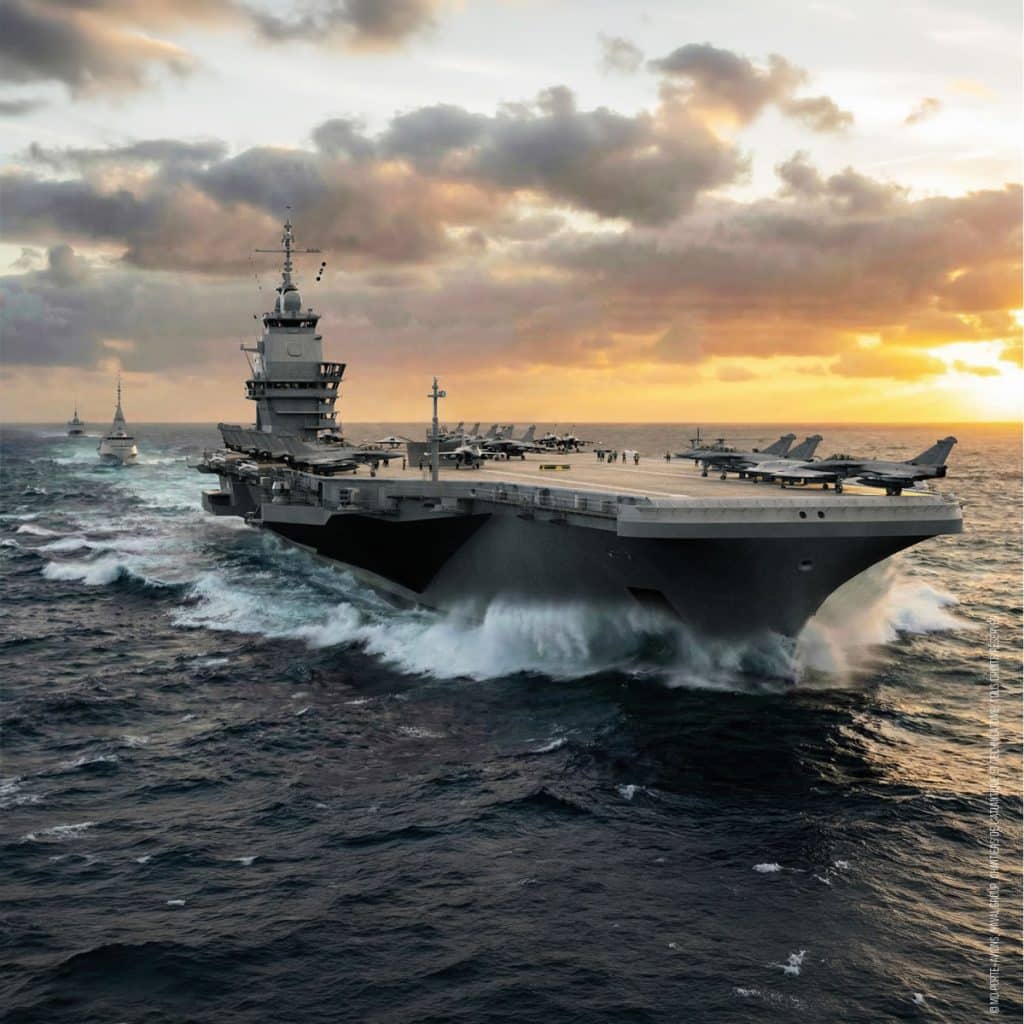
A defining feature of the new carrier is its adoption of the U.S.-origin Electromagnetic Aircraft Launch System (EMALS) and Advanced Arresting Gear (AAG), supplied by General Atomics under a Foreign Military Sales agreement. Three EMALS catapult tracks and three AAG arresting wires will equip a 17,200 m² angled flight deck, enabling simultaneous launch and recovery operations — a capability not available on the Charles de Gaulle. This layout is expected to significantly increase sortie generation rates during high-intensity combat operations (about 60 daily sorties).
The France Libre is designed to embark an air wing of approximately 30 combat aircraft, initially centred on the Dassault Rafale M in its F5 configuration, complemented by three Northrop Grumman E-2D Advanced Hawkeye airborne early warning aircraft and up to six NH90 Caïman helicopters. Looking further ahead, the carrier’s air group is projected to integrate unmanned combat air vehicles and, by the mid-2040s, the Next Generation Fighter (NGF) being developed under the Franco-German-Spanish Future Combat Air System (FCAS) program. This is at least still the plan as of today, despite growing tensions between Dassault and Airbus which could to lead to France and Germany parting ways (or designing their respective NGF).
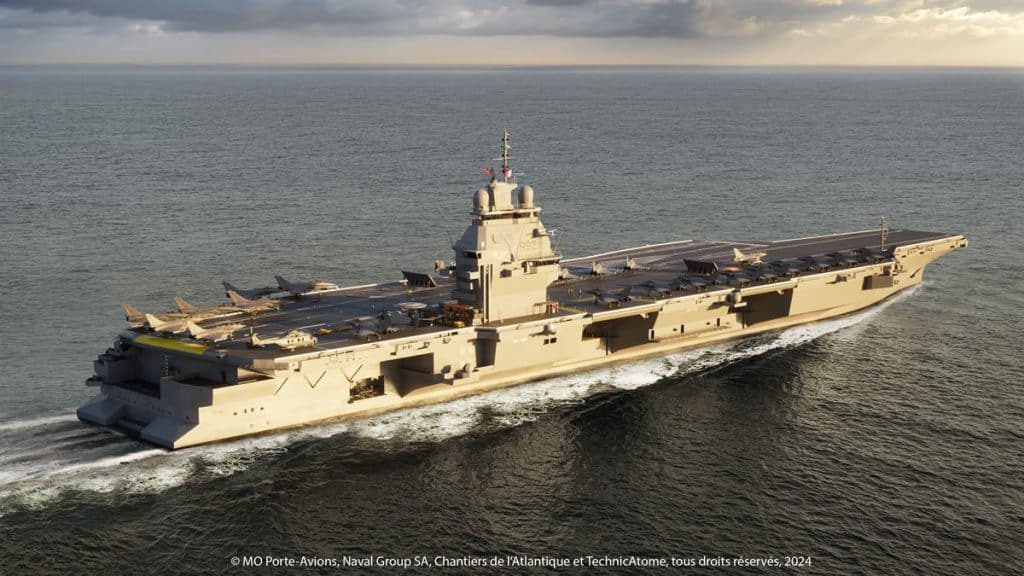
Below deck, the ship incorporates full electrification of onboard systems, a hangar served by two 40-tonne starboard-side elevators, and munitions storage engineered for sustained operations exceeding seven days at high tempo — a marked improvement over current French carrier logistics.
Construction of the France Libre is set to begin with hull assembly at Chantiers de l’Atlantique in 2032, before the vessel transfers to the naval base at Toulon for final outfitting and nuclear fuelling in mid-2035. Sea trials are scheduled for 2036, with commissioning into the Marine Nationale targeted for 2038, at which point the Charles de Gaulle is expected to begin its withdrawal from frontline service. The France Libre is expected to remain in service for about 45 years.
The program mobilizes some 800 suppliers and up to 14,000 jobs across the French defence industrial base, of which 80 percent are small and medium-sized enterprises, underscoring the project’s significance not only as a pillar of national defence strategy but also as a driver of high-technology manufacturing employment across multiple regions. Over 90% of the program’s procurement is sourced from French suppliers. The cost of France Libre is about 10 billion Euros according to the French president.


