North Korea’s practical teaching push lays bare Pyongyang-provincial education gap
A North Korean Ministry of Education showcase intended to model a new hands-on teaching approach at vocational colleges ended up drawing more attention to the wide gap in facilities between Pyongyang and the provinces, a source told Daily NK on Monday. The Ministry of Education oversees the country
Daily NK
75
5 min read
0 views

A North Korean Ministry of Education showcase intended to model a new hands-on teaching approach at vocational colleges ended up drawing more attention to the wide gap in facilities between Pyongyang and the provinces, a source told Daily NK on Monday.
The Ministry of Education oversees the country’s school and university system and has been pushing to reform vocational and technical education in line with the regime’s broader economic development goals.
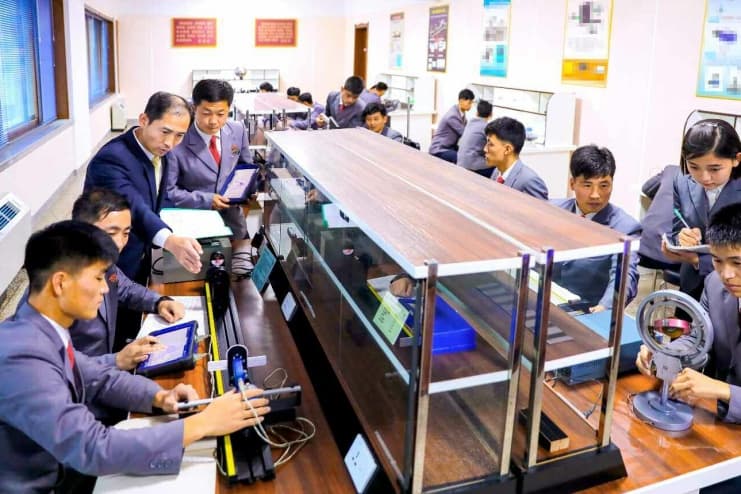
According to a Daily NK source in North Korea, the ministry held a two-day instructional demonstration on June 3 and 4 at Pyongyang University of Economics and Technology. Officials and teachers from vocational and technical colleges across the country were brought in to observe a model class and then take part in discussions evaluating whether the teaching method could be applied at their own institutions. In North Korea, this kind of structured instructional observation session is known as a “method-study” event, a format used to spread approved teaching practices across educational institutions.
The demonstration featured a computer simulation exercise in which students were tasked with diagnosing a production problem at a hypothetical factory and then adjusting the manufacturing process to resolve it. The ministry presented the format as an effective way to develop graduates capable of addressing real-world operational and management challenges, rather than simply memorizing theory.
The source said the push to expand this type of instruction is linked to the regime’s “Local Development 20×10 Policy,” a national initiative launched under Kim Jong Un to develop factories and infrastructure across 20 provincial cities over 10 years. Officials have identified a shortage of technically skilled and management-capable workers as an obstacle to that effort, and the new curriculum approach is intended to produce graduates who can be deployed directly to local industrial sites.
“The Ministry of Education has concluded that teaching only economic theory cannot produce the talent that local industry needs,” the source said. “Incorporating practical management tasks like production planning, materials distribution, and logistics into the curriculum is coming from that same concern.”
Gap in conditions, gap in outcomes
Despite those goals, teachers from provincial institutions raised serious doubts about whether the model could realistically be applied outside Pyongyang. A significant number of vocational and technical colleges in the provinces lack the computers and other equipment necessary to replicate the kind of simulation-based instruction demonstrated at the capital’s showcase university.
The source said the mood among participants was telling. “A lot of people were saying, ‘If only our university had conditions like this, we could also produce the kind of talent the workplace demands.'”
The observation session was meant to introduce a new teaching method, but what registered most strongly was the contrast in learning environments. “There was certainly interest in the student-centered problem-solving approach,” the source said, “but what really caught people’s attention was the high-performance computers, the multifunctional educational software, and the computerized practice systems. People came to learn a new teaching method and ended up feeling the gap between Pyongyang and provincial universities even more sharply.”
The Ministry of Education has signaled its intention to roll out this style of instruction at vocational and technical colleges nationwide following the demonstration. But teachers from the provinces said that simply mandating adoption without addressing the underlying equipment shortages would produce no meaningful results.
“There’s broad agreement with the direction of training students to be practical, work-ready graduates,” the source said, “but the conditions aren’t there. The gap between Pyongyang and the provinces is one thing, but there are also significant gaps among provincial universities themselves. The assessment from those on the ground is that applying a single teaching method uniformly across all of them is not realistic.”
A Note to Readers


