19 hours ago
Paul GlynnCulture reporter
The French-Iranian author and illustrator was known for her graphic novel series and Oscar-nominated film.

19 hours ago
Paul GlynnCulture reporter

 Getty Images
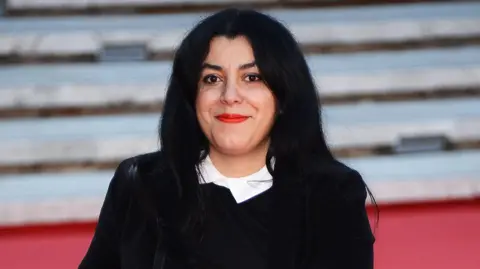
She "captivated a global audience with Persepolis", the palace said, calling her "a leading figure in French culture and an artist devoted to freedom, whose work carried a universal message and earned her immense international renown".
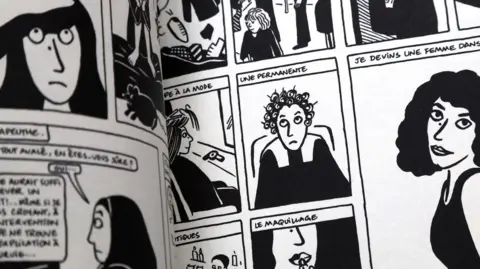
Persepolis, first published in 2000, follows the story of young Marjane growing up amid the Iranian Revolution, also known as the Islamic Revolution. Eight years later, the film adaptation was nominated for best animated feature at the Oscars, having been co-directed by Satrapi.
News agency AFP quoted a "member of her close circle" as saying she had "died of sadness a little over a year after the death of Mattias Ripa, her husband and the love of her life".
 Getty Images
France President Emmanuel Macron paid tribute to "a great artist who transformed an Iranian childhood into a universal fable".
The palace added: "With her childlike perspective, her irony, her tenderness, and her inner demons, the author created a deeply moving world with which readers identified."
Satrapi was an outspoken critic of Iran's government, and Persepolis - her graphic novel memoir-turned bestseller - depicts her childhood in the Iranian capital of Tehran, struggling under the rules imposed by Iran's Islamic leadership following the 1979 revolution.
It then goes on to follow her as she is sent to Europe by her parents to begin a life in exile.
Satrapi told the Guardian in 2024 that Persepolis was about making western readers reflect on the humanity of Iranian people, and to realise: "Oh, they're actually human beings like us".
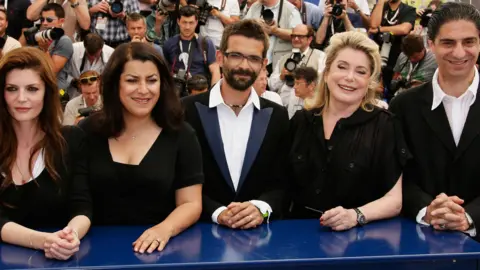
The film version stars Chiara Mastroianni as the voice of young Marjane and Catherine Deneuve as her mother.
President of the French National Assembly, Yaël Braun-Pivet, posted on X that France had lost "an immense artist".
She said: "Marjane Satrapi had turned her work into an act of freedom. With Persepolis, she had given a face and a voice to the Iranian revolution, proudly carrying the fight for women's freedom and dignity."
 Getty Images
Satrapi studied in Austria for four years as a teenager at the prestigious Lycée Français de Vienne.
She returned home for a period, after a serious bout of bronchitis, to find a much changed Tehran - as depicted in the second book in the Persepolis series.
She gained a master's degree in visual communication from the Islamic Azad University in Tehran, and also married but then divorced.
Her parents urged her to leave Iran and return to Europe, which she did, moving to France to further her education at the Haute School Arts Du Rhin in Strasbourg.
After more than a decade in the country, she gained French nationality in 2006, but last year refused the French legion d'honneur - the French equivalent of an OBE - over what she called her beloved adopted country's "hypocrisy" in its dealings with her home nation.
 EPA-EFE/REX/Shutterstock
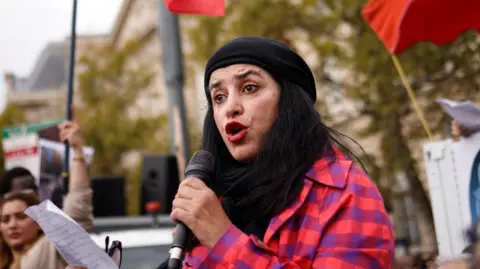
The artist supported protests for freedom and rights against the regime in Iran.
And she created Woman, Life, Freedom, a collection of graphic stories about the protests in 2022, following the death of Mahsa Amini, who was arrested by the morality police for not wearing her hijab properly.
Satrapi told Deadline at the time how her parents had previously taken to the streets to protest the regime's imposition of the hijab for women in 1983.
"He was one of the very few men; they didn't understand at the time that women's rights are society's rights," she said of her father.
She also revealed she had received threats and slurs from the regime regarding Persepolis and her activism.
"I've been called a liar and a spy. I've learned in life not to be scared," she said. "It's not that you don't feel fear; you feel the fear, but then you decide whether you care about it or not.
"It's not that I'm fearless or careless but there are kids in my country who are being shot and they are 17 years old, while I have lived for more than half a century."
"We artists must be humble but doing nothing is worse, being indifferent is worse," she said. "I don't think what I'm doing is huge or immense but I have a voice, I have a face and I'm known in France, I'm just doing what I have to do."
Satrapi told the BBC in 2024: "If you take the art and culture out from any society, this society falls down."
Her other film credits included 2014 horror comedy The Voices, starring Ryan Reynolds as a factory worker with schizophrenia, whose hallucinations drive him to commit murder.
She also directed Radioactive (2019), a biopic of the pioneering Polish-French physicist and chemist Marie Curie, starring Rosamund Pike; as well as Poulet aux Prunes (2011) and La Bande des Jotas (2012). Her other novels include Embroiderie and Woman, Life, Freedom.
Satrapi's husband, a Swedish producer, actor and screenwriter, died last year and she recently published a series of heartfelt Instagram posts saying: "For I Lost the love of my life".

Former Ukrainian Foreign Minister Dmytro Kuleba said Zelensky’s open letter to Putin was aimed not only at the Kremlin leader, but also at Ukrainians, US President Donald Trump and European allies. According to Kuleba, the letter’s central message was Ukraine’s confidence in victory and its willingn

The US House of Representatives approved the Ukraine Support Act by a vote of 226-195. The vote represents the first major Ukraine legislation to advance over White House resistance since Trump’s return to power in January 2025 and one of the most important congressional challenges to his foreign po
A tanker and two cargo ships in Taganrog Bay in the Sea of Azov, Russia's Krasnodar Krai, came under a drone attack on the morning of 5 June.

Ukraine's president tells the Russian leader that only "direct engagement" between the two countries could end the war, with the US focused on Iran.