Trump says he will visit India as frosty relationship with Modi thaws
16 hours ago
Sharanya Hrishikeshand
Anna Lamche

 Reuters
Trump made the announcement during chat where he also vowed to protect India.

16 hours ago
Sharanya Hrishikeshand
Anna Lamche
Reuters
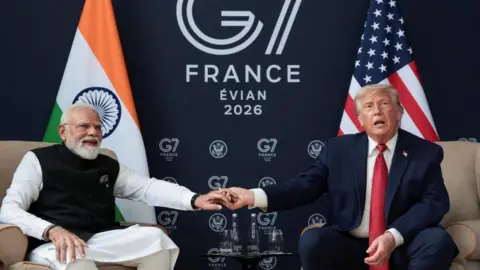
US President Donald Trump promised to visit India during a bilateral meeting at the G7 summit in France, signalling a thawing of relations between the two countries.
Trump said it would take place "sometime in the future", adding India and the US were close to agreeing a trade deal.
Relations between the two countries came under strain after Trump announced his plans to impose tariffs on India last year.
The sailors were killed in the Gulf of Oman in a strike after the US military targeted a tanker which it accused of violating its blockade on Iranian ports.
Indian Prime Minister Narendra Modi raised the safety of Indian sailors working in the Strait of Hormuz with Trump during their meeting at the G7 summit.
The pair also discussed their efforts to reach a trade deal - negotiations which were set back by a recent US announcement about new import taxes on countries judged not to be doing enough to tackle forced labour, including India.
Speaking to reporters on Wednesday, Trump called Modi a "tough negotiator", and pledged to visit the country soon.
Trump has been expected to visit India for several months now, potentially as part of a Quad meeting with Japan and Australia.
Questioned on the US-India defence relationship, Trump said America would "help" India if they were "attacked".
Referencing Modi, he said: "If anybody attacks that man, we're going to be there... Now, if there's a new leader, I'm not sure about it."
The meeting followed a period of heightened tension between the two nations. Delhi summoned a senior US diplomat twice last week following the killings of the Indian sailors and strikes on other tankers with Indian crew.
Domestically, Modi has been criticised by opposition parties for not directly condemning the US's actions and they have demanded that he raise the matter with Trump.
In a speech to G7 leaders on Tuesday, Modi mentioned the conflict in the Middle East, adding that "several Indian civilians" had lost their lives and that the safety of seafarers should be ensured.
"Today the world does not suffer from a shortage of resources; it suffers from a shortage of trust. And the future of our partnerships depends on building this trust," the prime minister said in remarks that some commentators in India linked to the meeting with Trump.
India imports about 90% of its oil and has been badly hit by the war in Iran and the closure of the vital Strait of Hormuz, through which about a fifth of the world's oil and gas supplies are normally transported.
Even if the strait reopens soon, global oil and gas supplies could take months to stabilise.
The meeting at the G7 marked a significant tonal shift in the relationship between Trump and Modi.
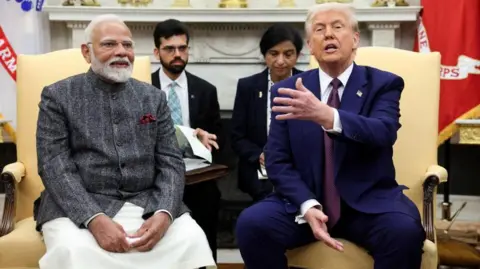
In February last year, Modi travelled to Washington for a meeting with Trump at the White House. Since then, they had several phone calls but Wednesday's meeting was their first scheduled interaction since Modi's US visit.
 Reuters
Officials are set to meet in Delhi next week to negotiate what India's commerce secretary has described as the "final touches" to the US-India trade deal.
India was among the first countries to open trade talks with the US last year, but the process has proven complicated.
At one point, the US imposed tariffs of up to 50% on some Indian goods before cutting them to 18% after the two countries agreed on an interim trade deal in February. The rates are currently at 10% after the US Supreme Court struck down many of Trump's tariffs, ruling them "illegal".
Over the past year, Delhi was also irritated by Trump's claims that he brokered an India-Pakistan ceasefire after a brief conflict in 2025 and his offer to mediate on Kashmir - a disputed region claimed by both countries.
Delhi rejects third-party mediation on Kashmir, and Modi "strongly" communicated this to Trump last year. In the months since then, Pakistan has managed to keep Trump on side, even playing the role of intermediary between Washington and Tehran in efforts to secure a peace deal.
Other sources of tension include the Trump administration's crackdown on immigration and restrictions on H-1B visas that have long been a pathway for skilled Indians to work in the US.
Following is an edited transcript of a conversation between John Mearsheimer, R. Wendell Harrison Distinguished Service Professor of Political Science at the University of Chicago, and South China Morning Post Executive Editor Zuraidah Ibrahim at the SCMP Plus exclusive: meet John Mearsheimer in per

The Middle East conflict has shaken up the global energy supply chain and Beijing needs to do more to protect shipments – such as finding alternative routes and boosting escort capabilities, according to industry analysts. Lu Ruquan, president of the China National Petroleum Corporation Economics an

Chinese ambassador to the United States Xie Feng on Wednesday proposed to increase the limit of tariff-free goods under the newly created US-China Board of Trade from the existing US$30 billion to US$300 billion – a 10-fold rise in non-sensitive trade covered by the mechanism. Addressing a gathering

The elevation of Senator Sherwin Gatchalian comes just weeks before the chamber is set to begin the impeachment trial of Vice President Sara Duterte.