
The U.S. Navy’s aircraft carrier fleet will receive a new round of funding as the iconic flattops will experience a limited shakeup in terms of continued service and procurement plans.
Within the recently release U.S. Navy’s shipbuilding plans under the Future Year Defense Program (FYDP), the carrier replacement program (the program to field the Gerald R. Ford-class of carriers to replace the aging Nimitz-class carriers) will receive roughly $4.07 billion in funding in Fiscal Year 2027, and a total of $22.34 billion stretching into FY 2031. The $22.3 billion allotted will provide $4.2 billion for advanced procurement relating to CVN-82 and $3.9 billion in advanced procurement for CVN-83.
Total CVN earmarked funding across the next 5 fiscal years is as follows; $4.067 billion for FY 2027, $4.822 billion for FY 2028, $5.358 billion for FY 2029, $5.027 billion for FY 2030, and $3.066 billion in FY 2031. Industrial base upgrades come in the form of $6.7 billion invested in the surface ship industrial base and a further $7.2 billion invested in Nuclear shipyard capability from fiscal years 2027-2031.
Additionally, the procurement of CVN-82 will be moved up by one fiscal year, transitioning from FY 2030 to FY 2029 with the acceleration fueled by additional funding. CVN-82 will be the Navy’s only new carrier to be procured within the FY 27 – FY 31 period, even despite the apparent re-prioritization given to the U.S. Navy’s primary strike asset.
Why the Aircraft Carrier ?
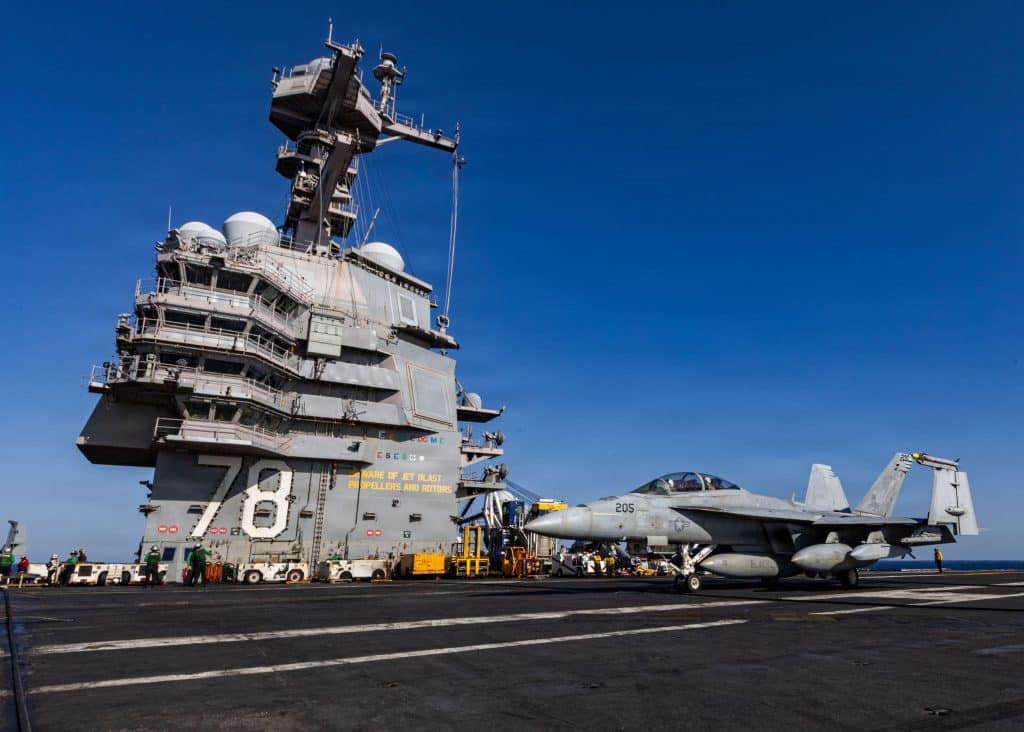
The glut of funding put towards aircraft carriers is likely due to the U.S. Navy’s re-assertion in it’s confidence in it’s carriers to continue to function as the Navy’s main striking force, even as threats posed to the floating airfields continue to advance. Of note is the backing of the Gerald R. Ford-class of vessels, with the Navy highlighting it’s design allowing for the launch and recovery of heavier 6th generation airframes and a total reduction of $5 billion in ownership costs associated with the Fords.
“Underpinning Expanded Maritime Maneuver (EMM) the CVN serves as a persistent, survivable, mobile sea base that enables the Navy to dominate contested environments and deliver decisive effects at ranges that outpace adversary anti- access/area-denial (A2/AD) envelopes without the need for Access, Basing, and Overflight.”
– Statement Revealing the Navy’s Reaffirmed Beliefs in Naval Dominance via it’s CarriersThe Navy’s associates it’s expanded emphasis on aircraft carriers with the 2025-2026 deployment of the USS Gerald R. Ford (CVN-78), and it’s demonstrated increase in capabilities. The Ford herself executed 10,500 fixed wing launch and recoveries over Operations Southern Spear, Absolute Resolve, and Epic Fury, and has met goals for sustained sortie generation rates.
Even as the Fords continue to come online, the U.S. Navy is also looking towards improving the current design, which will start with a new baseline established with CVN-82’s design. The stated rationale behind the design review is, “to further increase lethality, enhance survivability, and improve producibility, while also simplifying the design and potentially leading to decreased cost.” Despite these claims, it remains unclear what changes the design review will produce.
Carriers in, Carriers Out
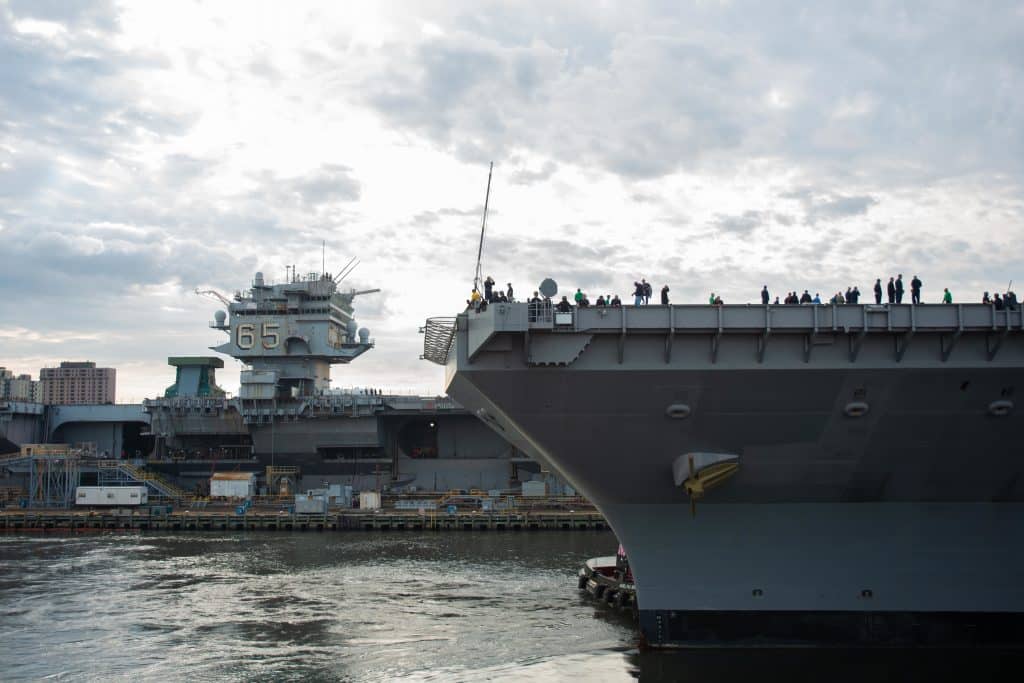
The U.S. Navy’s carrier availability rates may periodically drop due to Nimitz-class hulls being retired as the Fords continue to be slowly be inducted into service. By 2040, 4 carriers are scheduled to be delivered to the Navy, CVN-79 in 2027, CVN-80 in 2031, CVN-81 in 2034, and CVN-82 in 2039. However, in the same time frame, 1 U.S. Carrier will exit service for each one inducted (assuming there are no deviations from current projections), with the departure timeline leaving gaps in 2030, 2033, 2037, and 2038 where there are only 10 carriers in service.
Aircraft carrier sustainability is of particular concern to both Congress and Navy leadership, with previous Navy plans structured around maintaining a congressionally demanded minimum of 11 carriers, with the last instance of a 10 carrier Navy occurring between the commissioning of CVN-78 and the decommissioning of the USS Enterprise (CVN-65) in the early to mid 2010s. A 10 carrier Navy appears to be on the horizon again, placing further strain on what is perhaps the U.S.’s most in demand strategic asset.
