
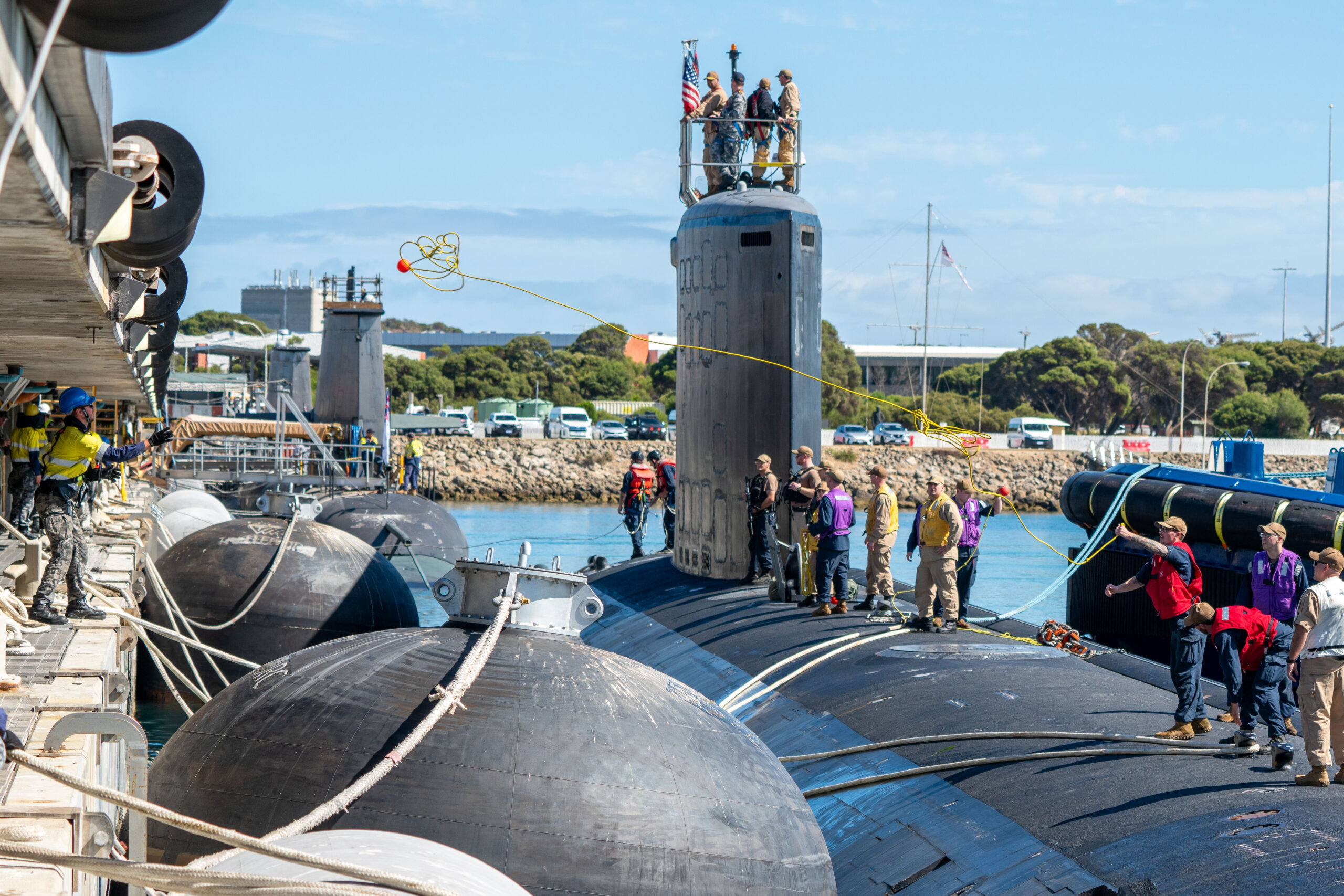
The U.S. will sell Australia three in-service Virginia-class submarines, pivoting from the planned acquisition of one new and two in-service Virginias, the countries announced Saturday.
U.S. Defense Secretary Pete Hegseth, Australian Defense Minister Richard Marles and U.K. Defense Secretary John Healey announced the revision to the AUKUS acquisition plan during the AUKUS Defense Ministers Meeting held on the sidelines of the International Institute of Strategic Studies Shangri-La Dialogue in Singapore.
“The Deputy Prime Minister and Secretaries welcomed the proposed approach to streamline Australia’s acquisition of Virginia-class submarines (VCS), simplifying supply chain management, operational and maintenance requirements and maximizing cost efficiencies. This approach would enable Australia to acquire three in-service VCS in lieu of a mixture of new and in-service VCS variants,” reads a joint statement issued after the announcement.
Under the trilateral agreement, the U.S. was slated to sell several Virginia-class attack boats to Australia starting in the 2030s while Canberra develops the domestic infrastructure and workforce needed to build and maintain an indigenous nuclear-powered submarine capability. Under the deal’s previous parameters, Australia was going to buy a new Block VII boat and two Block IV Virginia-class submarines that are already in U.S. Navy service. Additionally, a new nuclear-powered submarine design – a joint venture between the U.K. and Australian known as SSN AUKUS – is slated to come online in the 2040s.
In a Sunday press conference, Marles said the decision to change the parameters was made to simplify Australia’s future operations of submarines. Australia had planned to extend the lifespan of its in-service Collins-class submarine to operate alongside the two used Virginia-class submarines, a new-build Virginia-class and the SSN-AUKUS submarine. Doing so would mean Australia would at some point operate four classes of submarines.
“That gets pretty complicated in terms of how you’re operating a fleet of submarines,” Marles said, according to a transcript of the conference.
According to Marles, acquiring three used submarines will be a simpler and more cost effective pathway to acquiring three Virginias. The overall cost savings would be minor but welcome, Marles said.
“The way we are thinking about this is that the overall cost of the program is about 0.15 percent of GDP. That’s the most useful way to think about it. Over the life of what we’re doing here, it doesn’t fundamentally change that equation, but it helps. It definitely helps,” Marles said.
Navy officials have repeatedly said that the U.S. industrial base must build 2.33 attack boats per year, while also constructing one Columbia-class nuclear ballistic missile submarine each year, to sell the Virginia-class submarines to the Australians. The industrial base is currently building about 1.3 attack boats per year. Chief of Naval Operations Adm. Daryl Caudle told Congress on May 12 that he expected the two submarine a year delivery date to be achieved in 2032, USNI News previously reported.
However, Marles said that he and Hegseth are confident the production rates are improving.
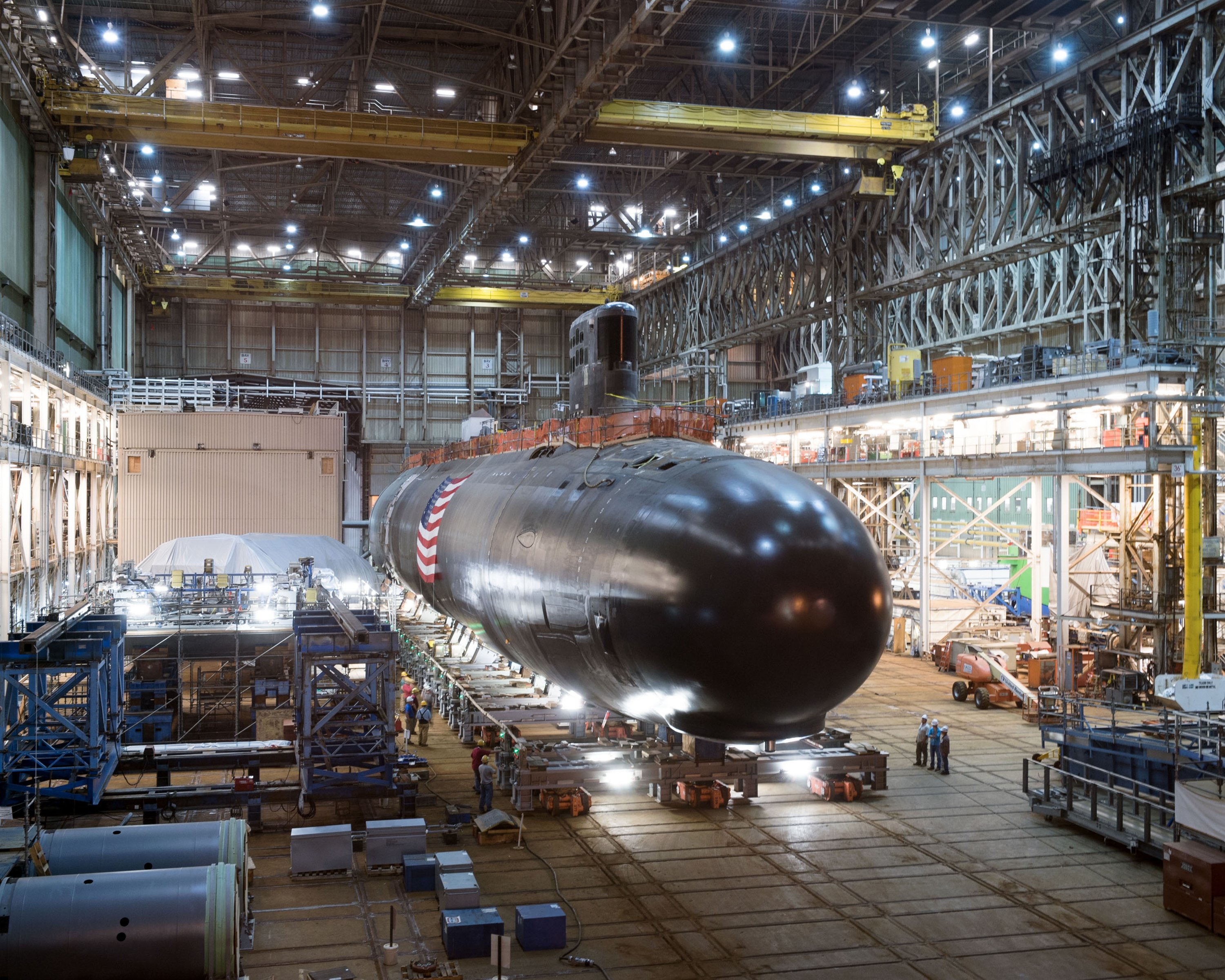
“I mean we’re well aware of the challenges in the U.S. industrial base but we’ve been aware about that from the very beginning when the optimal pathway was announced back in 2023. And that’s why we’re making a financial contribution to the U.S. industrial base to help it increase its production rate,” Marles said.
Additionally, Australian tradespeople are currently training in the U.S to work on nuclear‑powered submarines. Around 200 Australians are at Pearl Harbor working on getting Virginia-class submarines out to sea for the U.S. Navy, Marles said.
Marles spoke of the significance of establishing Submarine Rotation Force‑West, which is on track to launch in 2027. Under Submarine Rotation Force-West, nuclear-powered submarines – one from the U.K. and up to four from the U.S. – will be rotationally deployed at HMAS Stirling Naval Base in Western Australia.
“And all of that put together gives us a sense of confidence that the room will be there for the Virginia class submarines to be transferred to Australia in the early 2000s,” Marles said.
Saturday’s joint statement also announced an Uncrewed Undersea Vehicles (UUVs) program – the first program under AUKUS Pillar II, which pools the talents of each nations’ defense sector to develop advanced military capabilities to support security around the world. The UUV program will support the development of payloads, such as sensors and weapons systems, that can be deployed across all three nations’ UUV fleets. Delivery will begin in 2027.
“This project is intended to significantly enhance AUKUS partners’ ability to protect critical national seabed infrastructure; deploy cutting edge surveillance, reconnaissance and strike capabilities; conduct logistics operations; and bolster superiority in anti-submarine and anti-surface warfare, mine countermeasures, electronic warfare and contested littoral maneuver,” reads the statement.
The program will follow a two-phased approach, according to a U.S. Defense Department fact sheet. First, national payloads will be developed that are interchangeable and integrated by each partner nation with each nation’s development focusing on a different type of effect the payloads will deliver. The second phase will be the AUKUS partners jointly developing and producing trilateral payloads and enabling technologies, including next generation payloads.