101st soldiers use drones to drop grappling hooks, breach razor wire
The Army should treat drones like ammo, one officer said, estimating a brigade needs between 1,000 to 1,500 drones per week in sustained combat operations.
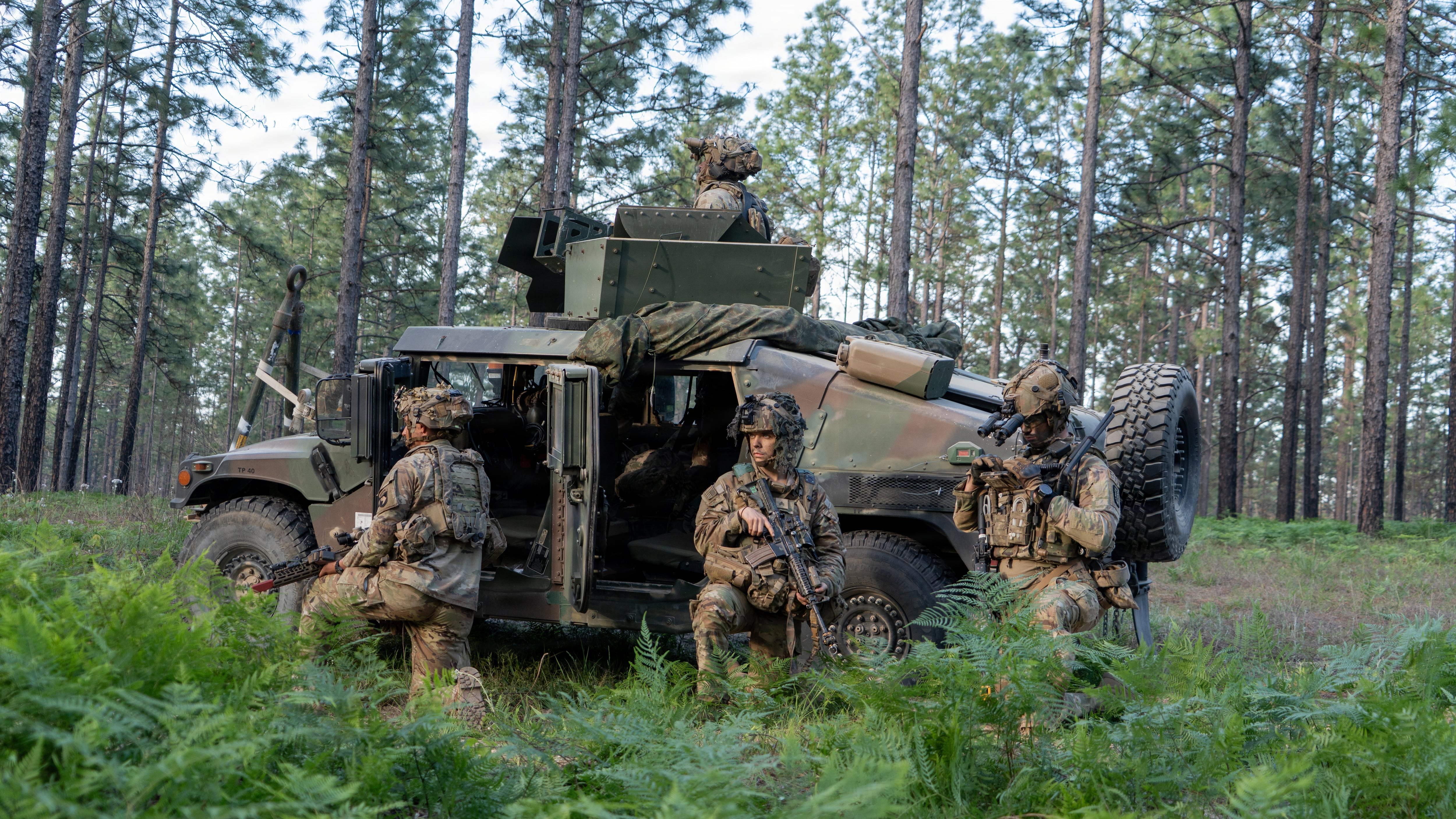
Soldiers assigned to the 3rd Mobile Brigade Combat Team, 101st Airborne Division, pull security and defend their positions during a Joint Readiness Training Center rotation at Fort Polk, Louisiana, April 8, 2026. (Spc. Sandy Vera Vazquez/U.S. Army)
In a recent critical training rotation, soldiers with the 101st Airborne Division expanded the scope of what’s possible with warfighting drones, developing new uses and making key determinations about how — and in what quantities — to build them into warfighting, officials said this week.
The 101st, which has since 2023 been designated as the Army’s lead experimental unit for air assault capabilities and strategic mobility, executed the field tests at the Joint Readiness Training Center in Fort Polk, Louisiana, in April. The division’s 3rd Mobile Combat Brigade traveled to the center, along with more than 500 drones, about 150 of which were one-way attack drones the unit had built in-house.
In a round table discussion with reporters Thursday, Col. Ryan Bell, the brigade’s commander, said the numbers matter — and represent an entirely new way of viewing and using drones.
“We need drones at scale. We need to treat them like ammunition,” he said. “When we do the math, I estimate a brigade needs between 1,000 and 1,500 drones a week when we’re in sustained combat operations.”
The drones the unit cut and assembled for themselves, dubbing them “Attritable Battlefield Enabler [ABE] 1.01,” allowed the unit to innovate based on their needs — with 3D printing and manufacturing assistance from the Robotics and Autonomous Integration Directorate, or RAID, at Fort Campbell, Kentucky.
“We had drones, but we were still sending soldiers up to breach obstacles with a manual grappling hook,” Bell said. “Raid … designed and built a grappling hook attachment for the ABE 1.01 so we could use a drone to drop a grappling hook at a distance instead of putting a soldier in the line of fire.”
The manufacturing facility also 3D-printed a special munition designed to allow the drone to blast through triple-strand concertina wire, thus dispensing with another obstacle, he said, and it added “mothership” capabilities to the medium-range reconnaissance (MRR) drones dropping the ABEs to build out their operating range.
These changes build up to an emerging Army vision: to have a front line entirely made up of machines that can largely dispense with obstacles and threats until human operators arrive.
Bell said he told one of his company commanders to conduct a fully robotic trench-line breach.
“I told him, ‘I want you to make this breach uncontested for your riflemen when they enter,’” Bell said.
The commander, he said, used an MRR drone to take out electronic warfare sensors and jammers and eliminate major targets, then sent in 25 ABEs to blast individual positions. Two more ABEs breached the concertina wire, and finally two of the Army’s experimental Hunter WOLF unmanned ground vehicles used C4 breaching charges to take out landmines and the rest of the wire.
“When the riflemen got there, the breach was uncontested,” Bell said. “Every target had been struck, and you didn’t have an engineer or a Sapper squad running out with a manual grappling hook trying to low-crawl with a Bangalore torpedo. It took us 35 drones and a little over 100 pounds of C4, but it was under the cost of three 155mm artillery barrages.”
The findings all spell out an overhauled way to fight — but one that will require a massive supply of drones and coordination from industry to provide them.
“The division itself doesn’t have the ability to scale production to those numbers,” Bell said. “I won’t speak for the Army, but if our experience of needing 1,000 a week is scaled out across the force, you can do the math. We’re trying to iterate and identify what capabilities are required for us to fight so that industry can help us solve those production problems.”