
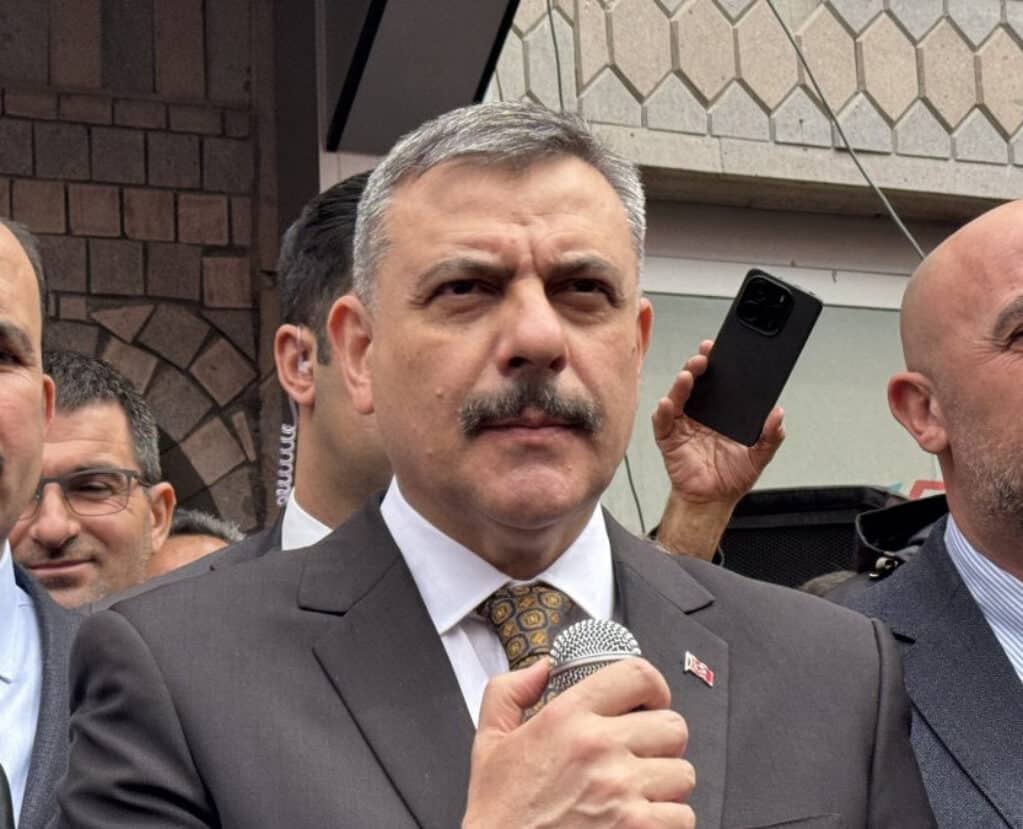
Turkey’s Interior Minister Mustafa Ciftci publicly expressed his desire to one day serve as Jerusalem’s governor, while suggesting that the city and other former Ottoman territories would eventually return to Turkish sovereignty.
Speaking at an advisory council meeting of the ruling Justice and Development Party (AKP) in the central Turkish province of Corum on June 6, Ciftci declared that Turkey would one day witness the “liberation” of Jerusalem, comparing such an outcome to recent developments in Syria and the South Caucasus. He further stated that lands once under the Ottoman Empire would “again come under our sovereignty and dominion.”
Ciftci also narrated a personal prayer he made while serving as governor of Corum and later Erzurum: “When I was governor, I had one supplication to Allah … my Lord, one day grant me the governorship of Jerusalem,” he said.
The remarks angered Israeli officials and generated significant traffic across Turkish and Israeli media. But the significance of Ciftci’s comments goes beyond a single speech, revealing a worldview increasingly embraced by senior members of Turkish President Recep Tayyip Erdogan’s government.
Ciftci is not a fringe political figure. Erdogan appointed Ciftci as interior minister in February 2026 after he spent years serving as governor in several strategically important provinces. As interior minister, he oversees Turkey’s domestic security apparatus, law enforcement institutions, and internal administration. Therefore, Ciftci’s comments carry greater weight than those of an ordinary party official or parliamentarian.
Under Erdogan, this worldview has often translated into policy. Turkey has expanded its military footprint across northern Syria and Iraq, established bases in Qatar and Somalia, intervened militarily in Libya, and sought to project influence throughout the eastern Mediterranean. Turkish officials frequently invoke Ottoman history when discussing regional affairs, presenting Turkey as the rightful guardian of Muslim communities beyond its borders.
Jerusalem occupies a particularly important place within this narrative. Erdogan has repeatedly cast himself as a defender of Jerusalem and the Palestinian cause, while Turkish government institutions have devoted significant resources to political, religious, and cultural initiatives in eastern Jerusalem. Ankara’s support for Hamas in Gaza and refusal to designate the organization as a terrorist group have further reinforced Turkey’s leadership claims on the Palestinian issue.
Amid this context, Ciftci’s remarks appear less like isolated rhetorical hyperbole and more like an expression of a wider ideological project. By describing Jerusalem as territory that would once again fall under Turkish sovereignty, the interior minister expressed a vision that blends Islamist politics, Ottoman nostalgia, and Turkish nationalism.
Ciftci’s comments also come at a time of heightened tensions between Turkey and Israel. Since the outbreak of the Gaza war, Ankara has intensified its anti-Israel rhetoric while increasing political engagement with Hamas’s leaders. Senior Turkish officials have routinely accused Israel of genocide, and Turkish intelligence chief Ibrahim Kalin has repeatedly hosted Hamas representatives in Istanbul.
While there is little indication that Turkey possesses either the capability or international support necessary to realize Ciftci’s ambitions, his remarks demonstrate how some members of Erdogan’s government increasingly frame regional politics. Jerusalem is not simply portrayed as a foreign city or even a contested holy site. In the mindset of Turkey’s ruling elite, it is increasingly portrayed as part of an unfinished historical mission.
For a senior cabinet minister responsible for Turkey’s internal security to openly voice a desire to govern Jerusalem — and to suggest that Israel will one day return to Turkish rule — illustrates how deeply neo-Ottoman themes have become embedded within the rhetoric of Erdogan’s government.
Sinan Ciddi is a senior fellow at the Foundation for Defense of Democracies, where he contributes to its Turkey Program and Center on Economic and Financial Power. You can follow Sinan on X @sinanciddi.
Tags: Israel, Israel-Turkey, Turkey


