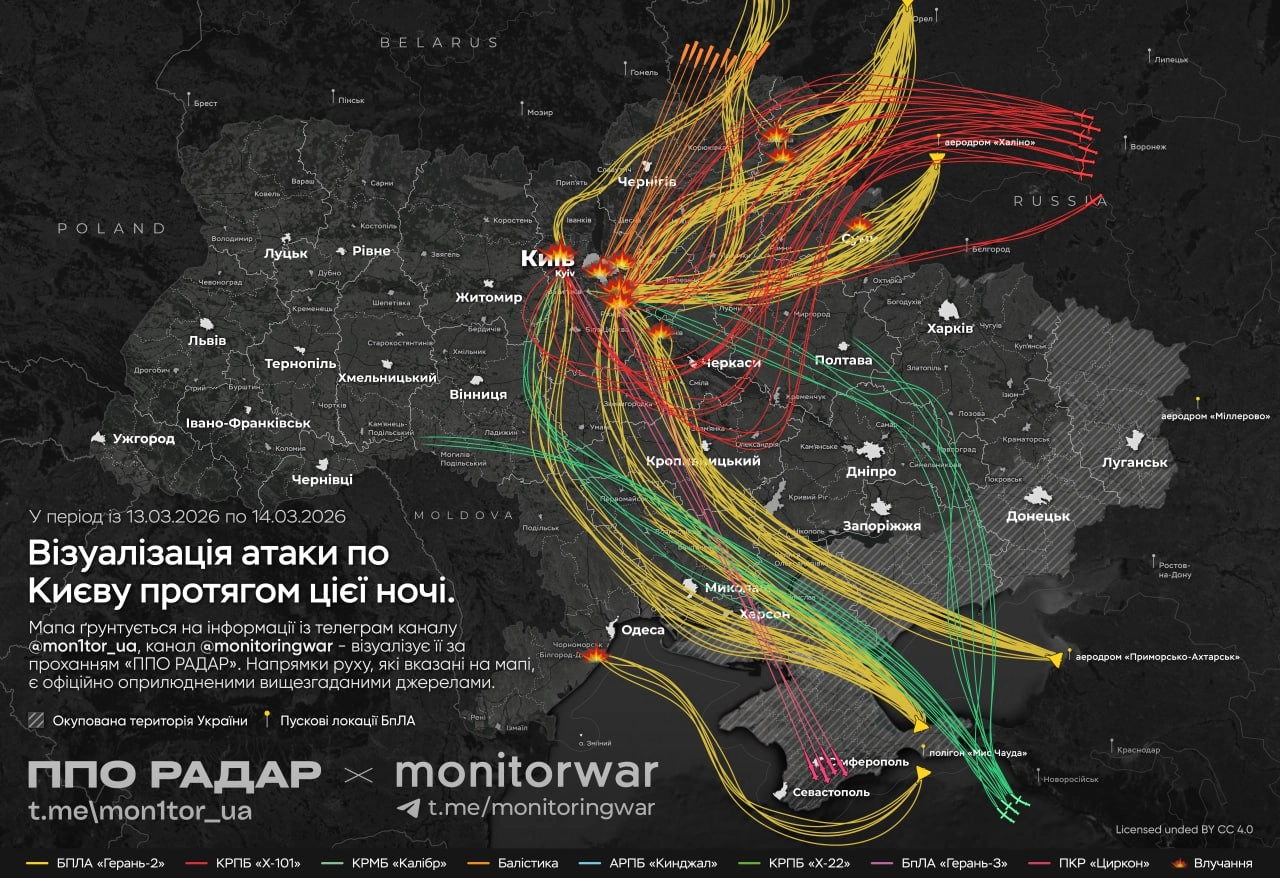
Anatomy of the Friday the 13th Airstrike – Part 1: How Russia Bombarded Ukraine One Night
This is the first of a two-part series looking at single Russian mass missile/drone assault on Ukraine, with a focus on the Kremlin’s airstrike package and Ukrainian defense tactics against it.
Kyiv Post
75
7 min čtení
0 zobrazení
On Friday the 13th, March 2026, the Russian Federation launched a major missile and drone attack against Ukraine that was fairly typical of the bombardment strategy employed by the Kremlin against its smaller southern neighbor, in more than four years of full-scale conventional war.
Ukraine’s defense against the strike was consistent the track record: complex, vigorous and often surprisingly effective. Four days later Ukrainian President Volodymyr Zelensky – using formerly secret air watch video as a visual aid to help explain to British parliamentarians how it had all been done – said his country employed limited resources and clever tactics to severely weaken a powerful Russian attack, but it had not been stopped completely.
Ukraine uses fused intelligence from thousands of sensors and other collectors to track every individual Russian drone and missile from launch to impact in real time, and automated data transfer processes allow sharing of that data across a nationwide network of thousands of air defenders, in an air defense network unlike any other country’s in the world, Zelensky claimed.
Close review of dozens of other sources documenting pieces of Russia’s heavy attack against targets deep inside Ukraine on March 13-14 found that Zelensky largely was accurate.
Broken down to details, Russia’s Friday the Thirteenth attack on Ukraine painted a picture of a sophisticated national air defense network well-practiced in coping with, if not always stopping, whatever the Kremlin could throw at it, research found.
Ukrainian advisers deployed to the Gulf were reportedly stunned by US reliance on costly missiles to intercept cheap drones, exposing a stark vulnerability in air defense tactics.
Russian Friday the 13th strike on Ukraine, as seen by a Ukrainian air watch group. (Image published by the Ukrainian air watch group monitorwar on March 14, 2026.)
On the night, the total was 498 weapons sent by Russian into Ukrainian airspace, of which 430 were drones and 68 were missiles, some carrying warheads with up to a ton of high explosive. Overall about 92-95 percent of all incoming weapons were shot down or otherwise disabled.
The Ukrainians had robust early warning. As had been the pattern since early 2023, the first intelligence to reach Ukrainian public service and air watch networks that a major Russian strike might be impending surfaced about 48 hours prior to the actual attack, with news that Il-76 cargo aircraft had flown cargo (probably cruise missile reloads) to air bases in Russia’s Murmansk and Samara regions.
Russian bombers normally based in the Far East, out of the range of Ukrainian drone strikes, were spotted flying west as well.
As in the past, the aircraft sighted marshaling on the bases were Tu-160 “Blackjack” and Tu-95MS “Bear” strategic bombers, both legacies of the Soviet-era, the latter a turboprop.
On Friday afternoon, as Kyiv wound down a fairly average work week in excellent Spring weather, reports flashed across TV networks and on smartphone notification banners: Drone units in Russia’s Bryansk, Kursk, Oryol, Rostov, Smolensk and Krasnodar regions, as well as in the occupied Crimea peninsula, had been spotted making launch preparations.
At about 6-7 p.m. on Ukraine-wide Eastern European Standard Time (EEST; 16:00-17:00 UTC), or a typical dinnertime in Ukraine but one hour later Moscow time, the first reports of drone launches came. Later it became clear the Russians launched their drones in three waves, each of about 150 airborne vehicles. This was the first wave.
Smartphones across the country flashed with the first air raid warnings between 9 and 10 p.m. EEST (19:00-20:00 UTC), a time in Ukraine when small children are supposed to go to bed. A reasonably clear picture emerged of impending missile attacks as well: Between 5-10 bombers appeared to be en route towards airspace long used for launches above central Russia, and truck-mounted missiles launchers had been detected going active in Bryansk region and in Crimea.
Sharp-eyed readers also spotted reports of warship activity in Novorossiysk, a base used by Russian missile boats and missile-launching submarines.
How the Ukrainians learn about Russian warship, bomber and attack drone activities is classified. The most common speculative answers are Ukrainian spies and satellite intelligence from a NATO-nation ally, most likely France, Germany and/or Finland, but less possibly also from the US.
Meanwhile, the first reports of drones above Ukrainian towns, villages and cities started trickling in along with a few claimed shoot downs.
The source of some of that information was clear: Official observers who had seen a Shahed themselves or been told about it by a reliable source, civilians sighting a machine gun truck or an automatic cannon shooting at something in the sky near their home, and other people reporting hearing the typical lawnmower engine sound of a Shahed.
But more often it was just a warning that Shahed drones had been detected moving in a particular direction.
People sometimes speculated whether the national air defense radar system had painted the Shahed, or if it was one of the 30,000 acoustic sensors authorities had rigged along the most common Shahed attack routes that had – thanks to data fusion at one of the command centers President Zelensky described to the meters per second – fixed the drone’s position and vector, including altitude, speed and heading.
Either way, by late evening, it was obvious hundreds of Shahed drones along with decoys would attack Ukraine throughout the night.
Around midnight for Ukraine (1 a.m. in western Russia, 22:00 UTC), the Kremlin’s missile launches began.
Altogether, the Russian “strike package” contained 2 hypersonic missiles launched from Crimean round platforms, 13 Iskander-M or S-400 ballistic missiles launched from Bryansk region soil, 25 Kaliber cruise missiles launched from subs or missile boats in the Black Sea, 24 Kh-101 cruise missiles fired by bombers flying over Russia’s Vologda region, and 4 Kh-59 missiles launched by Su-34 tactical bombers above its Kursk region.
Locals near near two airfields at undisclosed locations in Ukraine heard jets taking off near the middle of the night – in the past a possible indicator the Ukrainian Air Force was launching fighter interceptors to take on the cruise missiles.
With a flight time of five to eight minutes, and impossible to intercept except with a single missile (Patriot-launched PAC-3) the US only grudgingly sells to Ukraine in limited quantities, and with a warhead weighing close to a ton, by far the most dangerous weapons aimed and fired at Ukraine were the ballistic missiles.
In total, the Russian missile strike collectively was carrying 15-22 metric tons of high explosives towards its targets, and the drones probably were carrying another 14-15 tons of high explosives, a Kyiv Post estimate found.
By 1 a.m. local (23:00 UTC), the main directions of the Russian missile attack, based in good part on the Shaheds that had preceded them, were clear. The Kremlin on the night was looking to cause damage and destruction in Ukraine’s northern Sumy region, the eastern Kharkiv region and the southern Mykolaiv and Dnipropetrovsk regions; but overwhelmingly, with more than two-thirds of the Russian missile salvo heading its way, the main Kremlin target that night was the Ukrainian capital: Kyiv.
The first Russian Iskander ballistic missiles reached terminal phase and plummeted down towards the city, as a few interceptor missiles rose to meet them, about a half hour later.
This article was written using open Russian and Ukrainian sources including air warning and strike tracking networks like airguardua and monitor_ua, military officials and statements like the Russian Defense Ministry and the Ukrainian Air Force, local governments statements including regional defense command and regional emergency response agencies, eyewitness accounts and in some cases Kyiv Post reporter observations.
Russian attack tactics observed since September 2022 in more than 20 major missile/drone strikes launched by Russia against Ukraine were used to fill data gaps in a few cases.