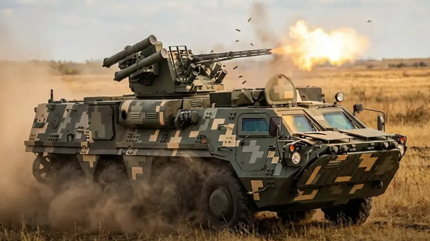
Three-compartment design with internal passage and rear doors; up to 110 km/h road, 60 km/h off-road.
BM-7 Parus RWS (30mm + grenades/MG + ATGM option), add-on armour, and fully amphibious (10 km/h in water).
Ukraine has revealed details of its BTR-4 ‘Bucephalus’ armoured personnel carrier (APC), a localised variant of the Russian-origin BTR design first introduced into Ukrainian service in 2014 and since upgraded through lessons learned during its ongoing war against Russia.
In a 9 April release, the Ukrainian Ministry of Defence (MoD) outlined some capabilities of the 8×8 APC and how it has moved on from the origin versions, including an updated interior layout, use of remote weapons stations (RWS), and updated armour to for use in assault operations.
It is not known how many BTR-4 APCs have been damaged or destroyed in combat operations, though given its use described as being an “assault workhorse” by the Ukrainian MoD, it is inevitable that Ukraine’s inventory will have been considerably depleted.
Exact numbers in Ukrainian service are unknown, but it is reasonable to estimate around 250 units were initially delivered, after a previous contract to provide the platform to Iraq was taken up by the Ukrainian military following Baghdad’s procurement reversal, and Ukraine’s extent ability to build armoured vehicles.
Losses of the platform could be around 145 units, according to open-source intelligence analysis conducted by Oryx.
According to GlobalData’s latest analysis into the Ukraine conflict, the use of APCs and global market is forecast to continue on a trajectory of “sustained growth”, as such the platform features heavily across national rearmament programmes.
Despite the influx of hundreds of APCs and other armour from the US and European partners, Ukraine still maintains the ability to develop and manufacture combat platforms for its own use, such as the BTR-4, but also the 155mm Bohdana artillery system, and 4×4 utility vehicles previously observed by Army Technology in Lviv.
BTR-4 Bucephalus APC: configuration
According to the Ukrainian MoD, one of BTR-4 Bucephalus APC’s key features is a three-compartment layout, which “sets it apart” from the “outdated” BTR-70 and BTR-80.
Front compartment: positions for the driver and commander, with large, armoured windows providing excellent visibility.
Middle compartment: houses the engine. As a result of this design, APC features a through-passage along its side, enabling the crew to now move from the cab to the troop compartment without stepping outside under enemy fire
Rear compartment: troop compartment for seven personnel. Embarked troops dismount through rear double-leaf doors, providing increased protection from enemy fire compared to a conventional hydraulic ramp
Engine and speed
The Bucephalus is powered by a Ukrainian 3TD-series diesel engine, described as being “loud but compact”, which has enabled the internal configuration.
The BTR-4 can reach speeds of up to 110 km/h on roads and up to 60 km/h off-road, with its corresponding average fuel consumption being around 100 litres of diesel per 100km on roads, increasing to up to 150 litres in “harsh” off-road conditions.
Firepower
The Bucephalus is armed with the BM-7 Parus remotely controlled weapon station, which includes the following key components:
30 mm ZTM-1 automatic cannon: a weapon used for engaging enemy light armoured vehicles and personnel
A 30 mm automatic grenade launcher (KBA-17) and a 7.62mm machine gun
In introducing an RWS, the gunner is seated inside the hull rather than in the turret, which significantly increases survivability in the event of a direct hit to the weapon system. The commander operates an independent panoramic sight and can designate targets to the gunner.
Armour and protection
The hull of the BT-4 Bucephalus APC is made of hardened steel, providing protection against 14.5mm rounds from the front, while the side armour withstands 12.7mm fire.
The design allows for the integration of additional panel or slat armour to be fitted, improving survivability without reducing mobility. Images also show the BTR-4 enclosed in a so-called ‘cope cage’, for protection against FPV drones
Amphibious capabilities
Unlike many Western counterparts, the BTR-4 Bucephalus is fully amphibious in its standard configuration, the Ukrainian MoD states. The vehicle is equipped with two waterjet propulsors at the rear, enabling speeds of up to 10 km/h in water.
The transition to amphibious mode described as “rapid” – requiring checks that hatches are sealed and fitting the air intake snorkels.