20 hours ago
Thomas Naadi,BBC Africa, Accraand
Basillioh Rukanga

 AFP via Getty Images
The West African nation was one of the main gateways for the transatlantic slave trade.

20 hours ago
Thomas Naadi,BBC Africa, Accraand
Basillioh Rukanga
AFP via Getty Images
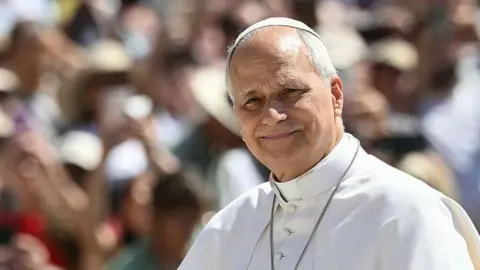
Ghana has welcomed Pope Leo XIV's apology for the Catholic Church's historic role in slavery, describing it as an "act of moral courage" that was important in the global pursuit of "truth, human dignity and justice".
The Pope issued the clearest apology yet for the Church's involvement in legitimising slavery and its delay in condemning it for centuries.
Ghana was a major hub for the transatlantic slave trade when millions of people were captured and loaded on to ships, never to return home.
Between the 16th and 19th Centuries, 12-15 million Africans were shipped to the Caribbean, with about two million dying during the journey.
Ghana has long been leading efforts for compensation and apologies from Western nations for the slave trade.
The West African nation's government said the Pope's recognition of the painful past was an important step towards healing, reconciliation and a just society.
''[The apology] reinforces the growing global understanding that confronting historical injustices demands truth-telling and moral responsibility as essential foundations for justice and reconciliation,'' its statement, released late on Tuesday, said.
The Pope's apology was delivered in what is known as a encyclical - technically a letter to Catholic bishops, but which over recent decades have been how a pontiff passes on messages to the world.
In the papal letter - titled "Magnifica Humanitas" ("Magnificent Humanity") - Pope Leo sincerely asked for a pardon in the name of the Church, adding that it was "impossible not to feel deep sorrow when contemplating the immense suffering and humiliation endured by so many".
Leo said Church authorities had at times responded to requests of rulers by "regulating and legitimising forms of subjugation, including the enslavement of of [non-Christians]".
He also acknowledged that earlier in the Middle Ages, ecclesiastical institutions had their own slaves.
"This constitutes a wound in Christian memory," he said of the Church's record.
 AFP via Getty Images
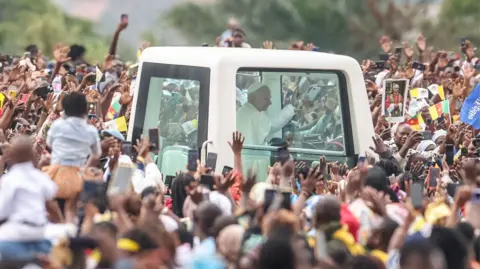
Ghana said the Pope's acknowledgment of the "painful history" was significant, at a time the world was having a "deeper reflection" on the effects of slavery and colonialism.
The country successfully pushed for a UN resolution in March, which recognised the enslavement of Africans as the "gravest crime against humanity".
Submitted by Ghana's President John Mahama and backed by the African Union, it aims to provide a pathway to healing and the payment of reparations.
It also seeks to address the enduring consequences of slavery like inequality and racial discrimination.
Ghana, which still has some of the forts that were used for holding captives under inhuman conditions as they waited to be shipped to the Americas by European powers, is due to host a conference in June to discuss the next steps following the adoption of the UN resolution.
On Tuesday, Human Rights Watch said the Pope's apology marked an important step, but stressed apologies alone were not enough and that real reparative justice needed to go further.
Religious institutions, along with states and corporations that benefited from slavery, should "reckon seriously" with their histories and take part in reparative efforts, the rights group added.
Additional reporting by Makuochi Okafor
 Getty Images/BBC
BBC Africa podcasts

It follows recent protests that have led to fears there could be a resurgence in xenophobic violence.

During the 2026 African Air Chiefs Symposium (AACS), more than 30 military leaders discussed ways to harmonize efforts to counter insurgencies and strengthen humanitarian assistance and disaster response. Throughout the event, the chiefs discussed enhancing regional security and interoperability and

A United Nations official warned that corruption and organized crime drive violence and terrorism in Nigeria as he introduced a five-year plan to bolster the nation’s criminal justice system, rule of law and judicial access. Cheikh Toure, Nigeria’s country representative for the U.N. Office on Drugs

Niger’s southwestern Tillaberi and Dosso regions have become host to the latest turf war between Sahelian terror groups Jama’at Nusrat al-Islam wal-Muslimin (JNIM) and the Islamic State Sahel Province (IS Sahel). In recent weeks, the two groups have attacked each other repeatedly as each seeks to es