9 hours ago
Anbarasan EthirajanGlobal Affairs Correspondent
Though Vijay campaigned only briefly, his fan club-turned-digital “warriors” amplified him online tirelessly.

9 hours ago
Anbarasan EthirajanGlobal Affairs Correspondent

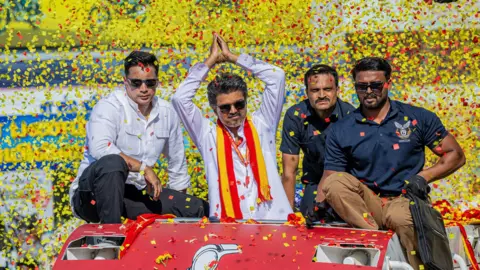 TVK
TVK
When pictures of Madhar Badhurudeen, campaigning in the recent assembly elections in India's southern Tamil Nadu state, emerged on social media, few thought he would stand a chance.
Badhurudeen belongs to the political party Tamilaga Vettri Kazhagam (TVK), headed by film star-turned-politician Chandrasekhar Joseph Vijay, popularly called Thalapathy (Commander) Vijay. He contested from the Madurai Central constituency, home to the Meenakshi Amman temple, a popular Hindu shrine.
Ahead of the elections last month, Badhurudeen, a 42-year-old meat shop owner, was seen seeking votes accompanied by a group of TVK supporters.
In contrast, his two rivals from the dominant regional parties - the Dravida Munnetra Kazhagam (DMK) and the All India Anna Dravida Munnetra Kazhagam (AIADMK) - had high-decibel rallies, colourful processions and high-profile senior leaders and celebrities campaigning for them.
They were also heavyweights - the DMK candidate was state minister and senior leader Palanivel Thiaga Rajan and the AIADMK had well-known actor-filmmaker Sundar C.
So no-one, including political analysts, thought that Badhurudeen - a skullcap-wearing Muslim contesting from the Hindu-dominated central region of a famous temple city - would win. He was not from a prominent family or a political dynasty. Even TVK leader Vijay didn't visit his constituency to campaign for him.
But last week, Badhurudeen defeated his powerful rivals, winning with a margin of more than 19,000 votes.
"My only strength was our leader Vijay and the electoral symbol of the party (a whistle). I campaigned based on the principles of our leader, offering a corruption-free administration," Badhurudeen told the BBC.
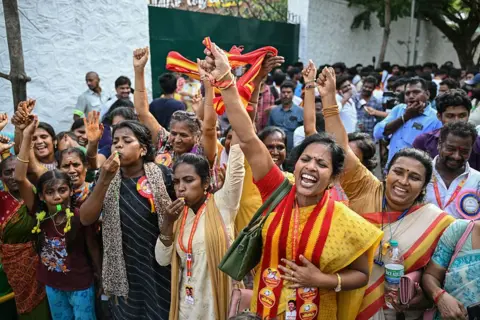 Getty Images
He wasn't the only one to spring a surprise. TVK candidates - mostly debutants - won 108 seats, leaving Vijay's party just 10 short of a majority in Tamil Nadu's 234-member assembly and pulling off one of the most stunning upsets in recent Indian political history. The actor was sworn in as the state's chief minister on Sunday after days of uncertainty about whether he would get enough numbers to form the government.
India's electoral landscape is usually dominated by money, caste and religion. Vijay, though one of the state's most recognisable faces, campaigned in person for less than three weeks altogether. He took a break from campaigning for more than two months after dozens of people were killed in a crowd crush at one of his rallies in September last year.
In some places, his rallies were cancelled due to what the party described as logistical issues and lack of time.
So how did candidates like Badhurudeen win despite being less visible on the ground?
Much of the answer, experts say, lies in social media. Behind the scenes, thousands of "social media warriors" from the TVK campaigned relentlessly online for him and others.
"Probably this was the first election in India that was won almost entirely with the help of social media," says Anup Chandrasekharan, a Bangalore-based media strategist.
He says that by cleverly using YouTube, Instagram, Facebook and other platforms, "Vijay's supporters have ushered in a digital revolution".
Indian elections are usually fought on the ground through massive rallies, fiery speeches, banners, door-to-door canvassing and relentless media outreach. Digital campaigning does play a role, as is to be expected in the world's second-largest smartphone market, but Vijay's supporters were operating several notches ahead of rivals.
Once he began his active political campaign last year, Vijay neither gave media interviews nor addressed press conferences, and his public speeches were notably shorter than those of other leaders. Instead, he communicated directly with supporters on social platforms.
But each of Vijay's appearances was amplified relentlessly online. His speeches and monologues were repackaged into Instagram Reels and YouTube Shorts, then blasted across WhatsApp groups and social platforms, finding old and new supporters who voted for the 'whistle' symbol in the hope that a new leader would usher in positive change.
For example, an edited selfie video of Vijay from a party conference in Madurai city got nearly 90 million views in 24 hours.
In many of his films he portrayed the image of an angry man fighting against corruption, injustice and inequality. He projected himself as a man who stood for the underprivileged and the voiceless - the defender of social justice. That made him hugely popular with fans.
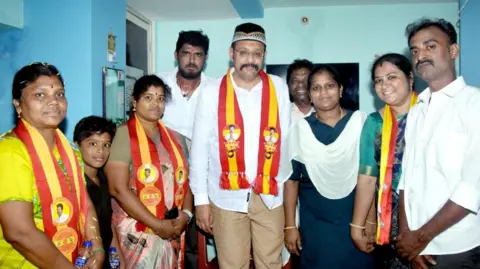 TVK
TVK
One of Vijay's biggest advantages was the network of around 85,000 fan clubs he had carefully cultivated over his 30‑year career in the Tamil film industry.
When he launched his party two years ago, his vast fan base evolved into an organised political machine and sophisticated online army, sharing campaign material and clips from his speeches.
"Vijay had limited campaign appearances. But that unseen force of the virtual campaign was highly effective. Traditional opinion polls and observers missed this trend," says Chandrasekharan, on why few exit polls captured the political wave ahead of the results.
Every Vijay rally, he says, quickly acquired a second, digital life. His team and supporters rapidly turned speeches into punchy short-form clips that flooded YouTube and other platforms within minutes. The party's well-funded and well-organised information technology wing also played a key role in churning out campaign material and in responding to criticism from rivals.
"The operating model blended everything - presence, content, networks, timing, speed and symbolism - into a single flow," says Chandrasekharan.
The strategy appears to have struck a chord with Gen Z voters and women, who backed him in large numbers. It is rare for a party to achieve such success in Tamil Nadu without allegations of influencing voters in some way.
Chandrasekharan, however, urges caution in the long run.
"This model has worked because Vijay has no baggage and is a new entrant to politics. But he needs to perform after coming to power. He also needs to strengthen his party structure - you can't be only campaigning in the digital world," he says
Many have also questioned the actor's lack of political and administrative experience as he steps into the top post.
His party colleagues say they are not worried.
"What kind of experience (did) the DMK have when they came to power in 1967? Our aim is to provide a clean administration, and our leader can do that," Badhurudeen says.
There is little doubt that Vijay has made history, single-handedly taking on Tamil Nadu's entrenched political giants, the DMK and AIADMK.
But amid the celebrations, there is growing recognition that winning an election is only the beginning in politics.
For Thalapathy Vijay and his virtual warriors, the real-world challenges begin now.

History was made this Labour Day, as China’s southern Shenzhen Bay port cleared 24 tonnes of South African apples and central Hunan province processed 6,000 bottles of South African wine – the first time these goods had reached the Asian economic giant under a new zero-tariff arrangement. The duty-f

Chinese researchers say they have developed a crocodile-inspired ceramic body armour that can deflect projectiles and potentially offer a low-cost alternative for lightweight ballistic protection. The team – led by associate research fellow Zhaoxiu Jiang at Ningbo University – based their design on

The first US presidential visit to China in almost 10 years will test a fragile tariff truce.

In the sci-fi novel The Three-Body Problem, humans build “gravitational wave antennas” to broadcast to the cosmos. Now, Chinese scientists have made a step forward in turning that idea into hardware – only in reverse. Science and Technology Daily reported on Saturday that a team from the Institute o