One of the key lessons of October 7 is that Israel needs buffer zones.
It needs sterile areas between its border communities and the enemies on the other side so that, as happened on that fateful October day, forces cannot overwhelm the border, enter communities, murder, rape, maim, and take hostages.
Which is why a buffer zone – essentially consisting of about half of the Gaza Strip – has been established in the so-called Yellow Zone inside Gaza. And why a buffer zone reaching kilometers into Syria has been created along the northeastern border, to keep ISIS or anyone else from approaching Israeli communities on the Golan.
Now it is Lebanon’s turn.
When Hezbollah joined the war on March 2 by firing rockets into Israel, it gave Jerusalem the opportunity to do something it failed to do in the past: finish clearing Hezbollah out of southern Lebanon.
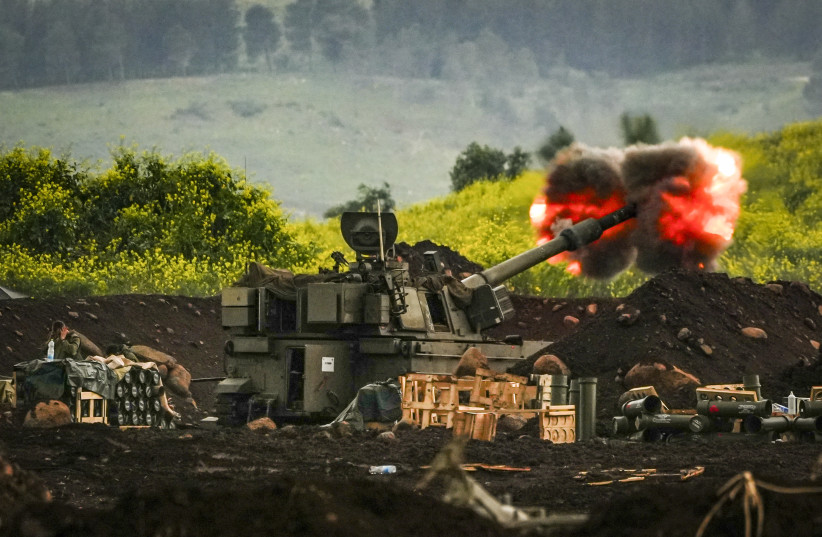
Israel had begun that job during Operation Northern Arrows in the fall of 2024, going from village to village, house to house, but when a ceasefire was brokered in November, it stopped before the work was complete. Under the terms of that ceasefire, the Lebanese government – and specifically the Lebanese Army – was supposed to finish the task.
As the continued fire from southern Lebanon makes clear, that did not happen – regardless of what Beirut claimed at the time.
Now Israel, which expanded its ground operations in Lebanon this week, is seeking to finish it.
But the goal is not only to dismantle Hezbollah south of the Litani River. It is to reshape the space along the border – to clear out a swath of territory so that villages within shooting range of the border can no longer endanger communities like Metulla, Shlomi, and Kiryat Shmona.
That means, as Defense Minister Israel Katz said this week, leveling the area Gaza-style. The IDF, he said, has instructions “to act and destroy the terrorist infrastructure in the contact villages along the Lebanese border – to prevent threats and Hezbollah’s return to the area – exactly as was done against Hamas in Gaza in Rafah, Beit Hanun, and other large areas that were neutralized.”
The reference is not incidental. In places such as Rafah and Beit Hanun, Israel did not merely degrade Hamas infrastructure; it flattened large swaths of the urban terrain that enabled Hamas to operate and thrive. The emerging idea in Lebanon appears similar: to create a “Yellow Zone”-type strip – an area where there are simply no people in immediate proximity to the border.
That is what differentiates the security zone now being contemplated from the one Israel maintained in southern Lebanon between 1985 and 2000.
Then, the population – much of which was hostile and sympathetic to Hezbollah – remained in place. Now, the idea is to push that population back, away from immediate contact with the border, creating distance from terrorists who, not long ago, could peer into Metulla from houses along the border.
All of this is not, obviously, happening in isolation. The main theater and focus of attention remains Iran. Nevertheless, Israel perceives an opportunity to significantly change the situation along its northern border as well.
The unsatisfying tone of previous Israeli policy toward Lebanon
FOR YEARS, Israeli policy toward Lebanon has oscillated between two unsatisfying poles: deterring Hezbollah or hoping the Lebanese state would eventually impose order.
In the wake of Operation Roaring Lion, that second option – long believed to be nothing more than aspirational – has returned to the agenda. Not because Lebanon has grown stronger, but because Hezbollah, and its patron Iran, have been badly weakened.
That shift creates a measure of shared interest. Israel wants a sovereign address on the other side of the border. Lebanon’s leadership, at least formally, speaks in those same terms: one army, one authority, one monopoly on force.
The current Israeli ground maneuver in southern Lebanon is partly intended both to test that proposition and promote it – to see whether incursion into Lebanese territory and pressure on Hezbollah can translate into action by the state.
The problem is the gap between policy and performance.
A recent analysis by the Institute for National Security Studies captures it succinctly: the Lebanese Army is both the key to Lebanon’s recovery and the weakest link in achieving it.
Under agreements in November 2024 that brought about a ceasefire, the Lebanese Army was tasked with dismantling Hezbollah infrastructure south of the Litani and collecting its weapons. It claimed progress – large caches seized, facilities dismantled, a broader deployment in the south.
But the current war has revealed how incomplete that effort was, and how vacuous those claims were.
Hezbollah retained infrastructure, redeployed terrorists, and continued to operate – often in ways suggesting the Lebanese Army avoided direct confrontation. Israeli officials charged that intelligence shared through the ceasefire monitoring mechanism leaked back to Hezbollah.
These are not just isolated incidents or lapses; they point to a bigger structural problem, and it starts with the Lebanese Army.
The Lebanese Army – charged with disarming Hezbollah – reflects Lebanon’s political system: fragmented, sectarian, and overcautious in order not to upset the status quo. Low pay encourages outside employment, with reports of a few soldiers even “moonlighting” with Hezbollah, where the pay is considerably higher.
And it is important to keep in mind that Hezbollah, which the army was supposed to disarm, is not some external adversary but an entrenched actor within Lebanon’s national fabric.
All of this severely limits what the army can realistically do.

Hezbollah in weakened position
YET, CONDITIONS now are not what they were in the past. Hezbollah is weaker than it has been in years – militarily, politically, and financially – and the damage it has sustained, both in 2024 and now, alongside Iran’s own pressures, has opened a narrow window in which the balance inside Lebanon might shift.
Meanwhile, Beirut is signaling – however cautiously – a desire to reassert state authority, creating a possibility that did not meaningfully exist in earlier rounds.
Israel’s challenge, therefore, is how to take advantage of the moment without repeating past mistakes. What is taking shape is a strategy that combines immediate military action with a longer-term bet: push Hezbollah away from the border now, and see whether the Lebanese state can fill the vacuum later.
But there is another question – one that lingers beneath the surface of this entire approach.
Does creating a depopulated buffer zone actually solve the problem exposed on October 7, or merely push it a few kilometers farther away, to be confronted later under more difficult conditions?
Israel has tried versions of a security zone in southern Lebanon before: first with the 1978 Litani Operation, which aimed to push Palestinian terrorists beyond the Litani, and then again with the First Lebanon War, in 1982.
In both cases, pushing the battlefield north reduced infiltration, pushed rockets further away, and bought time, but it did not eliminate the threat. Over time, Israel’s presence in that security zone exacted a price – steady casualties, growing public fatigue, and the sense of being drawn into a conflict without a clear end point.
Also, the enemies adapted, regrouped, and returned – often stronger; while diplomatic pressure created international constraints on Israel’s freedom of action.
A sterile strip may now create distance, but it does not, in itself, change the underlying reality on the other side of that strip.
WHAT DISTINGUISHES this moment is not the concept of separation but the conditions beyond it: a weakened Hezbollah and, in Beirut, at least the beginnings of an effort to reassert state authority.
In that sense, the buffer zone is less an end state than a bridge – one that creates both space and time. Space, by physically distancing Hezbollah from the border. Time, for the Lebanese state, with external backing, to demonstrate that it can begin to impose control where it previously could not.
If that happens, a long-term Israeli presence becomes less necessary. Withdrawal would not rest on trust, but on a change in realities on the ground.
If it does not, then Israel will be left with a familiar dilemma – only this time with fewer illusions about what others can or cannot do. Israel has been here before, and the memory lingers.
At the same time, the current moment is not a simple replay.
Hezbollah has absorbed significant blows. Its leadership has been decimated, its infrastructure has been degraded, and its freedom of action has been reduced. It is also under growing internal criticism for dragging Lebanon into another destructive war.
That combination – military pressure from Israel and political pressure from within – creates a dynamic that has not existed in quite the same way before.
This does not guarantee change. But it creates room for it.
Which leaves Israel trying to navigate between two familiar pitfalls.
On one side, the inclination to rely on others, on Lebanese commitments, or international frameworks that have not delivered in the past.
On the other, the risk of overextension – of trying to impose a long-term military reality that history suggests is difficult to sustain.
For now, Israel is attempting to steer between those options.
It is acting to create immediate security for the communities straddling the border – pushing Hezbollah away from the fence, dismantling its infrastructure, and establishing a buffer that reduces the threat to northern communities.
At the same time, it is interested in testing whether a different Lebanese reality can take shape, one in which the state, with outside support, begins to assume responsibilities it has long shirked.
Whether that effort will succeed remains uncertain. Lebanon has a long history of confounding expectations. But after October 7, Israel is no longer prepared to base its security on expectations alone.