Railwaymen’s Resilience: How Kyiv’s Oldest Club, Lokomotyv, is Reclaiming Its Identity in Wartime
In an exclusive interview, FC Lokomotyv President Oleksandr Yegorov recounts the club’s 107-year fight against identity erasure. Despite a 2024 missile strike, the “railwaymen” are reviving their professional status, reclaiming their true colors, and building the “Loko City” sports hub.
Kyiv Post
75
7 min čtení
0 zobrazení
Three years after returning to professional football, FC Lokomotyv – Kyiv’s oldest football club – is chasing promotion to Ukraine’s First League while emerging as a symbol of wartime resilience.
Founded in 1919 by railway workers as “Zaldor,” the club predates the formation of Moscow’s Lokomotyv. President Oleksandr Yegorov disputes the Soviet-era narrative that the Kyiv side was a subordinate branch of the Russian club, detailing a history of independent identity that began at the Kyiv railway junction.
Kyiv Post met with Yegorov to discuss how the “railwaymen” are reclaiming their historical identity, developing elite talent for European leagues, and building a premier sports hub in the capital.
This is the first of a two-part series.
Kyiv Post: Mr. Yegorov, let’s start with the origins. Lokomotyv is one of the oldest clubs in Ukraine. Why is it important to remember its roots now?
Oleksandr Yegorov: In reality, we are 107 years old. We can officially state that the club has existed since 1919. That was when the first game took place, information about which we found in the archives of the Kyiv Football Federation and sports reports of that time. Back then, the railwaymen of the Kyiv railway station played against their colleagues from Darnytsia.
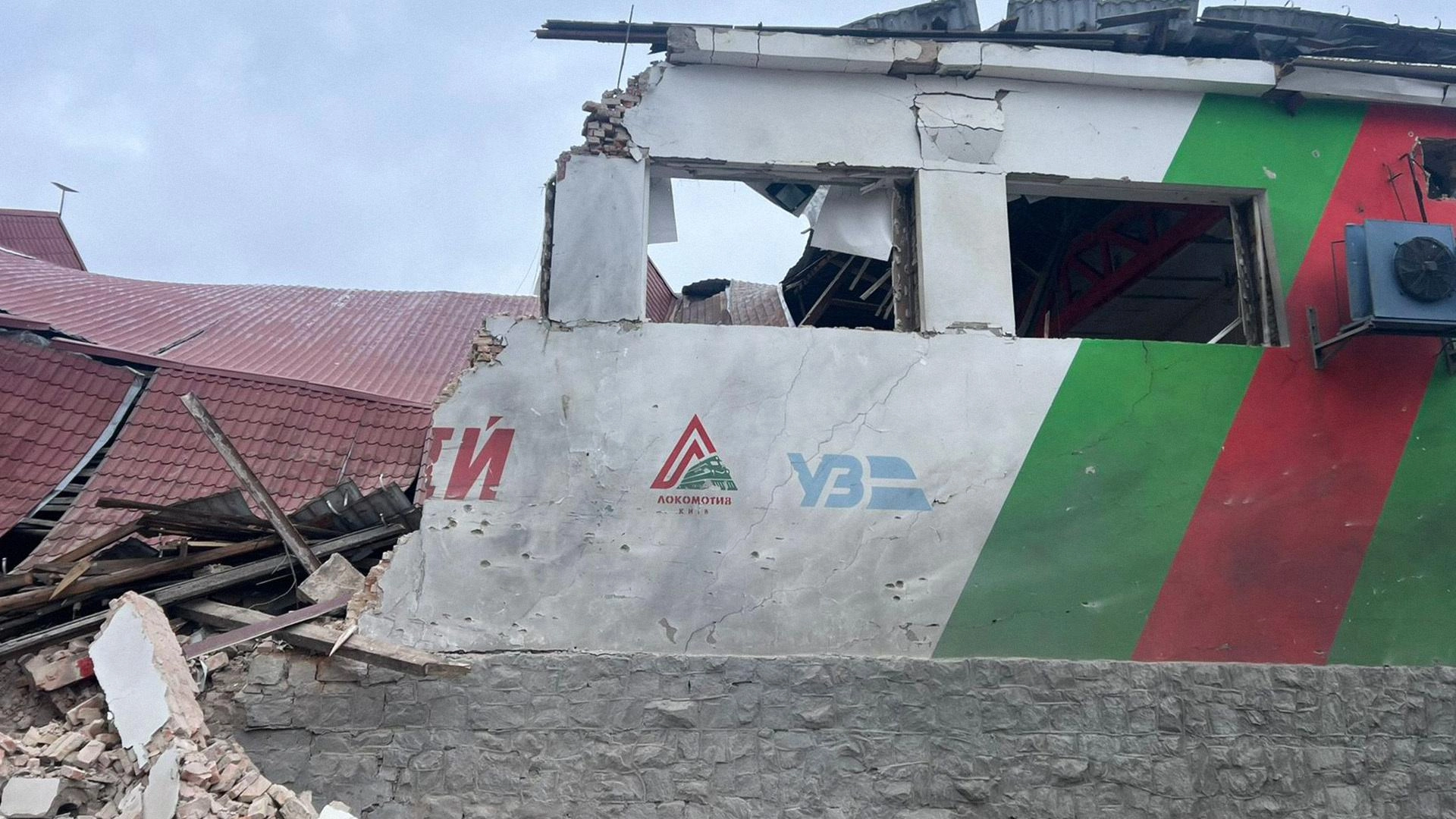
What is important: They played exactly on the spot where our base remains to this day. This location has remained unchanged for over a century. Our Lokomotyv stadium near the Kyiv railway station survived World War II but was destroyed during the Russian aggression. The main administrative building, which had stood on this site since 1936, was destroyed by a missile, and we had to demolish it.
Oslo’s latest NATO PURL contribution brings its total support through the program to over $1.35 billion, reinforcing Norway’s role as one of Ukraine’s strongest European backers.
The administrative building of FC Lokomotyv after a Russian attack. (Photo via FC Lokomotiv’s press service)
However, we decided to preserve part of the historical brickwork to incorporate it into the design of the new building to be erected during the reconstruction. This historical part of the new building will become a symbol of our resilience for over 100 years.
One often hears disputes regarding your club colors – red and green. Many people are still convinced they were borrowed from Moscow. Is this true?
This is an absolute myth. In fact, it was the other way around: Moscow later borrowed these colors from us.
In 1919, there was a huge problem with equipment. The players from Darnytsia performed in underwear, but the Kyiv railwaymen found a solution – they sewed uniforms from fabric that was in surplus at railway warehouses. It was fabric for signal flags used to dispatch trains. Red meant stop, green meant movement. These colors are native to us; they emerged from the essence of the railway profession in Kyiv long before the appearance of the Moscow namesake.
History of FC Lokomotyv in USSR
The club rose to prominence during the early Soviet era, adopting the “Lokomotyv” name in the 1930s and reaching the USSR Top League by 1938.
Success was met with systemic interference from Moscow following World War II. In 1947, the Kyiv side was stripped of its professional status after its top players, including Yevhen Rogov and Viktor Terentiev, were forcibly transferred to bolster Moscow’s central Lokomotyv club.
Oleksandr Yegorov: For decades, Moscow’s Lokomotyv did everything to suppress us. All resources were accumulated in Moscow, and funding went there as well, even what was earned in Ukraine. The Soviet leadership simply decided: “Why does the empire need two Lokomotyvs? Let there be one main one – in Moscow.” They tried to erase us from history.
That is why, in 1947, FC Lokomotyv (Kyiv) lost its status as a team of masters and focused on youth sports. Most talented Kyiv railwaymen who moved to Moscow in the 1960s and 1970s became the core of the USSR championships specifically for the “central” Lokomotyv.
Our club has trained more than 20 athletes who, in different years, were part of the USSR Olympic teams in various sports: rowing, athletics, volleyball, basketball. But Moscow appropriated these achievements.
Remember our volleyball players – Borys Tereshchuk and Volodymyr Ivanov. In fact, the backbone of that “golden” USSR volleyball team consisted of players from our club. And so, they became Olympic champions in 1968, but ideologically it was presented as a success of the Moscow “center.”
The same fate befell track and field athlete Vasyl Sukharev, who started at Kyiv’s Zaldor and later became a star of Moscow’s Lokomotyv and an Olympic medalist. Even in table tennis, we had world-renowned names like Svetlana Grinberg, who trained in Kyiv under Oleksandr Tabarovsky, but later her successes within the same “central” Lokomotyv were claimed by Moscow.
FC Lokomotyv in modern times
After the collapse of the USSR, a difficult period began for FC Lokomotyv.
By the late 2010s, the infrastructure had decayed, there were few children, and the identity was blurred. The club needed immediate reimagining, which the current leader understood immediately after starting work.
Oleksandr Yegorov: I must admit that back then (at the end of 2018), the club was literally “dying.” There were few children, everyone was in different uniforms, and some teams, even in 2018, were still playing with the Moscow Lokomotyv logo!
For me, it was a shock. I realized we had to completely change both the concept and the approach. We started with rebranding, brought back our symbols so that children felt they were playing for their own Kyiv club with a great history. Specialists from a serious company, Uvaga Communication, assisted us. Together with them, we brainstormed, and this new logo was born, reflecting our historical heritage.
Surviving Russia’s invasion of Ukraine
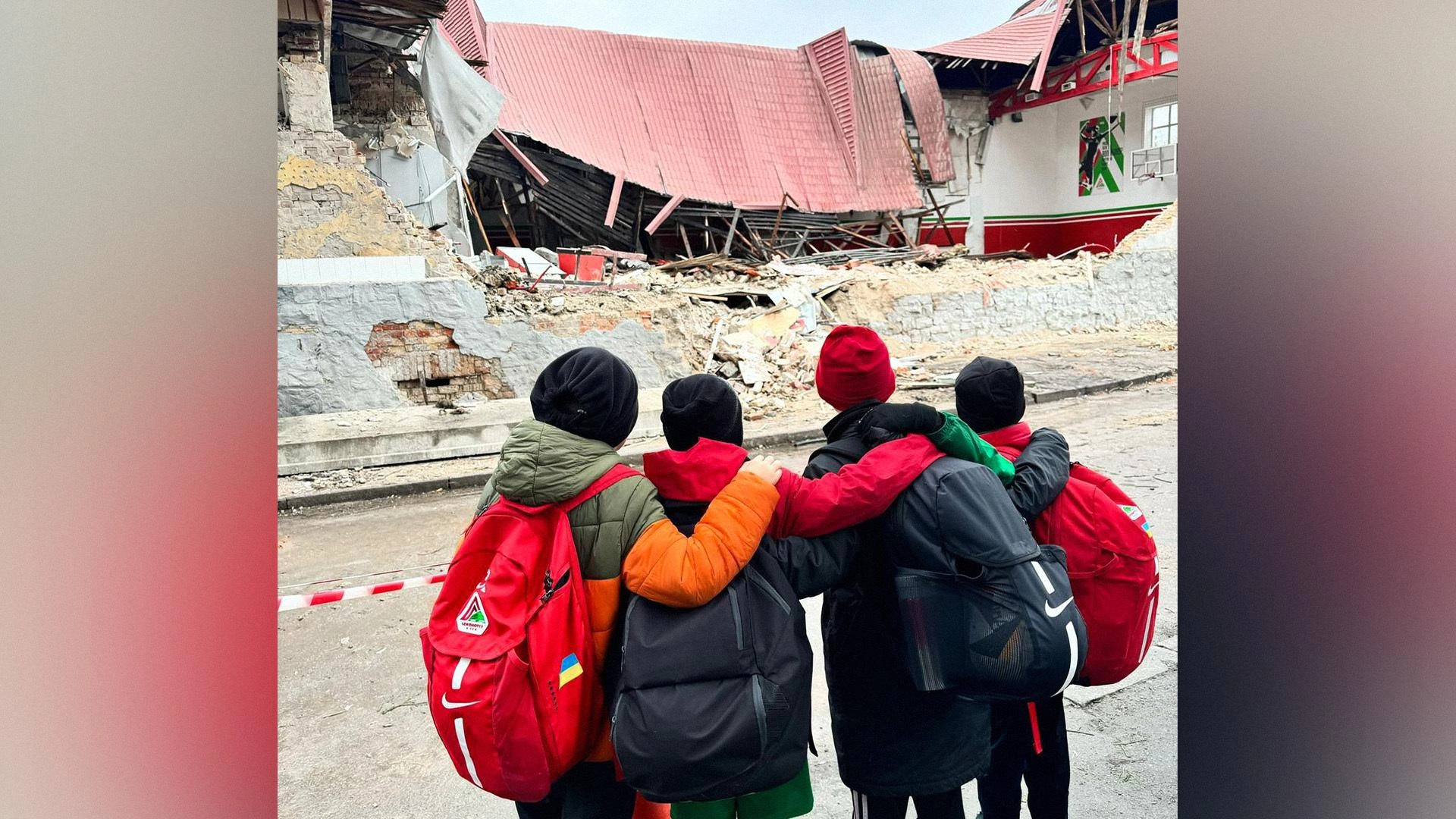
On the morning of Jan. 23, 2024, as a result of a Russian missile attack on Kyiv, the training base of FC Lokomotyv in Kyiv’s Solomyansky district was destroyed.
A Russian missile effectively obliterated the administrative building and the sports infrastructure of the complex, where hundreds of children practiced every day. Since then, the club has been restoring its historical home, and the base is currently closed for reconstruction.
Oleksandr Yegorov: The strike occurred at 7:30 a.m. – the building was completely destroyed, the foundation cracked, and we were left with nothing. Unfortunately, our former powerlifter, Mykhailo Donskyi, who spent 20 years at “Loko” and was working as a rehabilitator at the time, was killed.
It is a blessing that the children were not yet on the field, as the little ones train indoors, under the roof.
FC Lokomotyv youth players at the site of the destroyed administrative building (Photo via FC Lokomotyv’s press service)
We are very grateful for the support of all our partners. Howard Buffett became the main donor for the reconstruction. He personally came to the field and was struck by the fact that children continued to train next to the ruins. The Paris Mayor’s office, the German embassy, and football federations also helped.
Currently, we are preparing a large-scale project called “Loko City.” This new sports space will include not only football but also other sports. In the new “Loko City,” there will be mini-pitches, basketball and volleyball courts, and perhaps even a skate park. We want to create a multifunctional space that will become the heart of the district and where sports will be integrated into the life of the entire community. It is important to us that the children who train here have the best conditions at home, in Kyiv.
Overall, we are developing more as a full-fledged sports club; we have already returned the volleyball team to the Super League, where Lokomotyv used to be. We have excellent basketball players, and we are developing martial arts.
More details about the club’s present and future plans will be available soon on Kyiv Post in the second part of our conversation with Oleksandr Yegorov.