
Asymmetric attacks on commercial and naval shipping in the Red Sea region reiterated to Western navies their emerging need to be ready to counter any threat at sea at any time, naval chiefs told the recent Paris Naval Conference.
The chiefs’ conversations at the conference (an event co-hosted by the French Navy and IFRI, France’s international relations institute) also underlined the fact that high-end, more capable military threats can now emanate more easily and quickly from asymmetric actors due to the wider availability of such technology – again, as illustrated by the Red Sea example.
Starting in October 2023, as a spillover of the Israel-Hamas war that erupted in the Gaza region that month, Ansar Allah (Houthi) rebels operating in southern and western Yemen began launching ballistic and cruise missile and uncrewed system attacks against commercial and naval shipping transiting the Red Sea/Bal-al-Mandeb/Gulf of Aden corridor. The campaign peaked in 2024, but continues today (albeit at lower levels).
In response, Western navies rapidly deployed surface ships to the region. Two multinational naval operations were ‘stood up’ – the US-led ‘Prosperity Guardian’, and the European Union (EU)-led ‘Aspides’. Some navies were present as independent deployers.
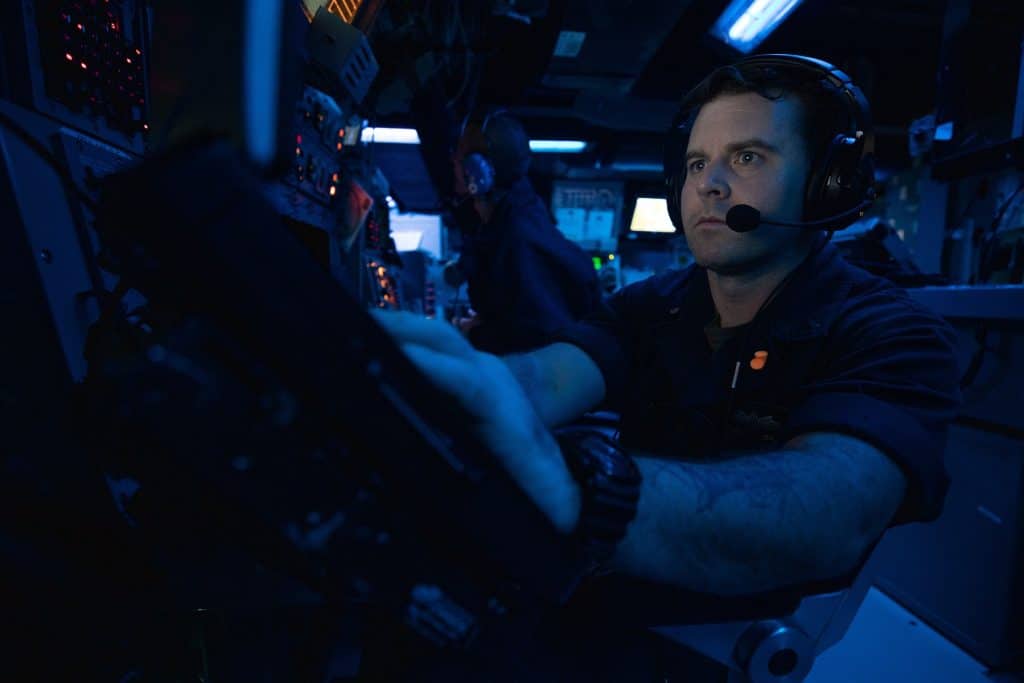
The intensity of the threat in capability and operational terms is a lesson the navies present took away.
“It’s a short shot. The Red Sea is small. You’ve got to be ‘on point’ in that body of water,” Admiral Daryl Caudle, the US Navy’s (USN’s) Chief of Naval Operations (CNO), told a press conference at the event.
The Commander of the Royal Netherlands Navy (RNLN) reinforced this view. Vice Admiral Harold Liebregs told the assembled media that, over previous decades, navies deploying overseas on ‘wars of choice’ (in other words, expeditionary interventions) would have time to prepare for higher-end operations while deployed, while at other times not being at full readiness. “We were not operating our ships at maximum performance …. We were happy to accept deficiency – but you can’t accept it anymore,” said Vice Adm Liebregs. Ships transiting the Red Sea did not anticipate being attacked. “You did not expect it – but all of a sudden you’re under attack, [under] ballistic missile threat and other things,” Vice Adm Liebregs continued.
“So, there’s no difference between wars of choice and wars of necessity [now]: we have to be ready all the time. I think that’s the major lesson,” Vice Adm Liebregs added.
Adm Caudle discussed a range of other lessons learned from the Red Sea shipping crisis. These included: navies understanding and sharing each other’s common operational pictures (COPs); sailors using shore-based radar experts to ‘de-clutter’ and ‘clean up’ the COP, to support enhanced response capacity; countering threats encompassing ballistic missiles to one-way attack uncrewed aerial vehicles (OWA UAVs); conducting at-sea logistics including re-arming, in a narrow, congested body of water; at a national level, building the learning cycles between ships, fleet command headquarters, and the shore-based warfare development centres; and at a multinational level, understanding how to enhance combined operations in pursuit of the same objective while some navies and ships conducted escort tasks and others conducted strike missions as well.
Noting that he had conducted a lot of operations across both the US 5th Fleet and US 6th Fleet areas of responsibility (AORs) during his career, Adm Caudle said “I don’t know that I can point to a time in which the collaboration and the learning cycle was greater than [that amongst] the forces who were joined together in the Red Sea.” This collaboration and learning was “world class”, CNO added.

Such learning remains vital. Admiral Nicolas Vaujour, the French Navy’s Chief of Staff, told the press conference that the Houthi threat continues. He pointed to the EU’s plan to extend ‘Aspides’ for a further year (to February 2027): this plan was confirmed on 23 February.
During the conference plenary session itself, the assembled chiefs discussed the residual Red Sea risk, and other lessons learned from operations there.
Adm Vaujour said that, alongside Western navies now facing state and non-state adversaries, the level of technological threat in the Red Sea region had been raised, to encompass not only surface-based threats including small remotely operated surface craft – such as rigid-hull boats and uncrewed surface vessels – presenting a waterborne improvised explosive device (WBIED) risk, but air-based threats including ballistic and cruise missiles and UAVs.
Such increasing range of threat capability was being exacerbated in its operational and strategic impact by ever-reducing costs of entry to generate that capability threat. “One of the things I’m very concerned with in overmatching potential threats in the future is the cost of entry for very significant capabilities, [now operated] by adversaries you would not normally think could actually hurt you, that are now on the table,” said Adm Caudle. “So, the number of potential adversaries that enter into that needs to be monitored also.”
The intensity and duration of the Red Sea operations, and the on-station rotations that resulted, have also prompted some navies to re-evaluate crewing levels. In recent times, many Western navies have been introducing reduced crewing models. However, Adm Vaujour explained, the French Navy has recognised the need to reinforce crews of ships deployed on such operations because the ships were found to be light in terms of human resource capacity. This challenge includes understanding where to set crew levels when considering both using and defending against new technologies.
