17 hours ago
Nicolas Negoce,BBC Africaand
Paul Njie,BBC Africa

 AFP via Getty Images
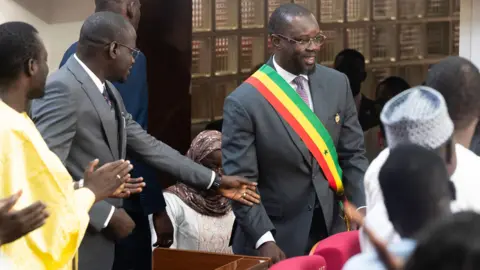
As speaker, Sonko could use his position to challenge the policies of the president, his one-time ally.

17 hours ago
Nicolas Negoce,BBC Africaand
Paul Njie,BBC Africa
AFP via Getty Images
Senegal's former Prime Minister Ousmane Sonko, who was dramatically sacked on Friday by the president, has been elected Speaker of the national parliament setting up a possible source of conflict at the top of Senegalese politics.
The West African nation's current crisis follows months of tension between Sonko and his one-time ally President Bassirou Diomaye Faye.
Parliament's previous Speaker stepped down on Sunday to make way for the former prime minister, who is a popular figure and whose Pastef party has a majority of the seats in the National Assembly.
On Monday, Faye appointed economist Ahmadou Al Aminou Lo to replace Sonko as prime minister.
Relations between the president and his now-former prime minister had been deteriorating for months, with Sonko openly criticising Faye for his handling of Senegal's debt problems.
"What is at stake is the relationship between morality and politics," Sonko has since said, promising not to use his new position to "to fight against anyone" and instead ensure that parliament acts in Senegalese citizens' best interests.
Yet Sonko has also said that his dismissal as prime minister does not mean his political career is over.
Sonko's new role as Speaker - the second highest political position in the country - could limit President Faye's ability to manoeuvre if he fails to secure parliamentary support for his policies, analysts say.
The president cannot dissolve parliament until at least two years after the last election - that means any move to prematurely end the mandates of lawmakers before November this year would be considered invalid.
The rift between Faye and Sonko further raises uncertainty over the political future of the debt-challenged country.
The 51-year-old ex-prime minister commands massive support across the country, especially among young people, and within his party, Pastef.
"Pastef remains open to responsible discussion that sets aside egos to complete this term in the best possible conditions," he said.
Though he welcomed Lo's appointment as prime minister, Sonko acknowledged they had "certain disagreements" on monetary and debt issues.
Lo, 60, is a former head of the Central Bank of West African States and is perceived as more of an establishment figure than Sonko.
The size of Senegal's public debt - now standing at 132% of GDP - has been a cause of major friction, with Faye seen as being more receptive to the belt-tightening polices of the International Monetary Fund (IMF).
Prior to Sonko's sacking, talks with the IMF were expected to resume in June over the lending programme, the Reuters news agency reports.
As an opposition MP, Sonko was renowned for fiercely challenging former President Macky Sall's policies - a trait which he also demonstrated against his boss Faye.
Sonko would almost certainly have taken the top job had he not been barred from running in 2024's presidential election because of a defamation conviction.
 Getty Images/BBC
BBC Africa podcasts

It follows recent protests that have led to fears there could be a resurgence in xenophobic violence.

During the 2026 African Air Chiefs Symposium (AACS), more than 30 military leaders discussed ways to harmonize efforts to counter insurgencies and strengthen humanitarian assistance and disaster response. Throughout the event, the chiefs discussed enhancing regional security and interoperability and

A United Nations official warned that corruption and organized crime drive violence and terrorism in Nigeria as he introduced a five-year plan to bolster the nation’s criminal justice system, rule of law and judicial access. Cheikh Toure, Nigeria’s country representative for the U.N. Office on Drugs

Niger’s southwestern Tillaberi and Dosso regions have become host to the latest turf war between Sahelian terror groups Jama’at Nusrat al-Islam wal-Muslimin (JNIM) and the Islamic State Sahel Province (IS Sahel). In recent weeks, the two groups have attacked each other repeatedly as each seeks to es