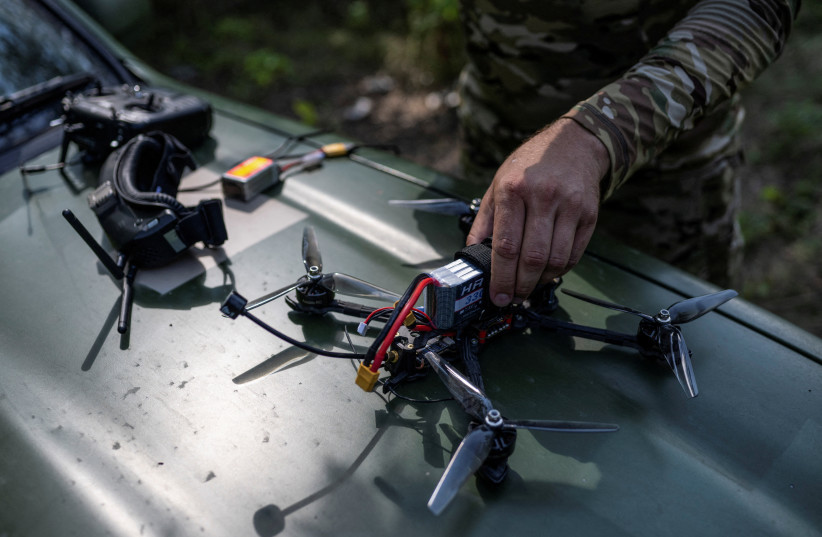
Hezbollah is increasing use of small, highly maneuverable fiber-optic drones along Israel’s northern border, targeting IDF troops and civilians. They are a threat that began as an improvised tool in Ukraine and has evolved into a defining feature of warfare from Europe to the Middle East.
These drones are small enough to evade air-defense systems and have turned the skies into a constant source of danger for ground troops, as they pose a challenge for even skilled sharpshooters.
And while the IDF seems to have been caught with its pants down, the risk is not new. Numerous counter-drone companies in Israel have been working for years on systems that can down aerial threats similar to those fired by Hezbollah. One company, Smart Shooter, known for its computer‑vision‑based fire‑control systems, has supplied its technology to the IDF and police for several years.
Speaking to Defense & Tech by The Jerusalem Post, Shir Ahuvia, VP of Product at Smart Shooter, explained that the IDF has purchased the system for troops for exactly this purpose.
Ahuvia also noted that the challenge has grown even more complex with the appearance of drones guided by fiber‑optic cables, which are immune to electronic jamming. Because their communication link cannot be disrupted, the only viable response is kinetic interception.

Using Smart Shooter’s system, “troops can carry out a kinetic interception of the threat,” Ahuvia said.
Smart Shooter systems are designed to help soldiers intercept drones by stabilizing their aim and tracking a moving target even under stress. The technology is optic‑based: A camera and sensor feed continuous imagery into an onboard computer, which analyzes the scene in real time. The system identifies the designated target, locks onto it, and calculates where the shooter needs to aim as the target moves. The operator presses a button to lock on, pulls the trigger, and aligns the weapon within the firing window that the system displays.
This approach allows troops to maintain accuracy even when they are moving, fatigued, or under fire. The system is also part of a soldier’s personal gear, rather than a separate platform, allowing troops to respond quickly, without relying on additional equipment.
This combination of simple hardware and advanced image-processing software effectively turns troops, even reservists with no training, into sharpshooters with the first round out of every rifle hitting its target.
Smart Shooter is able to rapidly introduce changes and modifications required by the forces in the field through software updates.
Ahuvia told D&T that the company has also learned lessons from other conflict zones. Pointing to the war in Ukraine, she discussed how mission profiles can change the drone’s speed and maneuvering. For example, drones often fly slowly while gathering intelligence, then accelerate sharply when shifting to an attack profile. Smaller FPV drones can be extremely fast, but once they carry a munition, they become heavier and behave differently in flight. These variations in speed and maneuvering must be accounted for in the system's algorithms.
“When we see a new threat, we record images and take it to our R&D teams” who begin analyzing how the system should adapt, Ahuvia explained. “Everything that is related to kinetic interception and moving threats is something we can handle.”
Magic
Smart Shooter’s origins lie in the ground battlefield. The company’s early work focused on the balloons and kites Hamas launched along the Gaza border several years ago. According to Ahuvia, the operational flow has remained similar, even as the nature of the threat changed.
What did change was speed. The FPV and fiber optic targets move differently from what Hamas was using almost 10 years ago, which led the company to carry out several upgrades of its software.
Smart Shooter describes itself as a software‑ and algorithm‑driven company, which it argues gives it an advantage in responding to new threats. And while it can continuously upgrade its software to handle new threats, the core technology remains consistent across platforms.
“Part of the beauty is that we can use the same core technology for different applications. We can continuously upgrade the software and provide it on various platforms in our broad portfolio,” Ahuvia told D&T. “That’s the magic.”
As drone threats continue to evolve, Smart Shooter says it expects to keep broadening its portfolio and refining its algorithms. The company’s focus, it insists, will remain on the same challenge that defined its earliest days: helping human operators counter fast, unpredictable, and increasingly sophisticated moving targets.