The world wants to eliminate cervical cancer - how Australian scientists led the way
2 days ago
Tabby WilsonSydney
For the first time, Australia has recorded no new cervical cancer diagnoses in women under 25. To get there, they vaccinated young men.

2 days ago
Tabby WilsonSydney

 University of Sydney
Six months after finally giving birth to her first child, following a years-long struggle to conceive, Chrissy Walters was told her daughter would likely grow up without her.
Walters had suffered a major bleed while at home in Toowoomba - a small city two hours inland of Brisbane - and several hospital visits, doctor appointments and biopsies later, the then 39-year-old was handed an advanced cervical cancer diagnosis.
"I just said to [my husband] Neil… there has been a huge mistake," Walters recalls.
She's now spent more than a decade undergoing treatments - both debilitating and incredibly invasive - but the cancer has spread to other parts of her body. Her doctors say her diagnosis is now terminal.
"I would never wish [this] on my worst enemy," she says.
Her daughter, now 12, has grown up with the disease omnipresent in her life - Walters says the family was having frank conversations about dying when she was as young as three.
But in 2026, her daughter has reached the age when Australia begins vaccinating children in its bid to eliminate the disease that will eventually take her mother's life.
The country is on track to do that within a decade, and is now racing other nations to become the first in the world to eliminate a form of cancer.
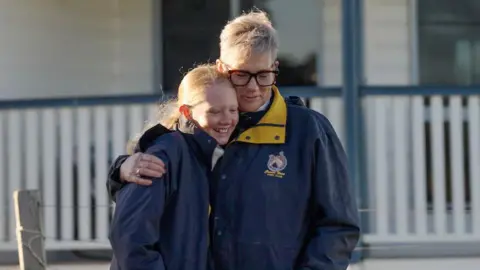 Nathan Morris/Australian Broadcasting Corporation
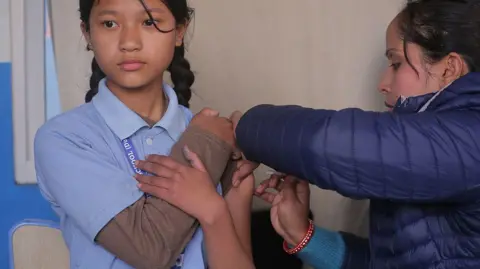
It's a scene familiar to many who've attended an Australian high school: a long line of fidgety 12 and 13-year-olds take their seat on a plastic chair, one by one, assured by a nurse that the needle will only hurt for a moment.
Minutes later, they head back to class, sporting a circular plaster on their upper arm.
There are three vaccinations offered to high school students as part of the National Immunisation Programme, including the human papillomavirus (HPV) vaccine.
Though HPV can have no symptoms, and even disappear without treatment, some high-risk strains can develop into cervical cancer, the fourth most common cancer in women worldwide.
Fortunately, it is also one of the few causes of cancer people can be vaccinated against.
A global leader in cervical cancer control, Professor Karen Canfell has seen the impact of the disease both in and beyond Australia. The epidemiologist tells the BBC it feels like "everyone has a mother or a sister or a grandmother that's been impacted by cervical cancer".
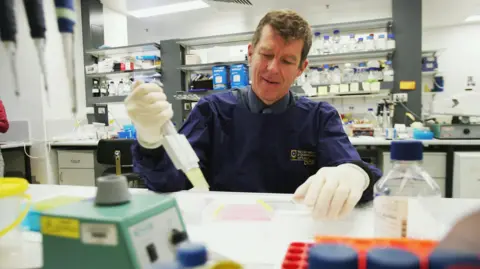
But in 2006, in a lab at the University of Queensland, there was a breakthrough.
After decades of research, Australian scientists had developed a pioneering new jab, named Gardasil, which could prevent HPV - and it had been approved by the medicines regulator. One year later, Australia became the first country in the world to roll out a national vaccination programme.
The vaccine gave global health experts hope for a future without the cancer, with modelling designed by Canfell and the World Health Organisation (WHO) charting a path to elimination.
"Public health innovations in Australia sort of gave a general exemplar for WHO to follow," says Canfell.
 Getty Images
Along with its broad vaccination programme - which in 2013 was expanded to include boys, who can be carriers of the virus - it also has a high-grade screening scheme.
In 2017, Australia was one of the first countries to transition from a pap smear to a more sensitive HPV-based cervical screening, which is only required every five years.
The nation was also one of the first to offer women the option of collecting a sample themselves - which the government has described as a "game-changer", particularly for those apprehensive about pelvic exams, or people with time and healthcare access barriers.
In practical terms, eliminating cervical cancer as a public health issue in Australia does not mean it would become a thing of the past entirely - scientists define elimination as fewer than four cases of cervical cancer per 100,000 people.
Assessors have published a report stating the country is on track to meet its target of eliminating the cancer by 2035 - and it may even get there early.
Since 1982, when records began, incidence and mortality rates for cervical cancer in Australia have both halved.
Most promisingly, the most recent data from 2021 shows, for the first time, there were no cervical cancer cases diagnosed in women under the age of 25.
"It's not all women of all ages yet, but you can see that concept of elimination being realised," Canfell said.
Australia currently has about 6.3 new cases per 100,000 women. Vaccination of girls under 15 hovers just over 80%, and 85% of women in the most critical age group have been screened for cervical cancer.
But Canfell warns the progress report does show a slight decline in vaccination rates - particularly among Aboriginal and Torres Strait Islanders, who continue to face greater barriers to healthcare access and worse health outcomes than the broader population.
Rates of cervical cancer are twice as high for Indigenous women, and they're also more than three times as likely to die from the disease.
"They're often detected at a later stage of cancer than non-Indigenous women," says Dr Natalie Strobel, an epidemiologist specialising in disease prevention in Indigenous communities.
Research has indicated that, on the current trajectory, cervical cancer will be eliminated for Aboriginal and Torres Strait Islander women 12 years later than the national 2035 target.
Strobel and her research partner Jocelyn Jones also say vaccine hesitancy in the aftermath of the Covid-19 pandemic, the rising cost of medical services and children missing school - and thus, the vaccine - are other factors which could hinder Australia reaching its goal.
"There's not a lot of a concerted effort to get them back in if they've missed it... The onus is very much on families to get their child caught up on that vaccine," Jones explains, adding that many don't realise it is free.
Expense is also a barrier to Australia's success being replicated in low and middle-income nations, who might not have the resources or the healthcare systems to support the push to elimination, researchers say.
Canfell and her team have tried to convince governments cervical cancer elimination is a worthwhile investment, which will save them money in the long run.
Beyond saving lives and having an "incredible societal impact", women can remain part of the workforce and economic productivity is increased. At risk of sounding insensitive, there is evidence of a "return on investment", Canfell says.
 Getty Images
Australia - through public money and philanthropy - is now helping its neighbours, countries like Vanuatu and Papua New Guinea, pursue elimination too.
However global cuts to foreign aid - which supports HPV vaccination in low-income nations - have had significant impact; in March 2025, US President Donald Trump announced he would end support for Gavi, an alliance that buys critical jabs for developing countries.
"To say the obvious thing, we are obviously lucky to be in a high-income country where we have a form of universal healthcare and access for all," Canfell says.
Walters says dealing with cervical cancer has felt like "a full-time job", but one you pay dearly to have.
There's endless appointments, all sorts of side effects from having your body "nuked like Chernobyl", fatigue from having to constantly advocate for yourself, and massive financial pressure - despite subsidies from Australia's universal healthcare system.
But there's great hope her experience may soon become something of the past.
"There's sort of a good-natured, almost race emerging between some countries about who will reach elimination first," Canfell says.
Sweden and Rwanda have both set ambitious targets of eliminating cervical cancer by 2027, separately launching accelerated vaccination and screening programmes, though both countries are lagging behind key milestones. The UK also has a goal of eradicating cervical cancer by 2040, but has faced similar struggles - both HPV vaccination and cervical screening coverage have declined over recent years.
Canfell emphasises that although there are excellent examples of infectious disease control, such as HIV prevention and management, the approach to cervical cancer has been unique and a true global effort.
"It's the first time that the WHO, and globally, we've said we're going to eliminate a cancer," says Canfell.
"That's actually a new concept for cancer."

As the energy shock unleashed by tensions in the Middle East rippled through Africa, a massive oil refinery in Nigeria’s biggest city of Lagos, owned by Africa’s wealthiest man, came to the rescue. Running at its full capacity of 650,000 barrels per day, the world’s biggest single-train refinery sup

In December 2010, on the final day of his three-day India visit, Chinese premier Wen Jiabao offered a metaphorical vision for bilateral ties, suggesting that “the dragon and the elephant should tango”. The analogy – dragon for China, elephant for India – had already circulated in Western academic an

As the closest mainland Chinese province to Taiwan, Fujian is a key site for Beijing’s messaging towards the island. In the second of a two-part series, Xinlu Liang looks at how the ancestral home village of William Lai Ching-te has become a focus for efforts to promote closer ties based on kinship

Driven by intensifying competition in advanced manufacturing, the world is waking up to “China shock 2.0”. The first “shock”, associated with China’s accession to the World Trade Organization in 2001, focused on low-tech manufacturing. Of course, this latest “shock” isn’t framed as such by Chinese p