9 hours ago
Anthony ZurcherNorth America correspondent
The odds of a quick resolution to the war appear to be dwindling by the day, and the political stakes for the president are only growing.

9 hours ago
Anthony ZurcherNorth America correspondent

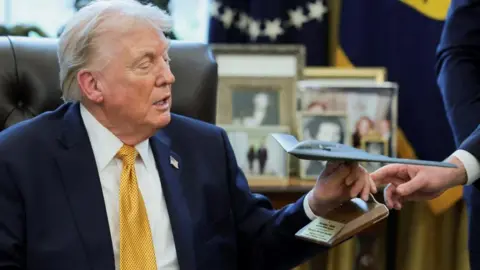 Reuters
In the third week of the joint US-Israeli war against Iran, Donald Trump faces decisions that could define the rest of his presidency.
But if the American commander-in-chief is grappling with a war of choice that seems in danger of spiralling in ways he can't control, those concerns are not playing out in public.
In more than an hour of public remarks at the White House on Monday, he discussed his thinking on the state of the war effort - and also on Kennedy Center renovations, White House ballroom construction plans, this year's World Cup tournament, the health of a Republican congressman and a host of other unrelated topics.
It was classic Trump, as unscripted and wide-ranging as ever. This past weekend, he played golf at his Florida resort. And on his Truth Social website, he devoted nearly as much time to railing about the Supreme Court as he did to discussing the Iran War.
While Trump may be interested in other topics, he is confronting a lesson previous American presidents have learned the hard way - that war can consume a presidency whether they want it to or not.
And evidence continues to mount that a war that Trump had previously said was "already won" and "very complete" now has a timeline that could stretch for weeks or even longer.
On Monday afternoon, Trump announced that the US had requested that a planned presidential trip to China in early April be delayed for a month because of the war.
"The president's utmost responsibility right now as commander in chief is to ensure the continued success of Operation Epic Fury," White House Press Secretary Karoline Leavitt said when the move was first reported, referring to the military name for the Iran war.
Over the weekend, the president posted on social media that he was forming a coalition of forces to help protect shipping through the Strait of Hormuz, which has been threatened by Iranian attacks.
"Hopefully China, France, Japan, South Korea, the UK, and others, that are affected by this artificial constraint, will send Ships," he wrote. "One way or the other, we will soon get the Hormuz Strait OPEN, SAFE, and FREE!
Since his call, however, a growing list of nations – including Japan, Australia and many European powers – have indicated that they are not interested in joining the effort.
"We will not be drawn into the wider war," UK Prime Minister Keir Starmer said on Monday, adding that he was open to a "viable collective plan" to address the situation in the strait.
That leaves Trump with the unpleasant decision of whether to more fully commit the US Navy to securing the narrow waterway through which approximately 20% of the world's oil supply passes.
On Monday, he noted that the US was destroying Iran's minelaying ships – which present a key danger to navigating the strait - but "all it takes is one".
"It's a little unfair," he said. "You win a war, but they have no right to be doing what they're doing."
There are some signs the US is taking steps to keep its military options open. Last Friday, US media reported that the president had ordered a Marine amphibious unit, which includes 5,000 soldiers and sailors, from Japan to the Middle East.
If Trump chooses to act, it could put US forces in greater danger due to their proximity to Iran.
If he doesn't act — if he instead announces the US has achieved its objective of significantly degrading Iran's military power and wraps up the American military campaign – Iran could continue to pose a threat to shipping and the price of oil could remain stubbornly high.
In the second scenario, the US may have spent tens of billions of dollars without conclusively altering the Middle East balance of power.
According to Clifford Young, chair of public affairs and strategic insights at polling company Ipsos, an extended surge in energy prices would pose a very real political threat to a president who is already on shaky ground with the American public.
For the moment, he said, polls indicate that Trump's core supporters continue to stick with him even as they have some doubts about the Iran operation and other core issues, like immigration and tariffs. The erosion of his support has come at the margins, among centrist Republican and independent voters.
While the president's popularity, with approval ratings in the low 40% range, should be a concern for Republicans, there's little sign yet that the Iran war is dragging him down significantly.
That could all change, however, if the war affects the issues that Americans tell pollsters they care about the most – the cost of living and affordability.
Prices, particularly for housing, groceries and consumer goods, continue to remain high even as the overall inflation rate has dropped over the first year of Trump's presidency.
At the very least, the war in Iran distracts Trump and his administration from efforts to convince the American public that the president is addressing their economic concerns. And if the cost of gas at the pump – until recently a source of pride for Trump - stays high, it could have dire consequences for his political standing.
The current average cost of a gallon of petrol in the US, according to the American Automobile Association, is $3.72 - a dramatic increase from the $2.94 average price a month ago.
"It just blows up everything," Young said. "The affordability agenda gets torpedoed from the Republican point of view."
On the other end of the risk equation for the president is the very real danger that comes with choosing to expand US operations in the Mideast.
With thousands of Marines reportedly on the way to the region, Trump could engage American ground forces to secure the Strait of Hormuz, to control Iranian oil export terminals or to locate and more thoroughly dismantle components of the nation's nuclear programme.
Any use of US troops, however, risks greater outcry from the majority of the American public that is wary of yet another protracted US military engagement, including many of whom believe Trump's campaign promises to avoid foreign wars.
"There's a forever war fatigue," Young said. "If we put boots on the ground, that's a whole new risk for the administration. That changes everything."
If the US involvement in Iran continues to be limited to an aerial campaign, however, Trump has time to regain his political footing. While Americans can be quick to blame the president for higher prices at the pump, their anger tends not to linger if those prices go down.
The midterm congressional elections in November are still more than seven months away, giving the president time to find a resolution that avoids a domestic economic crisis.
"We don't need anybody," Trump said on Monday. "We're the strongest nation in the world."
The challenge for Trump, however, is that – with or without help – none of Trump's present choices are without risk and the odds of a quick and easy resolution are dwindling by the day.
Follow the twists and turns of Trump's second term with North America correspondent Anthony Zurcher's weekly US Politics Unspun newsletter. Readers in the UK can sign up here. Those outside the UK can sign up here.
The leak of the attempt itself suggests a significant possibility that Larijani has been killed or at least wounded.
"There is a wide feeling across the Gulf that Iran has crossed every red line with every Gulf country,” said Abdulaziz Sager, chairman of the Saudi-based Gulf Research Center.
In a closed discussions with Prime Minister Benjamin Netanyahu, the defense establishment has increased its demands to NIS 177 billion, with the possibility that the war with Iran will take longer.

Israeli military strike targeted Iran's security chief Larijani, fate unclear, officials say Israel's military has targeted Iran's security chief Ali Larijani, four Israeli officials said, adding that it was not immediately clear whether