
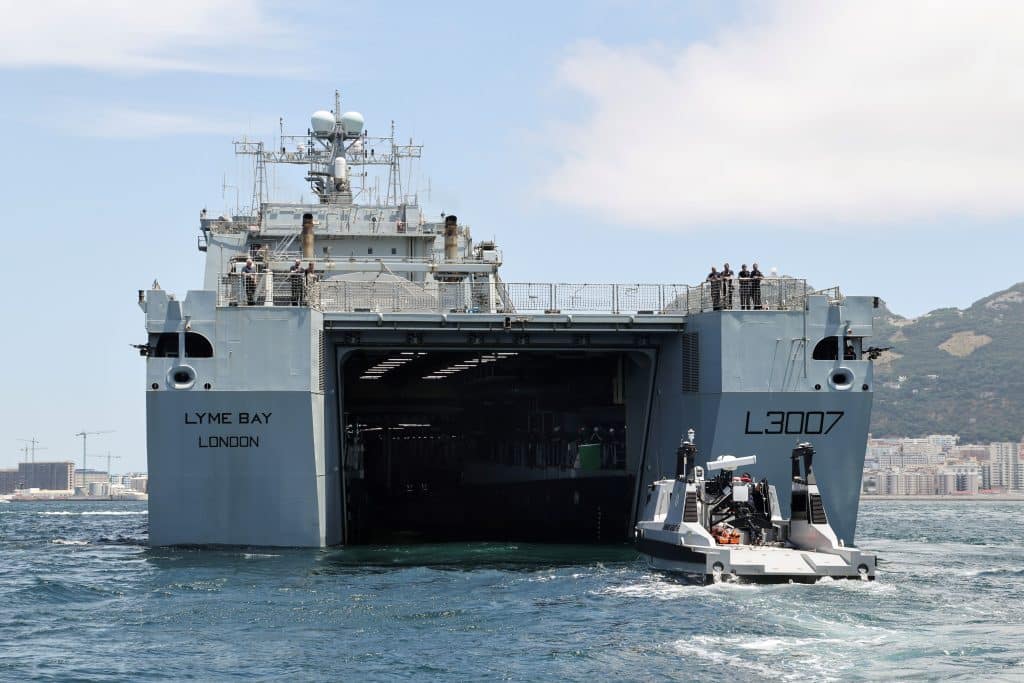
The UK Royal Navy (RN) support ship RFA Lyme Bay is continuing preparations to support potential requirements to deploy to the Middle East, in the event of an international maritime security mission being established to ensure safe shipping and freedom of navigation in the Strait of Hormuz.
In recent weeks, alongside in Gibraltar, the Bay-class landing ship dock auxiliary (LSD[A]) vessel has been undergoing capability upgrade work – specifically, the embarkation of maritime uncrewed systems (MUS) – to provide capacity to support an international mission ensuring maritime access through the Strait. The ship has been operating in the Mediterranean, including at heightened readiness, to support UK interests in the region, following the US/Israel versus Iran war that erupted in the Gulf in late February.
Naval News understands that, with equipment now embarked, Lyme Bay will conduct integration and training activities whilst sailing east. At the end of May, the ship was pictured visiting Toulon, France.
Security mission
A multinational coalition, led by France and the UK, has been preparing to launch a maritime security mission in the Strait once regional security conditions allow.
In the Gulf, a ceasefire has been in place since early April, and the US and Iran continue to negotiate its evolution into a longer-term peace accord. Despite the negotiations, however, the Strait remains closed. Iran closed it during the war, through the threat of mine deployments and actual use of missiles and uncrewed aerial vehicles against commercial ships in transit.
The United States also deployed the US Navy to blockade Iranian ports in the Gulf.
As reported previously in Naval News, Lyme Bay’s potential contribution to any prospective international mission to secure shipping access would be as a ‘mothership’ for autonomous and uncrewed naval mine-countermeasures (MCM) systems. Back in March, the RN announced the addition of a MUS-based MCM capability for the ship, to support the mine-hunting role.
On 25 May, the RN reported that Lyme Bay had sailed from Gibraltar, ahead of any potential mine-hunting mission, embarking various uncrewed vessels and sensors plus over 100 personnel from the navy’s diving and mine threat exploitation groups (DTXG/MTXG) as system operators. In a statement, the service said the ship “is preparing to be the mine-hunting ‘mothership’ for this cutting-edge technology, and play a central role in any future multinational effort to secure the critical waterway and safeguard freedom of navigation”.
Commander Dan Herridge, MTXG commanding officer, added in the statement: “This deployment reflects a significant, collective effort from across the enterprise, bringing together people, platforms, and technology at short notice to field an effective modern capability and ensure the RN remains ready to counter evolving maritime threats.”
The RN noted that the systems embarked had been tested and trialled in the UK and overseas, to develop and demonstrate mine threat detection capability in different waters and in challenging operational environments.
Equipment inventory
The RN has listed Lyme Bay’sembarked MCM-specific systems as including: RNMB (Royal Navy Motor Boat) Ariadne, a 12-m maritime MCM (MMCM) USV fitted with the Thales SAMDIS towed synthetic aperture module (TSAM) mine-hunting sonar; and a USV able to deploy REMUS and Seacat autonomous underwater vehicles (AUVs), which provide capability to conduct sonar-based seabed surveys. The navy noted that two other specialist vessels are also embarked.
For Ariadne, the embarkation included docking in Lyme Bay’s well-dock for the first time, the navy noted. Ariadne is designed to be operated without a crew embarked and to be controlled either by a host platform or a mobile operating centre; however, it can carry personnel if needed.
The AUV-capable USV is one of the RN’s five-strong fleet of ARCIMS vessels, which were procured under Project Wilton and the Mine-Hunting Capability (MHC) Block 1 programme.
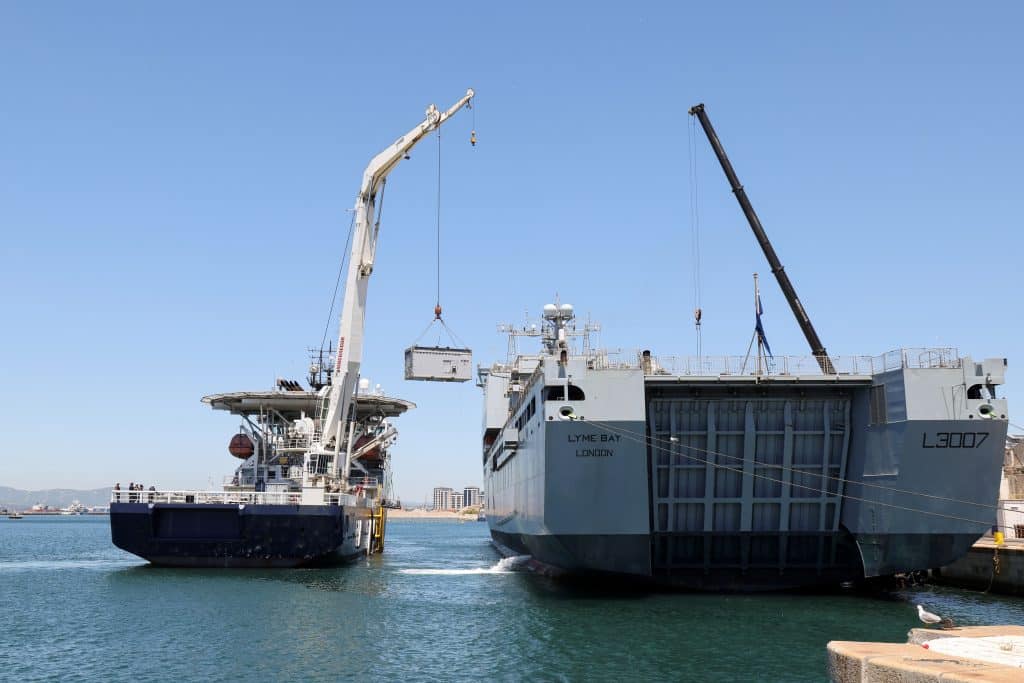
Ariadne was delivered to Gibraltar by HMS Stirling Castle, the RN’s specialist support vessel for autonomous MCM operations. According to an RN statement, Stirling Castle transported four mine-hunting vessels (as detailed above), plus three rigid-hull inflatable boats (RHIBs), 20 shipping containers, and what the statement referred to as “additional freight of varying sizes and complexity”.
The navy also announced that Lyme Bay is carrying two Video Ray Defender-Viper portable submersible systems, capable of detecting, identifying, and neutralising underwater devices. This system can be operated in a mobile manner, such as from a ruggedised laptop onboard a RHIB or a console carried in a shipping container. It also provides a continuous video feed to the operator.
Defender-Viper’s presence onboard Lyme Bay illustrates one particular MCM concept of operations: using uncrewed sensors onboard USVs or UUVs to detect and identify a mine-like object; and then deploying divers to verify and neutralise the target.
A ‘plug-and-play’ command-and-control (C2) capability has also been installed in Lyme Bay,to support both MUS systems’ effective integration and ship operation as a command node. Integrating MUS systems and a C2 set-up enables Lyme Bay to operate as an afloat forward support base for MCM operations.
Further capability for the mission, this time for intelligence, surveillance, and reconnaissance (ISR), is provided through Kraken Technology Group USVs procured under the RN’s Project Beehive. Operated by 47 Commando Royal Marines (which specialises in surface manoeuvre support and amphibious operations), these modular vessels are designed to support training, tactics, and other tasks. The RN has procured 20 to date.
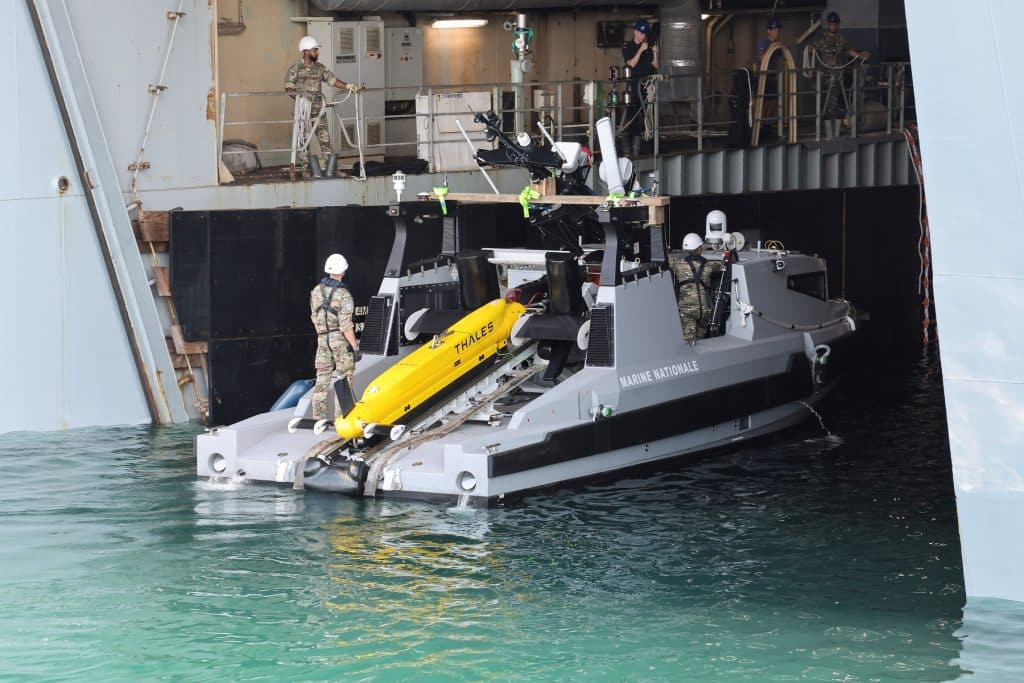
Neither navy provided comment to Naval News on Lyme Bay’s activities in Toulon. However, the UK Ministry of Defence released a small number of images showing the ship visiting the port, including the French Navy’s MMCM USV Sirius being embarked in the well-dock (picture above) alongside Ariadne. Metadata for some of the images noted the embarkation of French personnel, too.
Hybrid shift
As trailed by the UK’s June 2025 Strategic Defence Review (SDR), the RN is now transitioning to a ‘hybrid navy’ force structure, based around mixing crewed and uncrewed platforms to increase mass at sea with greater scalability and affordability.
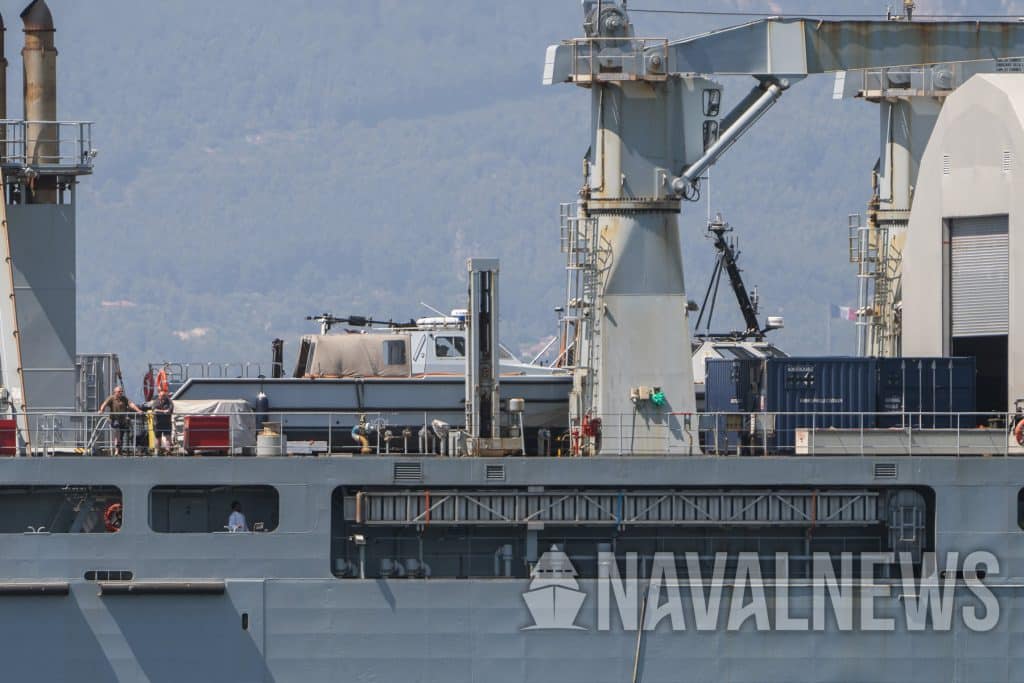
Lyme Bay’s embarkation of MUS capabilities to support a potential Gulf deployment demonstrates not only this ‘hybrid’ shift, but how the navy is trying to make this move at pace to deliver integrated crewed/uncrewed capabilities more rapidly for operations.
General Sir Gwyn Jenkins, the RN’s First Sea Lord and Chief of Naval Staff, underlined this point in a speech at the Combined Naval Event 2026 (CNE26) conference in May.
“A few weeks ago, we received our first fleet of uncrewed vessels as part of Project ‘Beehive’, marking a significant early milestone in the creation of the ‘hybrid navy’,” he said. “[The 20 boats] were delivered at remarkable speed: the first 10 … in just six days; we now expect to reach full operating capability within 12 to 14 weeks of the contract being signed [back in April]. This is the definition of an agile partnership.”
“It is also why ‘Beehive’ will be among the first of our ‘hybrid’ systems deploying to the Gulf as part of the UK’s contribution to the multinational force tasked with reopening the Strait of Hormuz when the conditions allow,” Gen Jenkins added.
The First Sea Lord noted that the UK Ministry of Defence has recently allocated GBP115 million to accelerate ‘hybrid navy’ capability development, including preparing the uncrewed system package for the potential Hormuz mission.
Gen Jenkins also underlined the importance of MUS mass in current operational contexts like the Gulf. “When you’re potentially dealing with fast inshore attack craft, mines, and sub-surface threats in one of the world’s narrowest and [most] congested chokepoints, the ability to deploy at scale numbers of autonomous and uncrewed sensors and effectors confers a clear operational advantage,” he said.
Another RN vessel preparing to potentially contribute to any Hormuz maritime security mission is the Type 45 destroyer HMS Dragon. Having deployed to the Eastern Mediterranean after war broke out, in early May the ship sailed through Suez to generate presence in the Red Sea before, in late May, integrating into the French Navy’s FS Charles de Gaulle carrier strike group. Dragon’s role in any such mission would be to provide air-defence capability.
