US Army tests DZYNE’s IonStrike interceptors for drone defence roles
The US Army’s 52d Air Defense Artillery Brigade is testing and evaluating IonStrike, a kinetic interceptor developed by DZYNE Technologies, as part of its strategy to strengthen defences against uncrewed aircraft systems (UAS).
Army Technology
75
4 min čtení
0 zobrazení
IonStrike provides a “potential” mid-range intercept option for air defence units facing complex uncrewed aircraft systems.
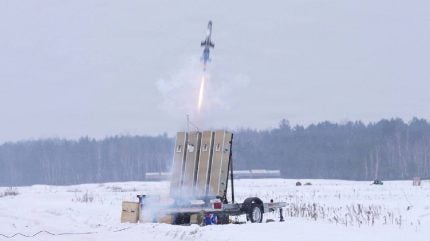
The 52d ADA BDE assesses IonStrike interceptors to support EFDI. Credit: U.S. Army photo by Spc. Luis Jimenez) (Spc. Luis Jimenez).
The US Army’s 52d Air Defense Artillery Brigade is testing and evaluating IonStrike, a kinetic interceptor developed by DZYNE Technologies, as part of its strategy to strengthen defences against uncrewed aircraft systems (UAS).
Developed to meet the evolving threat of drone incursions, IonStrike provides a “potential new mid-range intercept capability” for air defence units, US Army stated in a release on 22 May 2026.
Discover B2B Marketing That Performs
Combine business intelligence and editorial excellence to reach engaged professionals across 36 leading media platforms.
Find out more
The Army notes that this system is targeted at formations responding to increasingly complex UAS threats.
IonStrike is designed to connect seamlessly with the Army’s existing command-and-control frameworks, including the Forward Area Air Defense System and the Integrated Battle Command System Maneuver.
This approach allows soldiers to operate the interceptor through familiar platforms used for the detection, tracking, and engagement of one-way attack drones.
Current testing is also addressing IonStrike’s potential contribution to the Eastern Flank Deterrence Initiative (EFDI), a concept developed by US Army Europe and Africa (USAREUR-AF) and NATO Allied Land Command.
This initiative relies on integrating unmanned and minimally manned systems via mission command networks that process live data to support faster operational decisions.
Earlier this spring, DZYNE demonstrated IonStrike to military leadership in Europe, with senior officials from US Army Europe and Africa and NATO Allied Land Command (LANDCOM) in attendance.
Throughout these demonstrations, the 52d Air Defense Artillery Brigade collected insights from soldiers on practical deployment, system integration, and approaches to defending both fixed and semi-fixed positions from one-way drone attacks.
The 52d Air Defense Artillery Brigade operation officer major Cody Davis said: “IonStrike is important because it does not require Soldiers to learn a new kill chain. It integrates with approved C2 systems, cues on existing radar feeds, and provides commanders another kinetic option within the air defence architecture.”
IonStrike launches from a multi-interceptor pallet and relies on radar feeds already incorporated into approved command-and-control systems.
Trials are being conducted with a setup featuring four interceptors, with plans underway to expand to a 12-interceptor configuration to better address large-scale drone swarm incidents.
IonStrike allows operators to abort or redirect the interceptor after launch if a target is reclassified as friendly or no longer qualifies for engagement.
This feature enables commanders to initiate engagements earlier, adapt to changing information during an operation, and maintain the interceptor for future use instead of losing it automatically.
The system is also designed to handle multiple targets simultaneously, offering increased flexibility when confronted with drone swarms, the Army stated.
It can be integrated at scale using currently available soldier training and resources.
IonStrike achieves its effect through a terminal infrared seeker combined with a proximity-fuzed warhead, supporting use against various sizes of one-way attack drones in both daytime and nighttime operations.
The ongoing testing forms part of a larger brigade initiative to identify and implement new technologies capable of addressing evolving UAS challenges in operational settings.
The upcoming assessment will focus on IonStrike’s performance in several areas, including C2 integration, radar-based cueing, abort and redirection functions, launcher setup, reload efficiency, and kill effectiveness against selected drone types.
“The summer assessment will determine whether IonStrike can deliver a repeatable combat layer under operational conditions,” the 52d ADA BDE forward operations officer major Benjamin Bowman said.
Earlier this month, DZYNE secured a contract to supply three ULTRA Turbo (Uncrewed Long-endurance Tactical Reconnaissance Aircraft) platforms to the US Air Force Research Laboratory’s Center for Rapid Innovation (CRI).