US military spending on Iran campaign surpasses $11.3bn in week
US military spending on Operation Epic Fury has exceeded $11.3bn within the initial six days of the campaign against Iran, according to information provided by Department of Defense (DoD) officials.
Air Force Technology
75
3 min čtení
0 zobrazení
US forces struck more than 3,000 targets were struck in the first week of the operation.
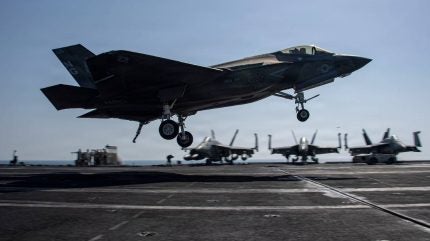
An F-35 aircraft launched from a carrier during Operation Epic Fury. Credit: U.S. Central Command via X.
US military spending on Operation Epic Fury exceeded $11.3bn within the initial six days of the campaign against Iran, according to information provided by Department of Defense (DoD) officials.
This was reportedly disclosed during a classified briefing to lawmakers on 10 March 2026.
Discover B2B Marketing That Performs
Combine business intelligence and editorial excellence to reach engaged professionals across 36 leading media platforms.
Find out more
Sources familiar with the briefing told the Guardian that actual expenditure in the early days is likely to be significantly higher than reported figures.
Operation Epic Fury began on 28 February 2026, following directives from US President Donald Trump, with US Central Command (CENTCOM) confirming that approximately 6,000 targets had been struck inside Iran as of 12 March 2026.
More than 3,000 targets were struck in the first week of the operation.
These actions included attacks on several naval vessels and made use of air, ground, and naval assets such as strategic bombers, fighter jets, drones, and missile defence systems.
GlobalData Strategic Intelligence
US Tariffs are shifting - will you react or anticipate?
Don’t let policy changes catch you off guard. Stay proactive with real-time data and expert analysis.
By GlobalData
The $11.3bn estimate presented in Congress largely covers munitions costs and does not reflect other operational expenses, according to one individual cited by the Guardian who has knowledge of the matter.
The same sources indicated that total costs are likely higher, as key details regarding expenditure remain sensitive.
Reports from the Associated Press and the New York Times have also corroborated this figure, which represents the most comprehensive breakdown given to Congress since military activities commenced in Iran.
Meanwhile, lawmakers are seeking further clarity on both overall costs and the number of US forces deployed in the region.
The initial phase of strikes utilised high-cost precision-guided weapons such as the AGM-154 Joint Standoff Weapon.
The price of this weapon can range between $578,000 and $836,000 per unit, according to the Guardian.
As operations continued, CENTCOM shifted to using less costly munitions like the Joint Direct Attack Munition (JDAM), with guidance kits costing about $38,000 each and the smallest warhead priced at roughly $1,000.
In the first week, CENTCOM also used Patriot interceptor missile systems, with each missile intercept costing $3.73m, according to the non-profit Missile Defense Advocacy Alliance.
In addition, the THAAD anti-ballistic missile system was deployed; each battery is reportedly valued at approximately $1bn, including around $300m for the radar component, according to the Center for Strategic and International Studies.
Earlier this week, CBS reported that two more MQ-9 Reaper drones were lost during operations in Iran, bringing total drone losses to 11 since the beginning of Operation Epic Fury. The cumulative value of these lost drones exceeds $330m.
Meanwhile, the Pentagon has reportedly declined requests for official comment about campaign expenditures.
Recently, the Financial Times reported, citing three individuals with knowledge of the situation, that the Trump administration has already expended several years’ supply of critical munitions since the conflict with Iran started.