
The U.S. Navy will fund development work on the Long Range ASW (Anti-Submarine Warfare) Weapon, otherwise known as LRAW, for the first time starting sometime in late 2026/early 2027. Details regarding LRAW broke cover in the U.S. Navy’s Research, Development, Test & Evaluation documentation for fiscal year 2027.
LRAW is to be the replacement/supplement for current vertically launched stand-off anti-submarine weapons currently employed by the U.S. Navy and it’s allies. Long range ASW capabilities are currently shouldered by the RUM-139C Vertical Launched Anti-Submarine Rocket (VL-ASROC), which consists of a booster/guidance section designed to propel a Mark-46 or Mark-54 Lightweight Torpedo to a designated drop point, from where the torpedo will seek out it’s target.
The Navy lists the primary justification for LRAW as a lack of sufficient range for current VLA (vertical launched, anti-submarine weapons) offerings. As such, LRAW is to have greater range than the RUM-139C, which has a publicly stated range of a bit over 10 miles. The Navy also states that he current pool of RUM-139s in service is shrinking, and only minimal quantities of the missile will be kept in inventory based off of limited maintenance funding, requiring a new weapon to be produced en mass.
LRAW will receive $11.423 million dollars in funding for FY 2027, with the funds allotted to the beginning of design work, including the modification of current VLA rounds, the production of test articles, and other associated engineering work. As the program is a new start for 2027, it remains unclear exactly how the weapon will function, although it will more than likely that LRAW will be of a similar role as the RUM-139, with the weapon possibly designed to deliver a torpedo out to stand-off distances.
The AUKUS Question
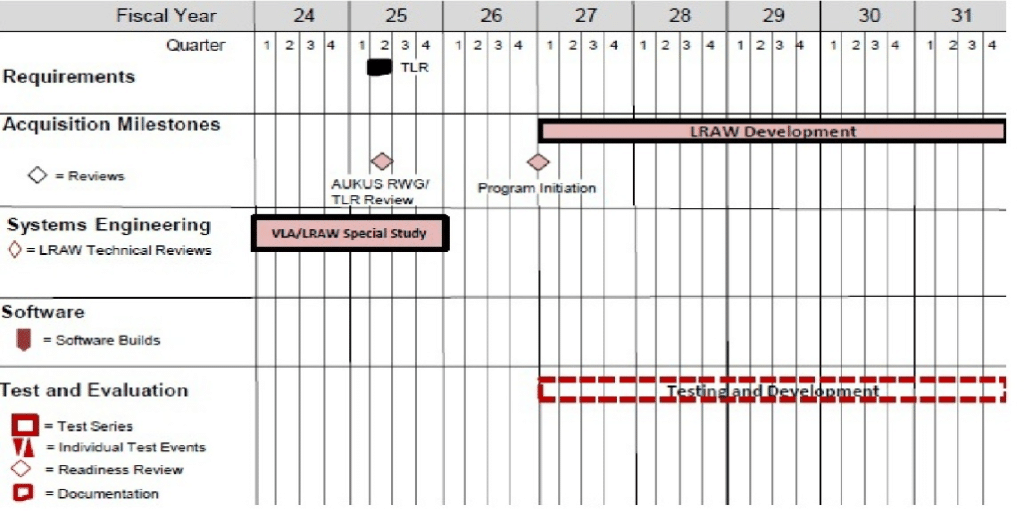
Nestled in the section dedicated to LRAW, the program schedule slide contains a nod to AUKUS, as the review is designated as “AUKUS RWG/TLR” review, likely standing for AUKUS Requirements Working Group/Top Level Requirements. In the present it remains unclear what exactly this design review accomplished, but it likely signifies the intent for LRAW to be compatible across Australian, British, and American service.
If LRAW follows in the footsteps of it’s predecessor and is compatible with the MK-41 Vertical Launching System, integration across the Royal Australian Navy and U.S. Navy could be relatively swift as both nations use the MK-41 extensively. Naval News has previously reported on the British LRAW program, detailing the program’s start and it’s possible use on Type-26 and Type-31 frigates, which are the only Royal Navy vessels slated to receive strike length MK-41 cells.
LRAW is relevant to AUKUS Pillar 2, the advanced technology wing of the trilateral security partnership between Australia, the United Kingdom, and the United States. While Pillar 1 focuses exclusively on helping Australia acquire its first fleet of conventionally armed, nuclear-powered submarines, Pillar 2 is about everything else in the future of warfare. Pillar 2 aims to accelerate the joint development and “interoperability” of several high-tech capabilities and one of the “key focus area” of AUKUS Pillar 2 is “Undersea Capabilities”.
