'We couldn't sleep because of fear': Residents flee as Israel pounds south Beirut
17 hours ago
Alice CuddySenior international reporter, Beirut
Communities across huge swathes of Lebanon have been told by Israel to leave their homes due to military action against Hezbollah.

17 hours ago
Alice CuddySenior international reporter, Beirut

 AFP via Getty Images
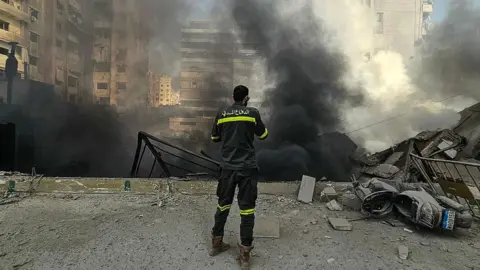
There is fear and confusion on the streets of Beirut as people displaced from their homes by sweeping Israeli evacuation orders wait to see what happens next.
Communities across huge swathes of Lebanon - including the south of the country and the capital's southern suburbs - have been told by Israel to leave their homes because of military action against the Iran-backed armed group Hezbollah.
The orders are unprecedented in their scale, with hundreds of thousands of people affected.
Families unable to find spaces in shelters spent the night sleeping on the streets or in their cars, as the Israeli military carried out what it described as a "broad-scale wave" of strikes on the Dahieh suburb of Beirut, a Hezbollah stronghold.
It said the strikes had hit "an executive council's command centre and a facility storing UAVs [unmanned aerial vehicles] utilised by Hezbollah for conducting attacks" against Israel.
Displaced civilians on the streets of Beirut were concerned about whether their homes would be hit and when they would be able to return.
"I got used to the sounds [of bombing] in the house. I didn't want to leave," Monira Hassan said through tears, as she sat with her daughter in a park in central Beirut having fled from the south of the city.
"I don't know what to say anymore. I just wanted to stay at home."
For residents like Monira, the current situation feels all too familiar. Many people had to evacuate during the previous war between Israel and Hezbollah, which saw Hezbollah's leadership assassinated, many of its fighters killed, and many of its weapons destroyed.
That war ended after 13 months with a ceasefire in November 2024, though Israel continued to strike Lebanon almost every day since, saying Hezbollah was trying to rebuild its capabilities.
Monira said she was particularly frightened after a statement by Israel's far-right finance minister Bezalel Smotrich, who said on Thursday that Dahieh would "look like Khan Younis", referring to a city in southern Gaza that has been decimated by the Israeli military in its war against Hamas.
Nearby, a group of women sat in a circle with their young children. One, whose two-month-old baby was lying in a holdall bag in front of her, said she had grabbed nappies when she had fled but had forgotten milk. She said she worried about how they would keep the children warm at night.
Others have been able to find shelter, with almost 96,000 people officially registered at displacement centres across the country.
At the National Theatre in Beirut, a small number of mattresses are laid out on the balcony overlooking the stage.
Mohamed Baydoun is staying there with his relatives after fleeing from his home in the southern city of Tyre.
"They're not giving a specific target. These are entire areas they're telling to leave… There is no mercy. The enemy doesn't have mercy," the 73-year-old said of the sweeping Israeli evacuation orders.
He added that he had lived through several wars, but that this one felt "different" - as though "only one side will be left standing".
Baydoun noted that Israel had continued near-daily strikes on targets in southern Lebanon it said were linked to Hezbollah after the November 2024 ceasefire deal, and believed that even if the group hadn't fired rockets at Israel on Monday "this would have happened anyway".
Elsewhere in the capital, 14-year-old Dunia Hassaballaa from Dahieh said this week had been "pretty scary to say the least".
Her family left their home immediately after the Israeli evacuation orders covering southern Beirut on Thursday, joining the gridlocked traffic.
Since getting to central Beirut, she said the family had "just been ordering food and trying to find somewhere to sit down and rest a bit".
"We didn't sleep last night. We couldn't sleep because of fear. We were just watching the news to check on our home," she added.
Volunteers working at shelters in Beirut have told the BBC they have already run out of space, and those supplying food to the displaced say they also worry about running out of supplies and donations dwindling.
Staff at the Barzakh bookshop cafe prepared carrot soup on Friday to serve at schools sheltering the displaced for Iftar - the evening meal that breaks the Ramadan fast.
"I'm 100% sure we're not going to be able to keep up," said operations manager Khodor Al-Akhdar.
The cafe provided free meals during the last war with Israel, relying on public donations, and had hoped they would not need to do it again.
"When the last war finished we thought it was going to be the end of this. But this week people started reaching out saying 'when are you going to start again?'" he said.
"We don't have the energy. Mentally we're not good, physically we're not good from the last war."
Lebanese Prime Minister Nawaf Salam warned on Friday that "a humanitarian disaster is looming" because of the mass displacement.
"The humanitarian and political consequences… could be unprecedented," he told foreign ambassadors.
French President Emmanuel Macron has also raised concerns about the escalating hostilities, describing it as a moment of "great danger".
"Everything must be done to prevent this country, so close to France, from once again being drawn into war," he said in a statement shared on X.
"Hezbollah must immediately cease its fire toward Israel. Israel must refrain from any ground intervention or large-scale operation on Lebanese territory," he said.
On the streets of Beirut, the displaced continued to wait on Friday to see if the bombing would increase.
"It's way too early for Lebanon to have another war," said 14-year-old Dunia.
Additional reporting by Angie Mrad and Wyre Davies
Several launch sites identified in western and central Iran were also struck in order to reduce the scope of fire directed at the State of Israel.
How can we deal with all this abnormal normality? The constant sirens, the fearsome explosions, of missiles falling, or the IDF’s interception system working but resulting in shrapnel dispersal?
Jerusalem residents faced a Shabbat like no other amid incoming missiles from Iran.
The announcement came as Iran continued to launch attacks in the region in response to US-Israeli strikes on the Islamic Republic.