
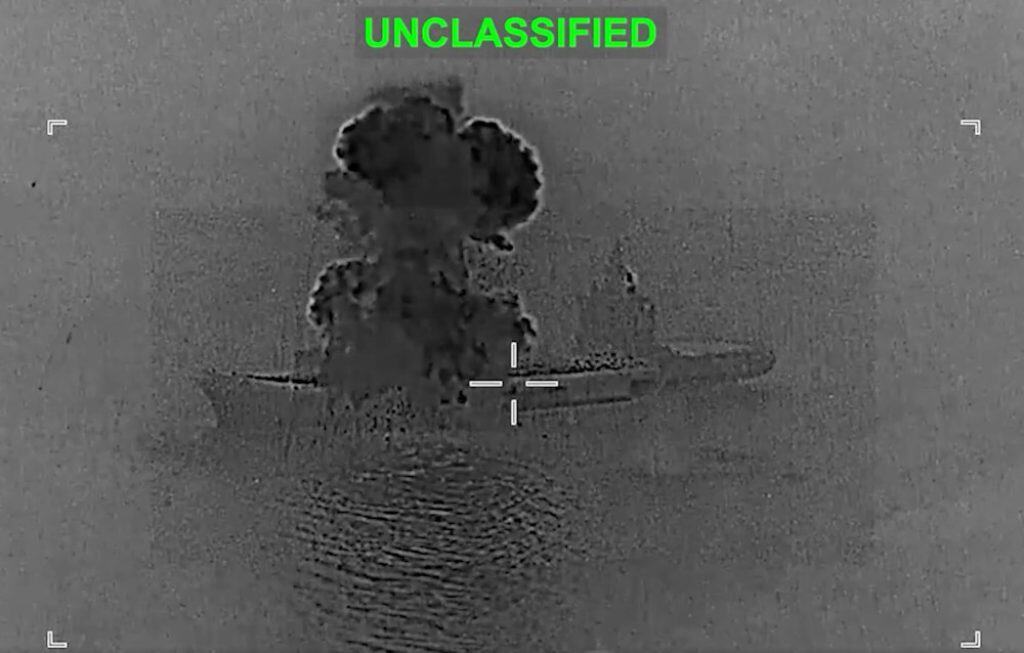
Head of US Central Command (CENTCOM) Admiral Brad Cooper said on March 16 that the United States has destroyed over 100 Iranian naval vessels. President Trump identified crippling the naval forces of the Islamic Republic as a core priority of Operation Epic Fury. Within just days, US Secretary of War Pete Hegseth declared the Iranian navy to be “combat ineffective.” The US has targeted various naval assets, including ports, bases, ships, and at least one submarine. As of March 10, US forces had also destroyed 16 mine-laying vessels that threatened the Strait of Hormuz, with Trump stating that the total had reached more than 30 on March 16.
The Islamic Republic of Iran operates parallel naval forces: the Islamic Republic of Iran Navy (IRIN) and the Islamic Revolutionary Guard Corps Navy (IRGC-N). The IRIN has had ambitions to function as a blue-water force with an area of responsibility that includes the Caspian Sea, the Gulf of Oman, and beyond. The IRGC-N is primarily a green-water force capable of operating in the Persian Gulf. However, in recent years, the IRGC-N has expanded its operating capabilities in neighboring seas. The two navies share responsibility for the Strait of Hormuz.
The following is a list of the top 10 targets hit by the US in the conflict, including facilities and ships:
Major naval ports targeted
Bandar Abbas is a major Iranian naval installation situated on the southern coast of the Strait of Hormuz. The port is home to the IRGC-N Headquarters, IRGC-N 1st Naval District, which is responsible for the Strait of Hormuz, and the IRIN Forward Southern Fleet Headquarters. Additionally, key Iranian vessels are based out of the maritime facility. American forces struck the port on at least February 28, March 2, and March 5. Satellite imagery shows that the strikes on Bandar Abbas damaged onshore infrastructure and docked vessels.
Chabahar and Konarak are port cities located on opposite shores of the Chabahar Bay on Iran’s southern coast, near the eastern border with Pakistan. The Konarak Naval Base is the headquarters of the IRIN 3rd Naval District, which has responsibility over the Gulf of Oman. Chabahar, which hosts the IRGC-N Imam Ali Naval Base, is a deep-water port and the Islamic Republic’s only port directly open to the Indian Ocean. The United States struck naval assets in the areas, including bases, vessels in port, and nearby air and drone bases, on at least February 28 and March 5.
Bushehr hosts the IRGC-N 2nd Naval District headquarters, responsible for the northern/central Persian Gulf. It formerly hosted the IRIN 2nd Naval District headquarters but is now a support base for the IRIN 2nd Naval District headquarters, which was relocated to Jask on the other side of the Strait of Hormuz. Satellite imagery confirmed that the United States struck naval infrastructure and vessels at Bushehr as well as the nearby airbase.
Bandar Mahshahr is the headquarters of the IRGC-N 3rd Naval District, located on the northern Persian Gulf near the border with Iraq, and is responsible for the northern Gulf area. Reported satellite imagery shows the port was struck in the first days of the conflict.
Significant vessels targeted
The IRIS Shahid Bagheri was a merchant vessel converted into a drone carrier with a nearly 600-foot runway. It was the only ship with a ski-jump ramp in the Islamic Republic’s naval fleet, a feature that enables more and larger drones to launch compared to other IRGC-N and IRIN vessels. The IRGC-N received the ship in February 2025. IRGC officials previously claimed that the carrier could conduct missions for up to a year without refueling, which would have enabled the IRGC-N to significantly extend its operational range and capacity. CENTCOM struck the ship on February 28 in the Persian Gulf, and it was reported to be sinking as of March 3.
The IRIS Makran was a converted tanker that served as the IRIN’s first forward base ship, capable of supporting helicopters and special operations forces independent of shore-based infrastructure. The US-Israeli operation targeted and destroyed the vessel in Bandar Abbas, with satellite imagery from March 2 showing it on fire.
The IRIS Dena was a Moudge-class frigate in the IRIN’s Southern Fleet that was commissioned in 2021. The vessel possessed a helicopter pad, anti-ship missiles, and surface-to-air missiles. It was intended to expand the IRIN’s ability to operate beyond Iranian waters. On March 4, a US submarine targeted the vessel with a torpedo and sank it in the Indian Ocean south of Sri Lanka as it returned from naval exercises in India.
Kilo-class submarines, of which the Islamic Republic has three, are operated by the IRIN and are the most capable class of submarine in the regime’s fleet. The Russian-built submarines can launch anti-ship missiles and torpedoes, as well as lay mines. Satellite imagery indicates that a Kilo-class submarine docked at Bandar Abbas was struck and likely sunk. CENTCOM head Cooper said on March 3 that the United States had sunk “the most operational Iranian submarine,” likely referencing a Kilo-class submarine.
The IRIS Shahid Sayyad Shirazi is a Soleimani-class catamaran warship commissioned in February 2024. It is one of the regime’s most advanced warships operated by the IRGC-N, with a vertical launch system for missiles and a launch pad for drones and helicopters. CENTCOM announced that it struck the ship on March 3, and it was reportedly still on fire, but not reported sunk on March 4.
Bridget Toomey is a research analyst at the Foundation for Defense of Democracies focusing on Iranian proxies, specifically Iraqi militias and the Houthis.
Tags: Iran, Iranian Navy, IRGC-N, IRIN, Operation Epic Fury, US-Iran


