
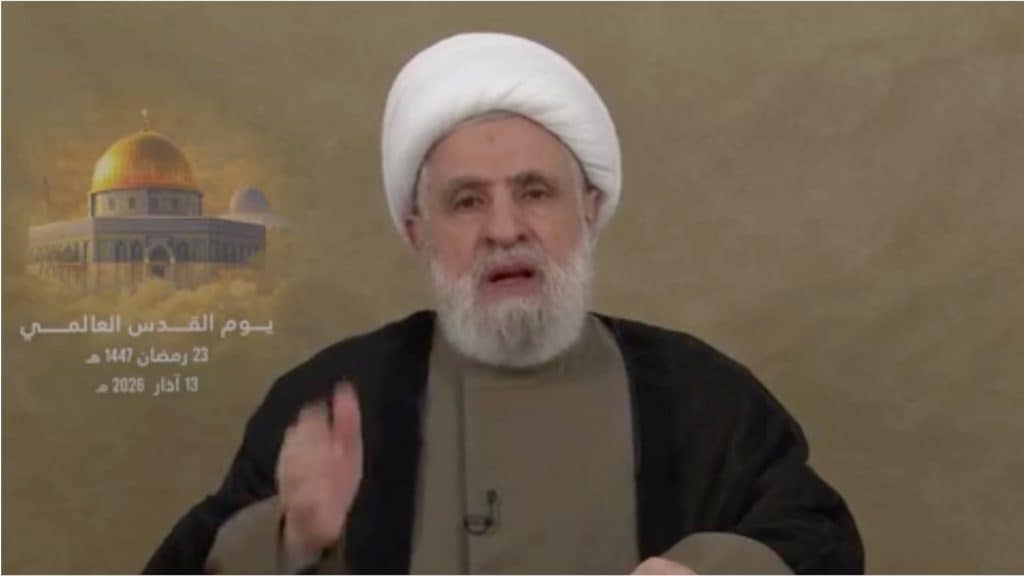
On March 13, Hezbollah Secretary-General Naim Qassem gave his second speech since the renewal of Hezbollah’s war with Israel on March 2. The speech marked the anniversary of Qods Day, an event held on the last Friday of Ramadan and created in 1979 by Khomeinist Iran to express solidarity with Palestinians and opposition to Israel’s existence. The main themes of Qassem’s speech included:
The importance of Qods Day
After delivering the customary religious salutations, Qassem recounted the history and significance of Qods Day. He said that Ayatollah Ruhollah Khomeini, Iran’s first supreme leader, had chosen to mark the event on Ramadan’s last Friday because it “represents championing the oppressed and the desire for independence.” However, Qassem said, Khomeini had conceived of the day’s significance as extending “beyond the call to liberate Palestine” to also be “a day for all the oppressed to confront the arrogant; a day when all the peoples groaning under the yoke of American and other injustice could confront the great powers” oppressing them.
Nevertheless, Qassem expressed that Palestinian “liberation” was the precondition to achieving justice on a global scale. He said that Palestine’s and Jerusalem’s “occupation”—in other words, Israel’s existence—was “the world’s greatest injustice that began in 1948 when America and the major powers sponsored this occupation by creating and legitimizing this cancerous tumor.” Qassem then argued that “liberating Palestine” would have regional and global reverberations. His rationale was that “this malevolent entity [Israel]” had created a base from which “the Israeli-American enemy” could spread regional chaos, and this disorder “will continue so long as [Israel] exists.”
Because of this collective interest in Palestine’s liberation, Qassem said, the responsibility to achieve that liberation was likewise “collective,” extending to “all Arab and Islamic nations, all free peoples, because by standing with Palestine they are standing with themselves.” Hezbollah, he stated, would not deviate from championing the Palestinian cause. “On Qods day, we declare the Palestinians are not alone,” he said, elaborating that “Hezbollah and the Islamic Resistance will continue to support Palestine’s total liberation” and are willing to offer even more sacrifices than they already have “for this cause, in defense of truth, and in defense of Jerusalem.”
Hezbollah’s war against Israel is defensive
Qassem, as in his previous speech on March 4, stressed that Hezbollah’s renewal of the conflict with Israel was an act of “lawful” self-defense “against a brutal Israeli-American aggression” and an “existential threat in every sense of the phrase.”
As part of this overall theme, Qassem sought to obscure the fact that Hezbollah had renewed the war to serve Iranian interests, even at the expense of bringing destruction upon Lebanon. He therefore insisted, once again, that Hezbollah’s March 2 attack on Israel was a response to Israel’s 15 months of operations against the group in Lebanon. He stated that Hezbollah had warned several times in the past that “patience has limits.”
To undermine the connection of conflict’s renewal to Iran, Qassem also claimed, for the first time, that Hezbollah had considered retaliation “at three different junctures” prior to March 2. However, “we decided to give additional chances, especially since some parties entreated us to do so, and therefore the conditions were inappropriate,” he said.
Hezbollah preempted a premeditated Israeli war
Qassem once again also claimed that Hezbollah’s attack hadn’t reinitiated the war but had instead preempted a premeditated and imminent Israeli campaign in Lebanon. Here, too, he was trying to explain away the Iranian connection to Hezbollah’s attack, claiming that Israel had decided upon launching this alleged campaign but was debating its timing. Thus, Hezbollah’s March 2 attack wasn’t in defense of Iran, he argued. Instead, it was only because the US and Israeli war against the Tehran regime had created the “proper conditions to confront the enemy.”
Qassem explicitly tried to reframe the discourse on the matter according to Hezbollah’s terms. “The debate isn’t about who started or who is fighting; the debate is about facing a 15-month-long aggression, Israel’s occupation of several points inside Lebanon, and the ongoing aggression,” Qassem said.
Israel, he argued, had been attacking for 15 months and had just killed “our Imam and leader,” Iranian Supreme Leader Ali Khamenei. In addition, “the coincidence” of Hezbollah fighting Israel during “the ongoing confrontation with Islamic Iran” meant Israel’s capabilities were more divided, he said, creating a “weakness” that Hezbollah could exploit to “compel [Israel] to accept a more favorable agreement.” This “combination of factors,” Qassem argued—not seeking to serve the Iranian regime’s interests—“contributed to [Hezbollah’s] decision to retaliate.”
Qassem, therefore, insisted that others “abandon” the idea that “Hezbollah caused this aggression” and instead blame “Israeli-American aggression.” In addition, he said that the “resistance” would “find a way to dialogue with other Lebanese,” if Israel would stop its attacks and withdraw from Lebanese territory. Otherwise, Qassem said, Hezbollah would never surrender, which would pave the way for the Israelis to “establish Greater Israel.”
A war in defense of Lebanon
As he did in his last speech, Qassem never directly addressed the accusations that many Lebanese citizens are directing against the group about renewing the war with Israel. Instead, he deflected with counter-questions.
“They say we provoked the enemy with a missile barrage—didn’t 15 months, 500 martyrs, hundreds of wounded, destruction, occupation, and detention provoke you? You consider our response a provocation? We consider ourselves to be acting from a position of lawful/legitimate defense,” he said. Hezbollah, Qassem implied, had been provoked by these actions, but not on behalf of itself alone, even though Israel’s operations exclusively targeted the group and overwhelmingly only impacted it. Instead, he argued, the group’s actions were on behalf of Lebanon. Rather than object, he said, other Lebanese should join Hezbollah’s war:
Let this be clear: the battle we are waging is the battle of the Islamic resistance in Lebanon and the people of the resistance in Lebanon against the Israeli aggression that is attacking Lebanon. Yes, other matters are included, but that doesn’t change the fact that this battle isn’t for anyone else. It’s for our own sake; it’s a Lebanese battle. The battle stems from lawful self-defense in which everyone must participate.
The “miserable failure” of the Lebanese state’s diplomatic efforts to secure an end to Israel’s operations and “protect its sovereignty or citizenry,” Qassem argued, left the group no choice but to act. Meanwhile, he tried to reframe the Israeli response as a deliberate war on the Lebanese people that was “killing civilians, displacing people, and demolishing homes … under the pretext of fighting the resistance fighters.” Qassem again cited Israel’s attacks on Al Qard al Hassan, one of Hezbollah’s main financial institutions, as proof that it was trying to harm the disadvantaged people served by that institution.
Hezbollah wants an Israeli ground invasion and is prepared for a long war
Qassem then claimed that Hezbollah had learned the lessons of the 2024 Israeli ground incursion into Lebanon and, therefore, welcomed a new one. “This isn’t a threat,” he said, “It’s a prelude to their defeat.” Every advance by the Israeli military into southern Lebanon, Qassem argued, would only give “the resistance’s fighters more opportunities to make gains in field operations by confronting the enemy at close quarters.”
Qassem then taunted Israeli officials to follow through on their threats of a ground invasion. “Let’s see you seize territory. Can you remain permanently and sustain your presence? You can’t, and you won’t be able to—not against this resistance, people, and army; this nation, and the honorable people of our homeland, Lebanon,” he boasted.
Qassem also claimed that Hezbollah had prepared itself for a long war with Israel that would be sustained by the morale of its fighters. Meanwhile, he alleged that Israel’s “goal” of killing civilians to decouple them from “the resistance” was failing, granting the group additional strength and endurance.
Lebanon must support Hezbollah
Throughout his speech, but especially at the conclusion, Qassem insisted that Hezbollah was an asset and a source of strength to Lebanon. Therefore, he argued, the Lebanese government should not offer Israel “free concessions” or offer “this country freely to the Israeli enemy” by turning against Hezbollah or demanding the group’s disarmament.
“This government must take a confrontational decision … and rescind some of their decisions against the resistance,” Qassem said. He didn’t specify which decisions, but presumably he meant Beirut’s March 2 decision to proscribe Hezbollah’s military activities. Qassem called for Lebanese strength through unity and for Beirut “not to stab the resistance in the back.”
Once Israel’s aggression was halted, he said, “then suggest whatever you want,” in a likely nod to resuming internal discussions on the fate of Hezbollah’s arsenal. However, in the meantime, he said, “This resistance continues, and the battlefield is the arena of honor. The word now belongs to the battlefield; we are ready for it, God is with us, our people are with us, and the free and honorable people in our homeland and the world are with us. This is the strength that will prevail, God willing.”
David Daoud is Senior Fellow at at the Foundation for Defense of Democracies where he focuses on Israel, Hezbollah, and Lebanon affairs.


