12 hours ago
Nadine YousifSenior Canada reporter
The deal would see one million tons of natural gas shipped annually from Canada to Germany by the early 2030s through a proposed terminal in British Columbia.

12 hours ago
Nadine YousifSenior Canada reporter

 Bloomberg via Getty Images
Canada has announced a landmark energy agreement with Germany that will see the first-ever long-term shipments of liquefied natural gas (LNG) from Canada to Europe in the coming years.
It comes as European nations search for new reliable energy sources and as Canada seeks to diversify trade away from the US.
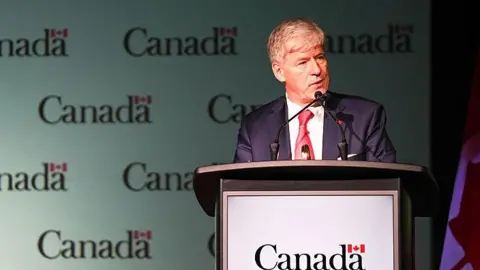
The deal was announced on Wednesday in Vancouver by Canada's energy minister, Tim Hodgson, who called it "an exciting and important milestone".
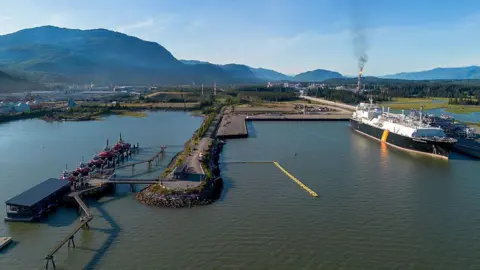
It involves the shipping of one million tonnes per year of LNG from Ksi Lisims, a proposed project on British Columbia's coast, to Germany by its national energy utility company Securing Energy for Europe (SEFE).
The deal with SEFE will see annual LNG exports from Canada to Germany for up to 20 years, beginning in the early 2030s.
Hodgson said the agreement is a sign that Canada can fill a gap in the global energy supply left after Russia's invasion of Ukraine, and more recently the ongoing war in Iran.
He touted Canada's "reliable democracy" and its access to rich natural resources.
The agreement with Germany is a major milestone for the Pacific coast Ksi Lisims LNG project in northwest British Columbia, which is still awaiting a final investment decision.
Hodgson said he believes the new commitment will help secure those funds "in a matter of months" and that construction on the project will begin shortly after.
Canadian Prime Minister Mark Carney has highlighted the Ksi Lisims project as one of national importance and so available for a fast-track review process.
Hodgson said the deal is a result of a trade mission undertaken by Carney and members of his cabinet last August to Berlin.
 Getty Images
While the agreement with Germany has been hailed as a win by government, the development of Ksi Lisims still faces many hurdles.
More than a dozen indigenous and environmental groups have vowed to fight it, arguing it is both legally contested and environmentally risky.
"Ksi Lisims is not a Canadian export success story waiting to happen," said Alex Walker with Environmental Defence, one of the groups opposing the project.
"It is a high-risk, legally contested fossil fuel project that has failed for decades to attract capital."
Some First Nations have also launched legal challenges against the project.
Not all are in disagreement, however. One of the project's proponents is the Nisga'a Nation, whose territory would house the Ksi Lisims LNG facility.
Carney is also facing pressure on climate from within his own Liberal Party caucus as he seeks to increase energy development in Canada.
Fourteen Liberal MPs signed a letter to the prime minister last week saying they are "deeply concerned" about what they say is a backslide of the government's environmental commitments.
And on Wednesday, former environment minister Steven Guilbeault said he will resign from caucus this summer. Guilbeault was a prominent environmental activist with Greenpeace before entering politics.
"These seven years, intense, demanding and deeply meaningful have been among the most formative of my life," he said speaking from parliament. "It is time now for me to fund new ways to pursue my life's work."
Reacting to Guilbeault's departure, Hodgson said Carney's Liberals are a "big tent party" with an array of views.
"At the end of the day we come together, form a collective view and execute on that," he said.
Separately on Wednesday, Carney announced that Canada will be purchasing early warning aircraft technology from a Swedish manufacturer instead of US contenders.
Carney has said Canada will reduce spending on US-made military gear, saying last April that "the days of our military sending 70 cents of every dollar to the United States are over".

The hostilities come during a fragile ceasefire between the US and Iran, and protracted negotiations to end the three-month war.

There is currently no recorded buildup of Russian troops on the territory of Belarus; however, Belarusian President Alexander Lukashenko may in the future allow Russia to redeploy forces to already prepared bases.

Dozens of people were also injured in the fire, the cause of which is not yet known.
EU foreign policy chief Kaja Kallas said on May 28 that the U.S. Embassy had evacuated its diplomats from Kyiv amid Russian threats to strike the city, a claim Ukraine’s Foreign Ministry denied.