Indian Navy, Skylark Labs test FOD detection system on aircraft carrier
The Indian Navy and Skylark Labs have concluded a demonstration of a fixed foreign object debris (FOD) detection system aboard an aircraft carrier.
The post Indian Navy, Skylark Labs test FOD detection system on aircraft carrier appeared first on Naval Technology.
Naval Technology
75
3 min read
0 views
The test confirms the system’s ability to provide continuous autonomous monitoring of the deck in a demanding naval aviation environment.
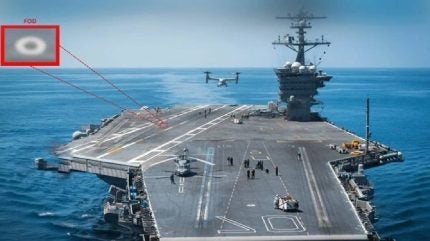
Real-time AI detection of FOD on an aircraft carrier flight deck during Skylark Labs’ autonomous monitoring demonstration. Credit: Skylark Labs, Inc./PRNewswire.
The Indian Navy and Skylark Labs have concluded a demonstration of a fixed foreign object debris (FOD) detection system aboard an aircraft carrier.
This demonstration confirms the system’s ability to autonomously monitor the flight deck under operational naval conditions. It represents the first validation of Skylark Labs’ fixed FOD detection capacity for both land-based and naval aviation operations.
Discover B2B Marketing That Performs
Combine business intelligence and editorial excellence to reach engaged professionals across 36 leading media platforms.
Find out more
Skylark Labs, which supplied the technology, said that its Fixed FOD Detection system enabled real-time monitoring via cameras strategically placed on the carrier deck.
The system detected and classified various types of debris without disrupting flight operations. Upon detecting debris, the system transmitted exact deck coordinates to flight deck and operations personnel, allowing for rapid response. Debris classification supported safety investigations and maintenance planning.
According to Skylark Labs, the system uses the Runway Monitoring Intelligence Layer, an adaptive AI framework also deployed in mobile Tracer AI Vehicles and at commercial airports.
Each installation maintains a local intelligence layer that adapts to environmental conditions and unique patterns of false positives or debris types.
Onboard the carrier, the AI adjusted to challenges such as salt spray, vibrations, glare, shadows, and background movement typical of at-sea conditions. This learning process is shared across all connected deployments, including land-based airfields, strengthening overall detection capabilities.
The company stated that the AI framework accumulates operational data over time to generate a longitudinal debris map of the carrier deck.
This mapping can identify recurring hotspots and link debris origins to specific aircraft or maintenance activities, supporting predictive maintenance and automated reporting.
Skylark Labs founder and CEO Amarjot Singh said: “Aircraft carriers are among the most unforgiving environments in naval aviation. This demonstration validated that our fixed detection system can continuously monitor carrier decks, filter environmental noise unique to at-sea operations, and deliver precise alerts so flight crews can act immediately.
“Because the same intelligence layer runs across our entire network—carriers, airfields, and mobile vehicles—every deployment makes the whole system smarter. The results give us strong confidence to expand this capability across naval and commercial carrier operations globally.”
Separately, the Indian Navy announced plans to commission its stealth Frigate Taragiri (F41) on 3 April 2026.
Built by Mazagon Dock Shipbuilders in Mumbai as part of Project 17A, Taragiri is the fourth ship in its class and features over 75% indigenous content involving more than 200 micro, small and medium enterprises (MSMEs).
The initiative aligns with government efforts to promote domestic industrial development in defence manufacturing.