
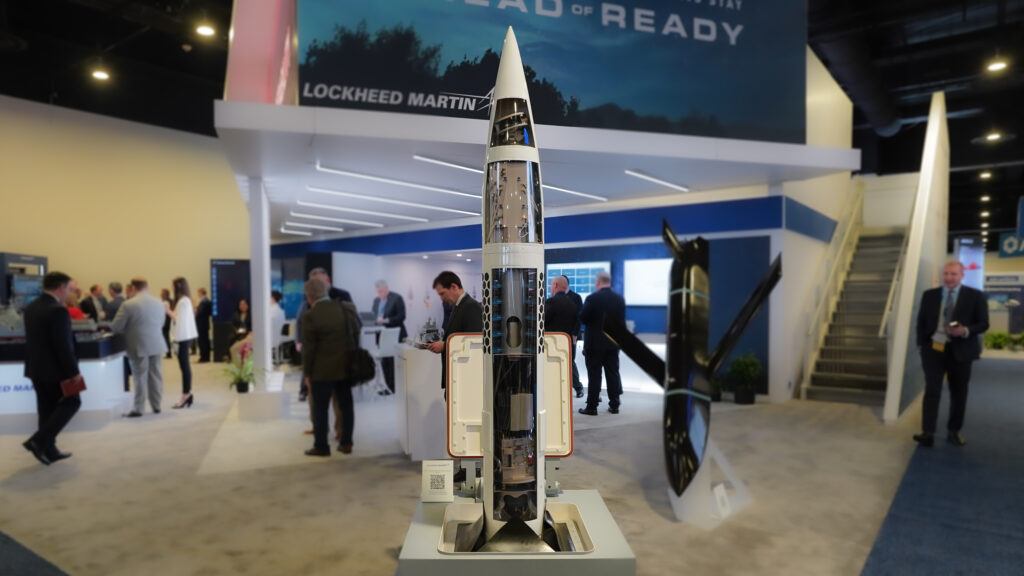
DETROIT and WASHINGTON — Lockheed Martin and General Motors have signed a partnership agreement aimed at harnessing GM’s manufacturing prowess to enable the world’s largest defense contractor to boost weapons production.
The memorandum of agreement, announced at the Reindustrialize Summit in Detroit, focuses on three areas: strengthening defense supply chains, advancing manufacturing, and “evaluating opportunities to expand production capacity through commercial manufacturing expertise and infrastructure,” the companies said in a news release.
Executives revealed few specifics about what the partnership will entail, but The Wall Street Journal reported that the companies are in talks about GM producing “commonly used parts” that could help Lockheed as it scales munitions production.
“What does a THAAD air defense interceptor have in common with Corvette?” Lockheed Chief Operating Officer Frank St. John said during the summit. “Well, both of them are highly engineered, both of them are precision manufactured, both of them have broad and diverse supply chains, and both of them are produced at rate.
“So what this is about is not trying to blend products, if you will, but to take the best of the infrastructure expertise, and how do we manage our businesses and learn from each other to raise the tide for the defense industrial base.”
During a separate phone call with reporters today, St. John and Bruce Brown, GM Defense’s vice president of strategy, said it’s “too early” in the process to determine precisely what product lines will benefit the most from the partnership, with Brown adding that right now, “the focus is on munitions, but it’s not exclusively about munitions.”
Among other goals, the partnership will help Lockheed fill a Pentagon request to triple and quadruple production rates of PAC-3 Missile Segment Enhancements and THAAD interceptors, respectively, over the next several years by leveraging GM’s supply-chain expertise, according to St. John.
“It’s a good partnership,” St. John said. “We have the understanding of the capabilities of the products we’re delivering, GM is bringing some expertise in scaling the manufacturing.”
The arrangement came about after the Defense Department urged Lockheed to find “non-traditional” business partners that would allow it to boost manufacturing capacity, St. John said.
“While they didn’t specifically put the two of us in a room and say we need to work together, they did create the environment and encourage us to find those non-traditional agreements,” he said.
Brown added that while the department provided “an initial kind of matchmaking,” the two companies worked through the legal and business details on their own, including conducting site visits.
Neither executive would comment on the financial commitment associated with partnership. Instead, both repeated previously announced investments from both firms, with Lockheed committed to investing $9 billion on over 20 facilities through 2030 and GM spending $7 billion in capital investment and an additional $9 billion in research and development across both its commercial and defense businesses.

