21 hours ago
Geeta Pandeyand
Nikita Yadav
The subject has polarised India for long, though some states and private companies offer menstrual leaves.

21 hours ago
Geeta Pandeyand
Nikita Yadav

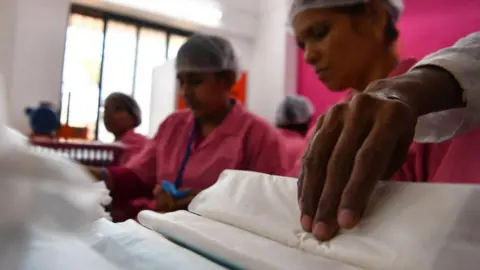 AFP via Getty Images
India's top court has rejected a petition seeking menstrual leave for working women and female students with the judges saying if they were to make such a law, "no-one will hire women".
The two-judge bench headed by Chief Justice Surya Kant said mandatory leave would make young women think they were "not at par" with their male colleagues and would be "harmful for their growth".
The subject of menstrual leave has long polarised Indian society - while many agree with the justices' views, others argue that a day or two off can help women deal with painful periods.
Some states and a number of large private companies have introduced menstrual leaves for employees over the years.
The top court's comments came while hearing a petition filed by lawyer Shailendra Mani Tripathi, seeking a national menstrual leave policy, legal website LiveLaw reported.
Tripathi later told news agency IANS that he had hoped that working women would receive "two-to-three days of leave" to account for menstrual difficulties.
The judges, however, said that introducing such a policy would not benefit women - instead, it would harm them by reinforcing gender stereotypes and affecting their employability.
They said this could make private-sector employers hesitant to hire women and might ultimately discourage their recruitment.
They added that "the government could come up with a menstrual leave policy in consultation with all stakeholders", LiveLaw reported.
The comments by the top court have once again spotlighted a topic that has long divided opinion in India and led to debates around whether it was a progressive move or encouraged stereotypes that women are weaker and unfit for the work space.
By saying that menstrual leave would make women "unattractive" as employees, the judges "reiterate the taboo around menstruation and rights that we have failed to address", public health expert and lawyer Sukriti Chauhan told the BBC.
She said there were laws in India that spoke of "workplace dignity, gender equality, and safe working conditions" for women and that "denying menstrual leave violates these principles by forcing women into uncomfortable, undignified or hazardous work environments".
"Providing menstrual leave not only supports women's health and well-being, but also promotes productivity and efficiency in the workplace," she added.
Some argue that giving women extra leave would be discriminatory to men and in a country where periods are often a taboo subject - with women barred from temples or isolated at home as "unclean" - menstruating women may even be too shy to claim it.
But campaigners point out that many countries like Spain, Japan, South Korea and Indonesia already offer menstrual leave and that studies have shown this time off can be beneficial to women.
Some Indian states also offer limited menstrual leave: Bihar and Odisha give two days per month to government employees, while Kerala provides it to university and industrial training institute staff.
And last year the southern state of Karnataka introduced a law approving one day off a month for all menstruating women.
In the past few years, several companies have also introduced similar policies for female staff.
In 2025, the industrial and services conglomerate RPG Group announced a two-days-a-month period leave policy for employees in its subsidiary CEAT. Engineering giant L&T also introduced a similar policy, offering a one-day leave in a month, while food delivery company Zomato offers up to 10 days of period leave a year.

Senior officials from China and the United States have started a new round of trade talks in Paris, as the two sides seek to pave the way for US President Donald Trump’s expected visit to Beijing later this month. The delegations – led by Chinese Vice-Premier He Lifeng and US Treasury Secretary Scot

Central Asian governments are leveraging the diplomatic fallout from the US-Israel war on Iran to assert their autonomy and reinforce their long-standing strategy of balancing major powers, according to analysts. For decades, the five former Soviet republics have been seen as Russia’s “backyard”. Ho

Several years ago, prime ground-floor spaces in major shopping malls across Beijing and Shanghai’s business districts were commonly occupied by electric vehicle (EV) showrooms, with staff often escorting customers to car parks for test drives. Many of these stores have now closed amid sluggish EV sa

Japan has deployed its domestically produced long-range missiles near the East China Sea – a move that could be interpreted by Beijing as crossing a “strategic threshold”, analysts said. Japanese Chief Cabinet Secretary Minoru Kihara said on Monday that the upgraded Type-12 surface-to-ship missiles