The TWZ Newsletter
Weekly insights and analysis on the latest developments in military technology, strategy, and foreign policy.
The news came after Moscow claimed it successfully tested Sarmat, which has been beset by technical issues and delays. The post Russia Plans To Deploy Sarmat ICBM Operationally Later This Year appeared first on The War Zone.

The TWZ Newsletter
Weekly insights and analysis on the latest developments in military technology, strategy, and foreign policy.
Russia has announced a successful test of its long-delayed Sarmat intercontinental ballistic missile (ICBM), which President Vladimir Putin now says will be operationally deployed later this year. The weapon, developed to deliver multiple nuclear warheads over great distances, has had a very mixed track record of testing so far, and was once planned to be fielded in 2020. All this makes today’s announcements more significant, although they have yet to be independently verified.
The test-launch from the Plesetsk Cosmodrome in the Arkhangelsk region took place at 11:15 a.m. Moscow time today, according to the Kremlin. Around half an hour later, Russian officials said that the missile had hit its target at the Kura test range on the Kamchatka Peninsula in Russia’s Far East.
🚀🇷🇺 Russia announced it has conducted a successful test launch of its RS-28 Sarmat intercontinental ballistic missile (ICBM) on Tuesday.
Russian President Putin said that the Sarmat is set to enter service within the Strategic Missile Forces by the end of 2026 (in 2021-2022,… pic.twitter.com/uX8cNeUZTt
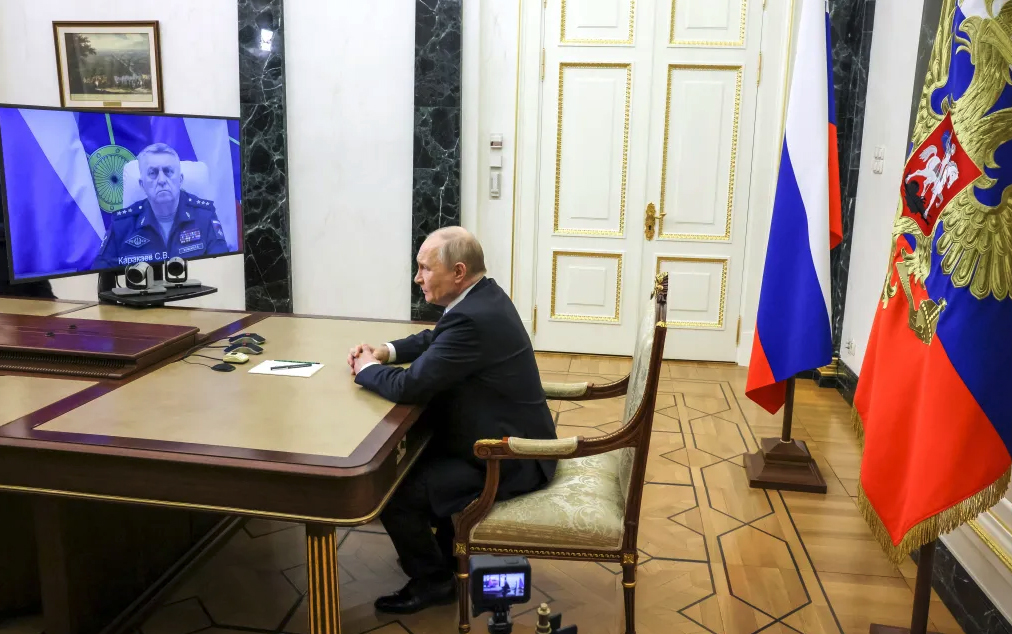
The commander of the Strategic Rocket Forces, Sergei Karakayev, informed Putin of the successful test. The Russian leader monitored the launch via video link from his office bunker.
Putin called the test a “major event and unconditional success.”
“The positive results of the Sarmat missile system launch will allow us to deploy the first missile regiment armed with this missile system to combat duty in the Uzhur formation of Krasnoyarsk Krai by the end of this year,” he added, referring to the 62nd Red Banner Rocket Division at Uzhur in Siberia.
Putin says the missile’s range could exceed 35,000 kilometers (21,748 miles).
Apparently, Russia managed a successful test-launch of its much-delayed new ICBM, Sarmat (RS-28, SS-29). A Russian MOD video allegedly shows the launch: https://t.co/V5fyAoYdnG (h/t to @krakek1 for first post).
Check back tomorrow for our new Russian Nuclear Notebook. pic.twitter.com/9QDn3KMl4m
The RS-28 Sarmat, known to NATO by the codename SS-29 Satan II, is Russia’s new-generation heavy ICBM, intended to replace the Soviet-era R-36M2 system (SS-18 Satan).
A video shows the launch of the R-36M2 ICBM (SS-18 Satan):
The Sarmat is a silo-launched, liquid-fueled, nuclear-armed ICBM. The missile will reportedly have a host of capabilities intended to defeat ballistic missile defenses, ranging from decoys and other countermeasures to a fractional orbital bombardment capability, and independent post-boost vehicles (IPBV). There have even been suggestions that it could carry a payload of multiple hypersonic boost-glide vehicles.
While these features are all relatively novel, the fact that the Sarmat is liquid-fueled might seem like something of a throwback to the Cold War. However, as we have discussed in the past, it does bring certain benefits:
A liquid-fueled ICBM might seem somewhat dated, but it does offer the advantage of a more capable and dynamic propulsion arrangement. But unlike a solid fuel design, it has historically been difficult to keep these types of missiles in a fueled state indefinitely, often meaning that launch crews had to go through a lengthy process of fueling the weapon shortly before launch. However, a hydrazine-based liquid rocket fuel with nitrogen tetroxide (NTO) as the oxidizer provides a more stable, less corrosive option that allows for long-term storage of missiles in a fueled, ready state when combined with the right component materials and environmental controls.
Details of the missile were presented by Putin back in 2018, at the same time as he unveiled several previously unknown strategic weapons systems.
An official video of the Sarmat released by the Russian Ministry of Defense in 2018:
The first successful test launch of the Sarmat took place in 2022, also from Plesetsk. However, it was followed by a failed test launch in February 2023. A further test in September 2024 was also unsuccessful, leading to the destruction of the Yubileynaya test silo at Plesetsk.
The original plan was for the Sarmat to become operational in 2020, something that obviously did not come to pass.
Exactly what has caused the problems is unclear. The delays could be due to technical issues with the missile, Russia’s sluggish economy, or, very likely, a combination of factors.
Indeed, there were delays in the development of the Sarmat even before Russia launched its all-out invasion of Ukraine in February 2022, which has led to international sanctions and other strains on the country’s defense industrial base.
On the other hand, the slow progress made by the Sarmat so far means that it will now enter service after the demise of the New START Treaty, which expired in 2021.
New START had placed hard limits on the number of deployed and non-deployed land-based ICBMs, total available launch tubes for submarine-launched ballistic missiles (SLBMs), and nuclear-capable heavy bombers that Russia and the United States could have in total. The agreement also set a firm limit on total deployed and non-deployed systems.
With those limits now gone, Russia will be able to replace the R-36M with Sarmat on a one-for-one basis, while still maintaining its other ICBMs if it desires, and moving ahead with other strategic weapons modernization programs, including the Avangard nuclear-armed hypersonic boost-glide vehicle.
A video released in conjunction with the fielding of the Avangard missile complex at the Dombarovsky Strategic Rocket Forces base:
Even under New START regulations, Russia had fewer than 520 deployed “launchers” as of September 2018, with the treaty allowing for a maximum of 700 such systems. These “launchers” in this context comprise land-based IBCMs, SLBM launch tubes, and heavy bombers.
Meanwhile, the lifting of New START limits on America’s nuclear arsenal means that, at this point, it is unclear whether or not the new LGM-35A Sentinel ICBMs will carry multiple warheads. Like the Sarmat, the Sentinel has faced issues, chief among them major delays and spiraling costs, driven heavily by complexities associated with building new infrastructure. Regardless, the ongoing development of the Sentinel in the United States is also spurring work on the Sarmat program.
At this stage, it remains to be seen whether the apparent success of the test today allows the Sarmat to enter service before the end of the year. So far, its test history has been distinctly patchy. If the missile can be perfected, however, it could pave the way for Russia to deploy even more strategic missiles in the future, with the potential for triggering a new arms race.
Contact the author: thomas@thewarzone.com

The 40th anniversary of the Chornobyl disaster serves as a stark reminder of Soviet – and Russian – disregard for human life. Safety measures were ignored, the explosion was treated as a state secret, and authorities forced 120,000 people to march through Kyiv under a radioactive sky five days later

This morning, Russian forces struck the city of Hlukhiv in the Sumy region, destroying an educational institution.

Ukrainian-made Chaklun interceptor drones achieve mission success rates of 88% to 100%. Maximum effectiveness is possible because, even in cases of unsuccessful interception or loss of communication, these UAVs can be safely returned, prepared, and redeployed.

In the temporarily occupied Crimea, drone flights and powerful explosions were reported overnight on May 13, and the Kerch Bridge was closed to traffic.