
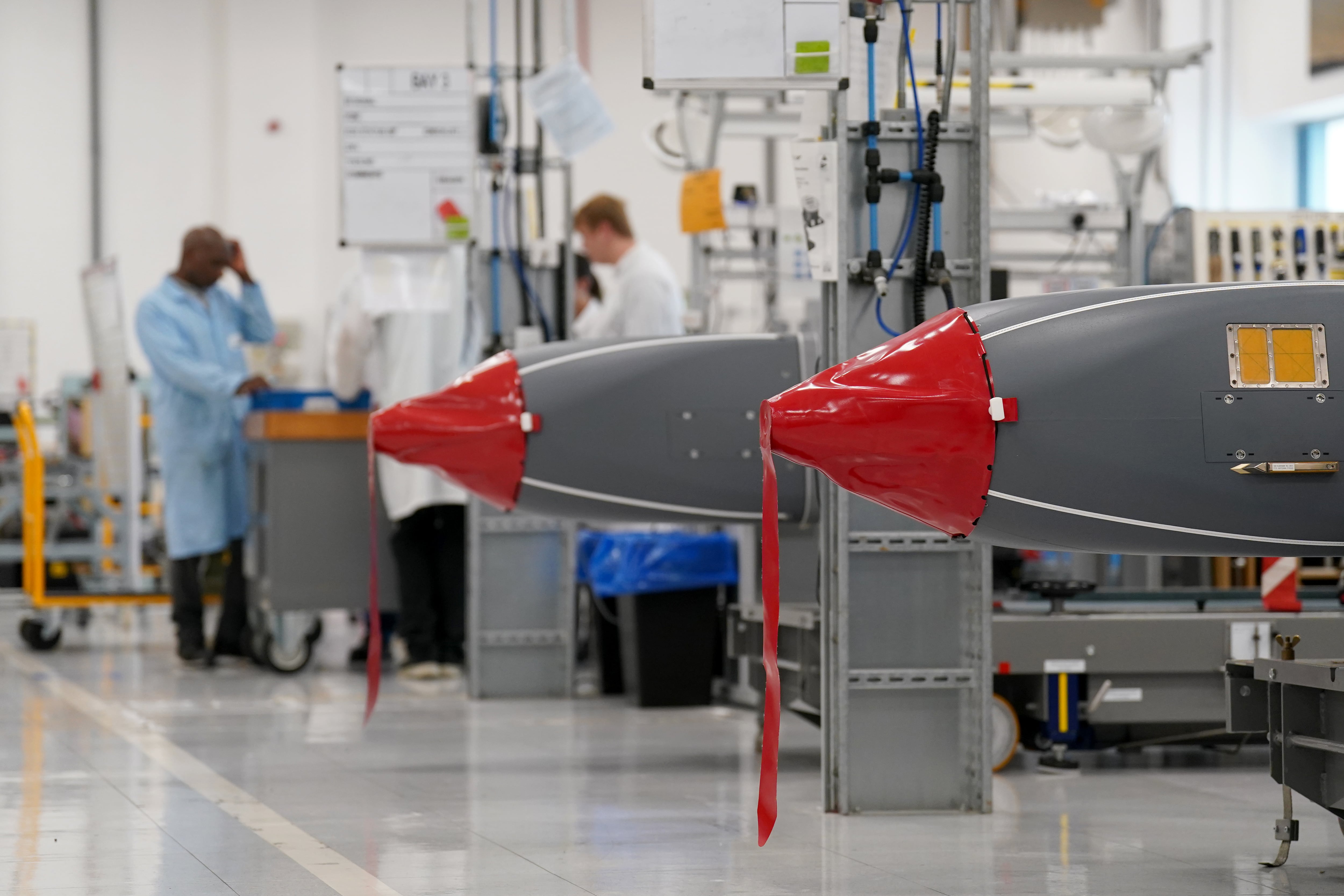
VIENNA — The United Kingdom unveiled a $50 billion, decade-long push to accelerate European deep precision strike capabilities during the NATO summit on Wednesday, positioning London at the head of a coalition of twelve NATO allies.
The figure is less a single procurement contract than a financing and coordination structure meant to knit together a scattered set of national and bilateral missile programs that have been building since 2024.
The announcement leans heavily on the idea of pooling, not building, new technology. British officials described the initiative as a mechanism to “share expertise, technology advances and deepen industrial collaboration to rapidly advance NATO capabilities,” rather than a specification for a single new weapon.
The breadth of range requirements involved − everything from 300 kilometers to systems eventually exceeding 2,000 kilometers − spans engineering problems likely too disparate to be solved by a single missile design.
Instead, the $50 billion appears to aggregate work already underway. The British contribution to the sum is £3 billion ($4 billion), according to a press release by the prime minister’s office, which was split across a bilateral project with Germany and trilateral work with Italy and France on the Stratus missile.
The U.K.-Germany Trinity House program targets the development of stealth and hypersonic weapons beyond 2,000 kilometers for entry into service in the 2030s. The Stratus effort, meanwhile, recently secured a fresh £1.4 billion ($1.9 billion) U.K. commitment over four years toward a Storm Shadow successor.
In the same announcement, London also said it is joining the U.S. and Australia in the Precision Strike Missile program, which is designed to replace the American ATACMS missile.
Separately, a day earlier, NATO said six of its members − Denmark, France, Italy, Norway, Turkey and the United Kingdom − had launched a “multinational Ground-Based Precision Strike Capabilities High Visibility Project to explore the multinational development of novel deep precision strike capabilities, including new launchers and missiles” under the auspices of the alliance. The relation to the U.K. announcement was not immediately clear.
The U.K. government did not specify which “around a dozen European partners” it had in mind for its $50-billion deep-strike scheme.
The new British announcement also sits against the broader backdrop of ELSA, the European Long-Range Strike Approach that France, Germany, Italy and Poland launched in July 2024, later joined by Sweden and the U.K. Analysts have described ELSA as a multi-pillar framework rather than a unified acquisition drive, and the new $50 billion commitment could be intended to inject momentum into an initiative that had struggled to gain real traction over its first two years.
The European scramble for deep-strike capabilities comes as the war in Ukraine has shown the devastating impact of these weapons on military supply lines far from the frontline. It has been instilled with further urgency by the partial U.S. withdrawal of troops from Germany, which has left Berlin scrambling to replace those capabilities domestically. Such capabilities had not been a key element in military planning across the continent until recently.
Linus Höller is Defense News' Europe correspondent and OSINT investigator. He reports on the arms deals, sanctions, and geopolitics shaping Europe and the world. He holds master’s degrees in WMD nonproliferation, terrorism studies, and international relations, and works in four languages: English, German, Russian, and Spanish.


