26 minutes ago
Lana LamSydney
Australia and the EU sign sweeping trade and security deals after years of negotiations.

26 minutes ago
Lana LamSydney

 Getty
Getty
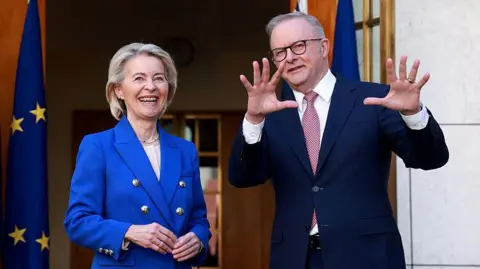
Australia and the European Union have agreed a sweeping free trade deal after eight years of negotiations.
The deal, worth about A$10bn ($7bn; £5.2bn), was signed on Tuesday with Australia's prime minister and the head of the European Commission describing it as a mutual "win-win".
As well as removing almost all tariffs on trade, the two have also agreed to increase co-operation on defence and critical minerals.
European Commission President Ursula von der Leyen described the deals as having a focus on "collective resilience" in a world that is "deeply changing".
"A world where great powers are using tariffs as leverage and supply chains as vulnerabilities to be exploited in our story," she said - a nod to US President Donald Trump's use of tariffs, as well as China's control of the critical minerals market.
She added that "trust matters more than transactions", noting Australia and the EU had a "unique relationship" that was "built for the long term".
Under the deal, almost all EU tariffs will be lifted on Australian agricultural products such as wine, fruit and vegetables, olive oil, seafood, most dairy products and wheat and barley.
This will mean a saving of about A$37m for local wine producers and exporters, the government said.
For Australian consumers, the deal will mean cheaper European wine, spirits, biscuits, chocolates and pasta.
The deal means Italian-style sparkling wine made in Australia can still be sold as prosecco domestically, though the name will be phased out over 10 years for exports.
Australian producers can also continue to use names including parmesan though feta will be subject to "grandfathering and lengthy phase-out periods".
The issue of food naming rights is sensitive in both Europe and Australia and Australia is now the only country outside of Italy to have secured EU permission to use the name prosecco.
Referring to the matter, Australian Prime Minister Anthony Albanese noted the country's modern history was built on migrants.
"That's why whether it's Greeks coming here and creating feta, or Italians coming and doing parmesan or people from Eastern Europe doing kransky sausages - it's a connection with Europe."
The trade agreement was a "perfect balance", von der Leyen said, as it will be easier for Australians to export to the EU while more EU-made goods will be available in Australia.
But Andrew McDonald from Meat and Livestock Australia said the deal on meat exports was not a fair outcome for Australian farmers who had wanted an annual quota of at least 50,000 tonnes - the deal allows for about 30,000 tonnes, up from 3,389.
"This is unquestionably a missed opportunity for Australia's red meat producers, processors and exporters," he said.
The new security and defence partnership will see greater co-operation in the defence industry, counter terrorism, space and maritime security.
Von der Leyen also announced greater co-operation on several critical minerals projects between Australia and the EU, including lithium and tungsten.

A Japanese person who claimed to be an active officer of Japan’s Self-Defence Forces illegally and forcibly entered the Chinese embassy in Tokyo, Beijing said. “China is deeply shocked by this incident and has lodged a strong protest with Japan,” Beijing’s Ministry of Foreign Affairs said on Tuesday

US biopharmaceutical company Gilead Sciences agreed to buy Ouro Medicines, which is developing an antibody-based medicine for autoimmune diseases licensed from China’s Keymed Biosciences, in a deal worth up to US$2.18 billion. Gilead Sciences is among a group of global drug makers facing patent expi

In a trip to Xiongan New Area, Chinese President Xi Jinping has called for the area to be transformed into an innovation hub to spark high-quality development in a project intended to take pressure off China’s capital, Beijing. It was the president’s first inspection tour to the “city of the future”

The deepening Strait of Hormuz crisis amid the war in the Middle East is choking the critical flow of not just oil but also fertilisers and perishable goods, and the Global South may face worsening food scarcity, warned the chief of a leading international business organisation. “We’re seeing the im